Safety pin of sense has snapped and impaled Britain’s posterior

THE proposition in the financial brokers’ radio ad is improbable, on the face of it.
The ad involves this woman who is just checking back on the facts a caller has just laid out. He was a shareholder in a high-tech startup, right? Right. He sold his shares eight years ago for about €8,000, right? Right. Those shares would now be worth about €90m, right? Right. And their former owner didn’t get the advice of a financial broker before he sold them, right? Gulp. I may not be accurately reporting the figures in the script, but you get the drift.
The listener feels briefly sympathetic for the poor eejit that sold the shares, before comforting themselves that this is just an urban legend — an amusing financial morality tale that could never have happened to anybody in real life. Except that it has happened to someone in real life. Back in the middle of the 19th century, when Ireland was a tad preoccupied with the Great Famine, an American mechanic named Walter Hunt got himself into a bit of debt. He found that he owed a pal $15. Which would be a few hundred dollars in today’s money. Hands up any body who has not found themselves in such a minor embarrassment.
Walter was properly bothered by this debt, and realised that he needed to come up with a source of cash outside of his normal work. You or I might think of doing a few nixers, but Walter thought outside the nixer box. Or, perhaps knowing himself to be gifted with creativity, he decided to invent something. He had invented gadgets before and would again. In this exigency, like any good inventor, he first looked around and spotted a gap in the market. Since pre-history, this gap in the market had existed. Nobody had invented a pin that wouldn’t tear apart the clothing to which it was affixed. Or do damage to the posterior of the baby in the nappy it held together. Or simply fall out at random, creating unexpected stretches of nakedness. Walter, fiddling with a bit of wire and noting that it snapped back into position when he created a little coiled spring in the middle of it, had a vision, and the vision was of what was to become the safety pin.
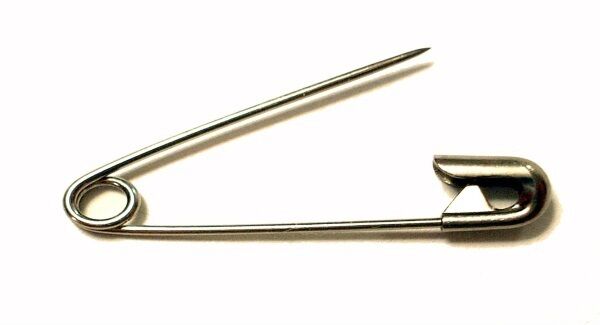
The safety pin Walter invented from a section of brass wire included a clasp that both restrained and covered the pointy bit, so that it couldn’t open by accident and impale an infant’s posterior, together with a circular coil at the bottom to serve as a spring and hold the thing in place. It worked. A problem going back to pre-history was solved, right there. (The Ancient Romans may have done a lot for us, but they were useless on the safety pin front.) Walter realised he needed to go about this in a businesslike way, he ensured he got a patent on his invention, (US patent #6,281 on April 10, 1849).
It was only then that he made the same mistake the guy makes in the financial brokers’ ad. He sold the patent to a company for $400 or roughly $14,000 today. Lovely grub: he paid off his pal and had a cosy cash cushion for himself. The only problem was that the company to which he sold it, WR Grace & Co went on to make millions and millions from the safety pin. History doesn’t record if Walter felt as much of a plank as the guy in the modern ad does.
The safety pin is now ubiquitous, not least because of dry cleaners, who affix their little blue tickets to your clothes using it. In our offices the other day when a client gestured, I spotted and tastelessly drew attention to the blue ticket and safety pin inside his cuff. He took it well, but reverted to me later suggesting that he might more usefully have had the safety pin on the outside of his sleeve, rather than on the inside, as a quiet anti-racism gesture. This novel use of the safety pin is an odd indirect outcropping of Britain’s referendum decision to leave the EU.
It has become obvious that Nigel Farage, Michael Gove, Boris Johnson, and their fellow Brexiteers were, to differing degrees of overt appeal, tapping into a mythic nostalgia about a Noddy and Big Ears Enid Blyton UK where Mr Plod the Policeman was very definitely, right down to his DNA and skin colour, one of ‘Us’. That was at the civilised end of things. At the nasty end of the continuum was an appeal to people whose sense of nationhood and identity is challenged by immigration and who lack the understanding to realise that, without immigrants, Britain grinds to a halt tomorrow.

The problem is that the referendum was simultaneously purgative and provocative. All of the idiotic observations that “there’s a lot of anger out there, you know” proved to be accurate. They always do, just as they are always and ever underpinned by an assumption that, if the anger wins, that will serve as a massive vent, relieving pressure. That never proves to be the case, if only for the simple psychological rule that the expression of anger tends to make people more, rather than less, angry. In this instance, as in so many historic examples, the expression of angry prejudice and the fact that the side espousing this viewpoint won the battle, has — post-factum — stoked, rather than quenched, the burning embers of hatred.
According to the UK’s Council of Police Chiefs, reports of hate crimes went up 57% in the four days after the referendum result was announced, when compared with the same four days the previous month. The message being sent seems to be that: “We voted to leave to prevent further immigration. Now, let’s go further and tell you to go back to wherever you came from.”
Simon Hoare, a Conservative MP, has talked of the referendum empowering a racist gene.
An American woman living in London didn’t like what she was seeing, and wondered if there weren’t some under-the-radar sign that anti-racists could use to indicate to potential victims that someone was on their side. Her suggestion? Wear a safety pin. Not something ostentatious that would further provoke the racists. Just a safety pin on a sleeve, to indicate to someone on the Underground or on a bus that here’s someone it’s safe to sit beside. Nobody has to join anything. Just wear something they might accidentally wear anyway, its very name indicative of its quiet purpose.
“It’s simple because you don’t have to go out and buy it,” the woman pointed out on social media. “There’s no language or political slogans involved. It’s just a little signal that shows people facing hate crimes that they’re not alone and their right to be in the UK is supported.”
It may or may not catch on. If it does, its inventor would have created something that, while it didn’t make him much money, proved, in the long term to not just have practical importance, but moral significance, too.

CONNECT WITH US TODAY



Be the first to know the latest news and updates