No country for old men... or any rural person for that matter
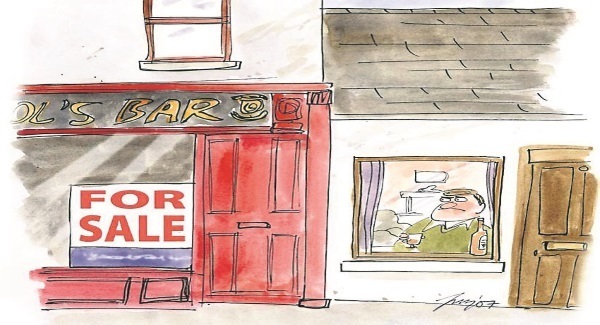
Such were the complaints voiced by outdoor people, convened indoors at the pub last Saturday evening, farmers, fishermen and their wives. The situation, they say, is getting beyond a joke, and Michael Healy Ray is the only hope, and his brother, Danny, behind him.
Even where the churches are still attended, many folk from isolated farms, where the only company is cows, sorely miss the news purveyed at the local shop and the pub. This is ‘community’.
However, as we know, even if a pub has survived in the village, if it is beyond walking distance from outlying farms, a farmer has no way of reaching it and returning without breaking the law, short of mounting a horse or a bicycle. And who, in last winter’s weather, would venture forth on a bike or a horse?
A traveller for a grocery wholesaler was referred to. Seven village shops, he’d said, had closed in County Cork in the previous week. For those who can’t count (and the clientele, believed the Party Leaders and TDs, for all that they are ex-schoolteachers, must be innumerate) that amounts to one shop every day.
Of course, the political hierarchy, it was agreed, spend their time in Dublin, running the country as a fealty, and none of these closures affect them.
Superstores are blamed for village shop closures. My local village has lost its post office and shop.
A respected local man, a non-driver, regularly suffers the indignity of standing, often in the rain, hitch-hiking like a teenager, setting out to buy himself the staffs of life at the nearest shop that would entail a six-mile walk, coming and going.
Happily, unselfish volunteers, and strong community spirit and financial support, has combined, and a local community shop will soon open to replace the one just closed.
On a small Canary Island which I visit regularly, there are no superstores. In hamlets of a few dozen houses, there is always a shop and a bar, family owned — that, perhaps, is the ‘trick’; local families make a living supplying local needs.
In the valley we know best, population 4,000, family-owned restaurants, small hotels and self-catering facilities pre-empt multinational chains that would cover the seafronts with concrete.
The single large supermarket is not one quarter of the size of the foreign-owned hypermarkets in the towns here in west Cork.
The cohesion of the EU that allows one member state to establish a business in the next seems good on the face of it. But something has gone wrong.
Rural communities are dying, the unthought-of side-effect of allowing vast retail outlets, while many rural people maintain that zero-tolerance drink-driving laws has led to more deaths through loneliness and depression than would have measured constraints that allowed for sociability while proscribing drunkenness.
These laws, they say, have led to increased alcoholism, because two pints of hypermarket booze, drunk at home, cost less than one in the pub.
Unquestionably, Ireland’s rural communities have been the singular victims of burgeoning shopping arcades, outcompeting local traders, and of blanket drink-driving diktats.
These communities will entirely die out if Dublin and EU planning is not urgently revisited, and we will have a land of cities and large towns with a depopulated hinterland, leaving Ireland’s green acres to be tended by huge, robotic machines, and a few humans to service them The entire culture, the cohesion that made us the companionable, imaginative, friendly people that we are, will disappear.
The failure of our government to understand rural geography and bureaucratic high-handedness toward rural people was brought home to me recently when I went to replace my expired driving licence with the new Photo-ID card.
Not only did it, in any case, entail a 130km drive (but turned out to be much more) and evidenced a disturbing arrogance as well.
After my wife had driven me 20km to my doctor to complete my Medical Report Form, we drove the first leg of the 55km to the nearest NDLS centre. There, with all my papers in order, I was refused a licence.
My doctor had made a slip in spelling one of my forenames, but had overwritten it legibly. The clerk refused to accept the amendment or to telephone the doctor to verify it.
In Dublin, the doctor would be around the corner. For us, the there-and-back journey to his surgery was 110km. In all, we drove 176 km on appalling rural roads in appalling weather. My NDLS experience reflected the face of Ireland’s inconsideration for rural people today.