Utopian glow off Sinn Féin will fade once they get closer to power
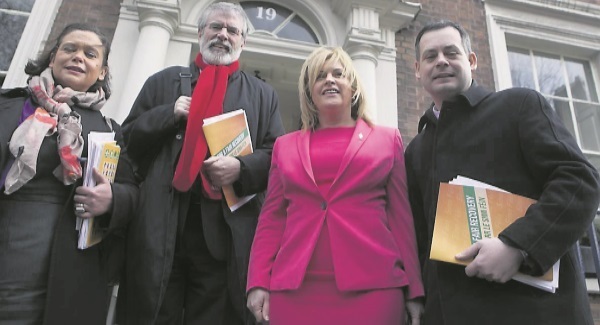
YESTERDAY the Sinn Féin manifesto was published. Freeze frame the picture from Monday night’s debate between the finance spokesmen of the four main parties on RTÉ’s Claire Byrne Live. It is not just that with Sinn Féin’s arrival there is another chair on stage, the dynamic has changed too.
It tightens the space within the conversation Labour has left to manoeuvre in. Not only had the other three a little less time, thematically Labour was squeezed between being in government on the one hand and Sinn Féin being free to roam on its left, on the other.
Sinn Féin is now permanently seated on the main stage and after polling day they are going to have more seats and an even bigger role. I very much doubt by the way that Sinn Féin will ever actually govern to the left of Labour, but that is another issue for another day. For now, they can graze out on left field, hem Labour in, and hold the Anti-Austerity Alliance off.
If this election is about the economy, it seems strange the main, once-off economic debate on television was so early. There is a lot more to trash out.
Yesterday morning Sinn Féin published its manifesto. It is full-on tax and spend. There is an eye-catching commitment to create a third tax rate of 47% on income of more than €100,000. This would be a serious blow for foreign direct investment, and many of the corporate folk attending those lush party dinners in New York wouldn’t be slow saying so. But that is not the point.
For more election news, analysis and general banter join us HERE
This is not about governing, it is about framing the debate and gaining traction electorally. Sinn Féin, regardless of whether the eventual outcome meets expectations, will be a larger, more important party in the next Dáil. If that Dáil results in a minority government or an unstable administration, this unquestionably translates into power.
Sinn Féin is not so much running against the establishment, it is running against liberal democracy. I do not say the party is undemocratic. That is caricature. The subtler truth is one we are more familiar with. Unlike all other political parties, its essential frame of reference is internal, within the movement. Sinn Féin as a party is an instrument, not the genesis of the movement. In terms of power, it is the movement, not the formal party structure itself, which is most important. No, I do not believe that that the IRA army council is effectively leading or dictating Sinn Féin policy. That is more caricature and belies the extent to which Gerry Adams, Martin McGuiness, and more have moved the movement on. However, because of the unique circumstances of the evolution of modern Sinn Féin, it is true and understandable that a small group, only some of whom are elected and all of whom are closely associated over years, through evolving iterations, are effectively a collective leadership, beyond the reach or accountability of formal structures.
It could hardly be otherwise, given the circumstances of the past 30 years. In war, what was illegal had to be secret. Conjuring a peace out of a still violent conflict similarly required omertà. Volunteers had to be fired up to shoot. That the eventual “treaty” was a complete abandonment of the aims of the war that had been pursued at such a cost to life, required enormous internal cohesion to withstand dissonance, defection, and the consequent danger from both.
If the danger to key figures prominent in the party remains, the events of the past 30 years now seem long ago for many people. In a sense they are right. Times have changed and moved on. What remains present tense, however, is that uniquely at the core of the Sinn Féin project, the key personnel remain intact. Their modus operandi, remains indelible to what they are and how they do it. They are nationalist’s first, not liberal democrats. Their cartography of accountability is fundamentally different from most of ours.
In politics now, and before politics became their almost exclusive focus, they promise a sort of utopian victory. In this utopia, supporters will not only be unburdened of austerity, implicitly they will be unbound by the restraints of a law-based society. This is why in that code Thomas ‘Slab’ Murphy is unquestionably a good republican. Not only has he done the movement significant service, he is a totem of a code where no soldier is left behind, injured on the field.
Populist, nationalist but infinitely flexible on issues of principle, Sinn Féin promises voters the illusion of constitutional victory at the ballot box.
If you are angry, it seems like justice. If you are dispossessed, it appears overdue reward. If you see others in pin-striped suits help themselves to what they are not entitled to, why shouldn’t you have your go? It is potent and to a degree it will be politically successful.
The appalling murder last Friday in the Regency Hotel in Drumcondra and another revenge gangland hit on Monday at nearby Poplar Row was an extension of the same mentality. Some, but by no means all, of the origins of those events can be traced back to the “war” so-called conducted by the movement that modern Sinn Féin is an extension of.
The current party is in no way culpable for the events of recent days. Their culpability instead rests in their ambiguity in ensuring the State has the means to effectively try and convict the perpetrators, assuming they can be caught. Those gunmen are collateral beneficiaries of the moral amnesty insisted-on for the good republican Thomas ‘Slab’ Murphy, namely that his conviction in the Central Criminal Court is unfair, and the institution should be scrapped. It is carte blanche for crime, a licence for the horrible reality that we can take what we deserve, as distinct from the utopian glow of its promise. The communities most vulnerable are among the poorest, in Dublin’s north inner city, and Limerick, and along the border.
This is the constitutional authoritarianism — a refusal to vindicate the means of ensuring a sturdy liberal democracy — free of fear, that Sinn Féin is culpable of. It is not the same old thing that has never gone away. It is its mutation, adapted in different circumstances for different times. The continuum at its core is a leadership, small but significantly wider than Adams and McGuiness, that enjoys continuity longer than any in nationalist Ireland since de Valera.
Its mutation are the able lieutenants speaking so plausibly from the fourth chair, on the public stage.