Buttercup family is large one
Through the spring, summer and autumn the changing colours are a constant source of distraction to me as I sit in front of the keyboard.
At present it is dominated by the yellow of buttercups. Everyone knows buttercups. Buttercups and daisies are probably the first wild plants we identify as children.
But the identification of buttercups is actually a bit more complicated than that because they are quite a large family of native Irish plants.
The ones I am looking at are meadow buttercups, fairly tall plants that flower from April to October in damp meadows. The leaves are divided into anything from three to seven lobes and the central lobe has no stalk. Like most members of the family it’s poisonous, although there is a Munster folk tradition of using it’s root as a cure for toothache.
It’s close relative, the creeping buttercup, is one of the most hated weeds in my garden. It has hairier leaves with three lobes and sends out runners, in the same way that strawberries do, with a speed and enthusiasm that allow it to colonise a garden plot very quickly.
It’s very tenacious and hard to get rid of. You can bury it deep in the soil and a couple of weeks later it has struggled to the surface again and started another campaign to conquer the garden with new plantlets on the end of hairy runners.
There is another, rarer one called the bulbous buttercup. It gets its name from the fact that the base of the stem swells into a bulb-like structure in which the plant stores food for the winter. The leaves are three-lobed but in this species the centre lobe has a long stalk. It likes dry, lime-rich grassland and is also sometimes found in sand dunes.
One branch of the buttercup family lives in the water. They are called water crowfoots (or should that be crowfeet?) and have small white flowers. They like trout streams with clean, fast-flowing water and gravel beds and in the angling literature they are often referred to as ‘ranunculus’, the botanical name for the whole family.
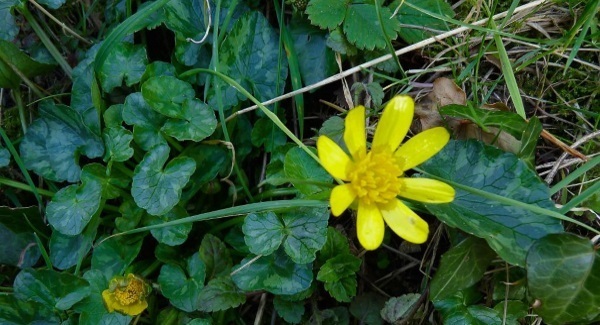
The lesser celandine, with shining yellow flowers that open when the sun shines, is often the first wild-flower to brighten hedge-bottoms and road verges in the early spring. It’s also a member of this extended family and one of my favourites.
Another is the lesser spearwort, which doesn’t actually grow in streams like crowsfoot, but likes very wet places. Its flowers look like small buttercups but its leaves are totally different, being spear-shaped not lobed.
So the buttercups outside my window belong to a large family.