Crab Apple or Bramley Apple Jelly
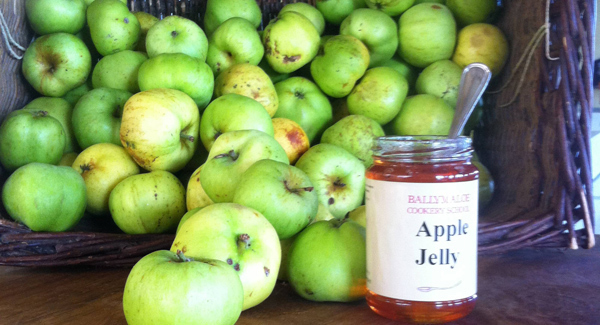

After we’ve shared with our neighbours and friends (that’s if they’re not in the same situation as we are!), don’t forget St Vincent de Paul and Penny Dinners — they may also be happy to receive a basket or two of either cookers or eaters.
There’s the dilemma, not everyone knows what variety of apples they have in their garden. The original labels may have got lost or simply got blown away. If you’re anxious to identify the variety, start with your local garden centre, alternatively, the heroic team at the Irish Seed Savers will identify the variety for a few euros per apple (pop them into the post). Contact www.irishseedsavers.ie. Finally, order a copy of Heritage Apples of Ireland by Michael Hennerty, which has brilliant illustrations of many Irish apples.
So back to the dilemma of what to do and how to store your harvest.
Apples can last for a surprisingly long time in a cool, preferably north facing garage. It’s important that they don’t touch each other, if one starts to deteriorate, the rot quickly spreads.
The low sided, timber crates that some fruit comes in stack perfectly, so ask your greengrocer or supermarket to keep some for you. We also use the compressed cardboard or moulded polystyrene dividers that come in the boxes of apples.
You’ll need to check regularly and use the ripe eaters as soon as possible. Cookers like Bramley Seedling really do keep brilliantly if stored in a cool shed. We’ve managed to store them until February or March. However, they must be properly mature and blemish free before they’re picked, use the windfalls first.
When I was a child in the Midlands, winters were definitely colder. Mummy asked Pad (our brilliant gardener-cum-handyman) to make a pit to store the cookers in, I wish I could remember exactly how it was done. I seem to recall the top soil being dug out from a rectangle in the vegetable garden, then a three or four inch layer of sand which was topped with straw. The apples, carefully sorted, were laid on top in layers. Was there straw in between? The mound of apples, about 12 inches deep was covered in straw, then a layer of sand, then finally the whole pit was covered in soil. The edges and top were smoothed off with a shovel and a few bits of old carpet or sacks were laid on top to protect from rain and the occasional shower of snow.
The pit was opened from the narrow end and the apples carefully extracted as needed and then the pit was meticulously closed again. We seemed to have had apples for most of the winter.
Apples can also be frozen — peel, core, quarter and dip in acidulated water (add lemon juice) until you have a bag full. Drain, seal and pop straight into the freezer.
Apple purée freezes brilliantly in tubs, great for apple sauce, crumbles, apple snow, apple charlotte. Fresh apple juice can be frozen in recycled litre milk containers — much fresher tasting than the pasteurised apple juice available.
And then of course there’s cider, great fun to make — dash off to a brewing or DIY shop and buy a little bit of kit. You’ll need a few demi johns, air locks, campden tablets, a syphon tube and a sense of adventure. Hygiene is crucial, every batch will be different depending on the mixture of apples, but it should all be drinkable! There’s also a tonne of information on the internet about cider making.
Here I give recipes for some my favourite chutneys, apple and ginger jam, Bramley apple sauce, apple jelly….
Wash the apples and cut into quarters, do not remove either peel or core. Windfalls may be used, but make sure to cut out the bruised parts.
Put the apples into a large saucepan with the water and the thinly pared rind of the lemons, cook until reduced to a pulp, approx ¾hour. Turn the pulp into a jelly bag and allow to drip until all the juice has been extracted — usually overnight.
Measure the juice into a preserving pan and allow 450g (1lb) sugar to each 600ml (1pint) of juice. Warm the sugar in a low oven. Squeeze the lemons, strain the juice and add to the preserving pan. Bring to the boil and add the warm sugar. Stir over a gentle heat until the sugar is dissolved.
Increase the heat and boil rapidly uncovered without stirring for about 8-10 minutes. Skim, test and pot immediately.
Follow the crab apple jelly recipe and add about 1/3 to 1/2 roughly chopped rose hips in proportion to your crab apples.
The secret of really good apple sauce is to use a heavy-based saucepan and very little water. The apples should break down into a fluff during the cooking. Freeze in small tubs to accompany pork or duck, also brilliant for kids.
Peel, quarter and core the apples, then cut the quarters in two and put in a small stainless steel or cast iron saucepan. Add the sugar and water, cover and cook over a low heat.
As soon as the apple has broken down, stir so it’s a uniform texture and taste for sweetness. Serve warm.
Try to find home-grown Bramley Seedling. They have quite a different flavour and texture from commercial varieties that have now been adapted to keep their shape in cooking rather than endearingly dissolving into a fluff as Bramley’s always once did.
Peel the apples and remove their cores. Put the peels and cores into a stainless-steel saucepan with 425ml (¾ pint) of water. Cook over a medium heat until soft. Meanwhile, chop the apples and put them into a wide, stainless-steel saucepan. Add the finely grated zest and freshly squeezed juice from the 2 lemons, plus the ginger and 600ml (1 pint) of water. Bring to the boil and cook until the apples dissolve into a purée.
As soon as the apple peels and cores are soft, strain though a nylon sieve into the other saucepan. Bring the mixture back to the boil, add the hot sugar and stir to dissolve. Boil until the jam reaches a setting point. Pot into sterilised jars and cover while still hot. Store in a cool, dry place.
3.6kg (8lb) ripe tomatoes, peeled and chopped 450g (1lb) onions, peeled and chopped 450g (1lb) eating apples, peeled and chopped 1.3kg (3lb) sugar 850ml (11/2 pints/3 3/4 cups) white malt vinegar 2 tablespoons salt 2 teaspoons ground ginger 3 teaspoons ground black pepper 3 teaspoons allspice 4 garlic cloves, crushed 1 level teaspoon cayenne pepper 350g (12oz) sultanas
There are a million recipes for tomato chutney. This is definitely one of the best and has the advantage of using up a glut of windfall apples as well. Makes 12 x 450g (1lb) pots
Prepare all the ingredients and put into a large, wide stainless-steel saucepan. Bring to the boil. Simmer steadily, uncovered, for about 1 hour, until reduced by one-third and slightly thick. Pot in sterilised jars, cover with non-reactive lids and store in a cool, dry place.
Tip from Noma in Copenhagen: Snip off the flowers from your parsley plants and scatter over salads or smoked fish.
Congratulations to Avril and the Allshire family of Caherbeg Pork Products and Toby Simmonds and Johnny Lynch of Toonsbridge Mozzarella company, worthy winners of the Belling West Cork Artisan Food Awards. Elma Nolan of Union Hall smoked salmon was also presented with a Hall of Fame award for her contribution to the artisan food sector .
Date for your diary: Bandon Engage Arts Festival September 26–28. This year’s instalment of ‘The Art of Living’ series features the Ferguson Family of Gubbeen Farm, Schull, Co Cork. This event will include a discussion hosted by food writer Dianne Curtin with Giana and Fingal Ferguson about their philosophy and how that has shaped their business and lifestyles. Audience participation is encouraged and taster plates of Gubbeen’s produce will be shared out. There is no advance booking or charge however as space is limited to 30 seats early arrival is recommended. For more information: Ruth Healy, Urru; 023-8854731/086-8372138

CONNECT WITH US TODAY



Be the first to know the latest news and updates











