Walking and using sticks go hand in hand
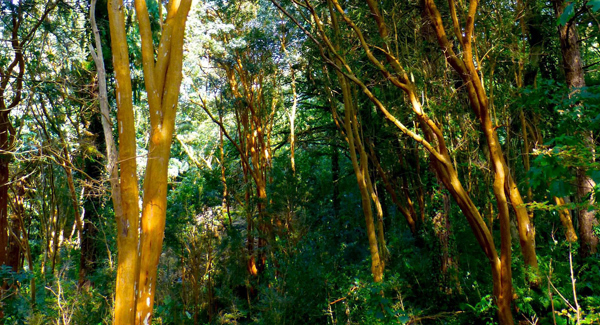
West Cork woodland takes on the appearance of a jungle in the Chilean highlands with Orange-bark myrtles growing to 50 or more feet in height, and wild-seeding themselves on the forest floor.

Walking and using sticks go hand in hand

West Cork woodland takes on the appearance of a jungle in the Chilean highlands with Orange-bark myrtles growing to 50 or more feet in height, and wild-seeding themselves on the forest floor. Introduced in the mid-19th century, this elegant species has become naturalised in the mild climate of the south west.

I AM not a walking-stick walker. A straight, stout hazel makes a good companion and last year a friend delivered four fine specimens of Connemara hazel to our door. A stick is a great help when ascending or descending steep slopes, but I’m generally carrying a bag with camera, binoculars and map; if I’m ‘writing-up’ a trail for the Monday’s Examiner, then I have a dictaphone machine in one hand and am delivering a walking — as opposed to a running — commentary as I ramble. Freeing one hand to take a stick would be mighty awkward.

Some years ago, before the advent of the ubiquitous mobile phone, folk that met me on lonely trails would look askance, thinking I was talking to myself as I walked. Now, of course, they think I am using a mobile, and am one of those people who cannot resist mouthing inanities to some friend miles away even as they walk down avenues of trees replete with blossom and birdsong, or across bogs with bees humming and butterflies dancing.

I continue to be jaw-dropped every time I see a lone person walking across a vast, empty beach, with the surf breaking and the sea gulls crying and the breeze stirring and the sand hoppers hopping and the turnstones turning the flotsam weed of many colours — brown kelp, green sea lettuce, yellowed sea oak and pink carrageen — their eyes on the sand at their feet and a mobile stuck to their ear.

I am even more dumbstruck upon seeing young couples, a handsome boy and pretty girl walking out together, holding hands, while with the other hand each holds a phone to their lug-hole (vernacular for ear) and chatter away to persons remote, never saying a word to one another.

The same amazement overcomes me at the behaviour of lovers in restaurants. The guy takes the girl out to dinner, and then he, or she, spends the time between courses with phone- glued-to-ear speaking to someone elsewhere, until the companion, bored rigid, dials a number himself/herself — any old number, perhaps — just to have something to do rather than sitting staring into space waiting for the paramour to finish.

What’s with the old art of ‘chatting one another up’?! Where’s the ‘drowning in the pools of one another’s eyes’ that used to be?! Have the young become entirely addicted to telecommunication? Are the walkers/diners actually on the phone not to strangers but to one another, although they are no more than a few feet apart?

But back to walking and sticks.

I was, lately, presented with a fine, sturdy walking stick cut from a myrtle tree. The bark was russet red, and the wood hard and tight. Here, on this dulcet Gulf Stream coast, we have wild-seeded Orange-bark Myrtle (Luma apiculata) all around us, jungles of saplings of it, not simply because an old estate edges our property and the landowner planted exotic trees — dawn redwoods, live oak, myrtle and limes; “the house of the planter/ Is known by the trees” as Austin Clark put it. But because wild myrtles thrive in West Cork and Kerry, as they do in Devon and Cornwall, although they never grow beyond bush-height in Britain’s eastern shires. A myrtle hedge, eight foot tall, encloses one side of our yard. It blooms in July as does the tall myrtle tree that overlooks it and, until a month ago, resembled a giant bouquet of white flowers standing on a red stem. Myrtles behind the Courtmacsherry Hotel are 50 feet tall.

A native of temperate Chile and Argentina, the species was first introduced to Europe in the 1840s. The small, waxy evergreen leaves exude a sweet, spicy aroma. The puffy four-petalled flowers are fragrant and the centimetre-diameter berries, appearing in autumn, are at first red, then purplish-black and very shiny. They are consumed by humans in Chile, and widely used medicinally. Here in the south west, they are fat and juicy, and beloved of blackbirds.

Most striking of all, perhaps, is the bark for which the tree is named. Almost russet, it flakes away in patches revealing the white wood beneath. I’m afraid the beech mast I lauded last week turns out to be all husk and little kernel I’ve tried it. Come October, I will turn to fat myrtle berries instead.

More in this section

Revoiced

Newsletter

Sign up to the best reads of the week from irishexaminer.com selected just for you.

Cookie Policy Privacy Policy Brand Safety FAQ Help Contact Us Terms and Conditions

© Examiner Echo Group Limited