Be gentle with herons. They break
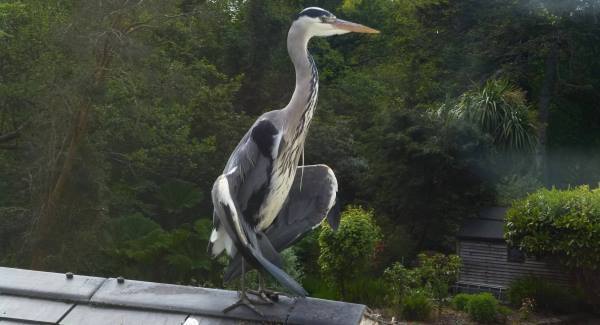
There, only a few metres away, was a heron standing motionless in the shallows, illuminated by the early morning sunshine.
Seen at close range it was a beautiful bird. The formidable yellow beak seemed fused to the front of the skull. In fact it doesn’t only seem that way. The beak actually is an extension to the front of the skull which in turn is connected to half a metre of well-muscled neck. This combines to produce a spring-loaded harpoon gun of huge power. Though the analogy to a harpoon is not totally accurate because herons don’t spear their prey. They open their beaks when they strike and grab it. But the power of the strike is enormous. In France, a man once went to try and help an injured purple heron. This is a smaller and more slightly built species than our own grey heron. He was killed by a single peck to the skull. So be cautious if you encounter a heron at close quarters.
Of course, the weapon is mostly used for catching fish up to about 25 centimetres in length, though they will tackle eels that are much longer than this. They are also very fond of frogs and I have watched them hunting for them on raised bogs a long way from any open water. They will also take rats and ducklings and even adult birds. This is why small birds and rooks and jackdaws mob them when they’re in flight in the same way that they mob birds of prey. Seen at close range the patterns of the plumage were also impressive. The white head has two jet black locks sweeping back on each side of the crown and ending in a long black neck plume. The Northern Irish writer on birds Anthony McGeehan, who has a great way with words, describes them as looking ‘like a balding bloke with an embarrassing ponytail’. The rest of the plumage is a neat combination of black, white and grey. Because of the upright stance of the bird, I’m always reminded of a man wearing a formal morning suit with a tail coat. All that’s missing is the top hat.
Then the heron spotted me inside the boat and took off, giving a harsh, gutteral alarm call that sounded like ‘frank’ or ‘crank’. In flight they look clumsy, their wings bend at an odd angle like a prehistoric pterodactyl and they don’t seem to have total control of the direction they’re travelling in, particularly in a wind. But this ungainly flight must be more efficient than it looks, though not perhaps their directional abilities. Herons from France have ended up in the Caribbean and others, probably from Ireland, in Canada.
There are about 75 species of land snail in Ireland, plus water snails and a couple that are amphibious, but the best known is the garden snail. It’s a large snail, up to 40mm across and 35 mm high, the average Irish snail is only 3 or 4mm across as an adult. It’s also unusual in that its diet consists largely of living vegetation, other snails tend to eat dead vegetation or fungi. The shell colour is variable but almost always brown with yellow stripes, flecks or streaks. The body colour is normally grey. The shell usually twists to the right, though left-handed ones are occasionally found. They have four horns, the two longer ones have eyes on their tips and the shorter ones are organs of smell and touch. Snails travel using wave-like contractions of their belly and lubricate their path with mucus. They can reach a top speed of 47 metres and hour.
CONNECT WITH US TODAY



Be the first to know the latest news and updates