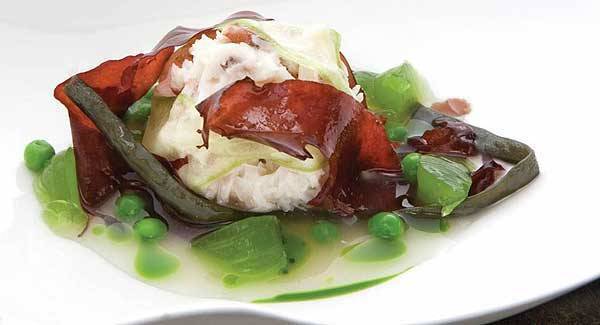
Brown Crab with Pickled Red Dulse Seaweed, Cucumber with Summer Peas and Coriander Oil
We were always big fans (and still are) of carrageen moss and dilisk, but that was pretty much the limit of my knowledge up to relatively recently. Dr Prannie Rhatigan whetted my appetite when she wrote Irish Seaweed Kitchen in 2009. Occasionally, I would meet Oliver Beaujoran on his market stall in Kenmare or at food festivals around the country — Oliver from France had an innate knowledge of seaweed and was permanently perplexed as to why we Irish didn’t seem to be excited or knowledgeable about the wealth of free and delicious food along our coast lines. Since 1999 he has been selling seaweed tapenade and sea spaghetti at farmers markets to his devotees and chefs.
More recently several companies, including Algaran Seaweed Products in Donegal and Wild Irish Sea Veg in Clare have developed very successful seaweed processing companies and there’s lots more in the pipeline.
The big breakthrough for me was when Sally McKenna, who wrote the excellent book Extreme Greens: Understanding Seaweeds, explained that all seaweeds are edible; some may not be particularly palatable to nibble but none are poisonous and they are all immensely nutritious. Ever since I’ve been prowling along the coastline and seashore snipping and nibbling and having so much fun.
We’re making seaweed salads, adding seaweed to bread, sauces, stews and drinks, sometimes fresh, sometimes dried, always with interesting and mostly delicious results. Recently I met Kate Burns whose family have lived and fished sustainably on Rathlin Island off the coast of Antrim for four generations. Kate with a ton of letters after her name has been involved in rural and marine development not just in Ireland and the UK but also in Cyprus, Estonia, Latvia and Lithuania for decades.
She introduced me to Rathlin Island kelp which is being harvested sustainably by Benji McFaul in the same time honoured way as it was by his father, grandfather and great grandfather before him. The cold waters are clean and pure due to the mix of Irish Sea and Atlantic currents. It comes ready to use in packets, shredded like fettuccini and I love it. The environment creates ideal conditions for growing kelp. The McFaul family are well known for their commitment to the caring for the environment. Benji’s father Jim and brother Fergus won Northern Ireland organic farmers of the year in 2010 and their fishing and seafood business follows responsible harvesting principals.
Kelp is amazing stuff, it has more calcium, iron and roughage than any other vegetable —it’s a kind of a wonder food. I know I advise people against buying anything that makes a health claim but this time I really believe it.
There are three types of kelp — alaria, digitata and laminaria saacharina — you can get it fresh or frozen, noodle cut salad cut and wraps.
Kelp is just one of the myriad of seaweeds around our coast. We also love pepper dilisk, sea lettuce, sea spaghetti, kombu. We’re no longer surprised to find stinging nettles, elderflowers or dandelion leaves on restaurant or country pub menus so watch that space because many chefs have discovered the magic of seaweeds and are having lots of fun. Meanwhile you too can experiment.
Brown Crab with Pickled Red Dulse Seaweed, Cucumber with Summer Peas and Coriander Oil
Taken from Chapter One an Irish Food Story by Ross Lewis
We know summer is here when the best crab starts to arrive, matched by sweet tasting seasonal peas. We get a wonderful crop of seaweed from Manus McGonagle in Donegal. We pickle it and combine it with cucumber jelly, so this dish is fresh, summery and salty, with a sweetness from the crab. There is a deep umami flavour from the seaweed with the sweet-popping peas and the cucumber jelly makes it a real summer favourite at the restaurant for the crab.
40g salt
1kg crab claws
Splash of spirit vinegar
40g mayonnaise (Ross uses an egg white mayo (see hot tips for details of Chapter One book)
1 spring onion, very finely sliced
1 tbsp finely chopped fresh chives
4 drops Tabasco sauce
Juice of ½ lemon
2 cucumbers
2 tsp mirin
1 tbsp light soy sauce
1 tbsp mirin
For the fresh peas:
About 2 tsp coriander oil, in a small
squeezy bottle
Put the water in a large pan with the salt and vinegar, and bring to the boil.
Blanch the crab claws. For medium claws, cook for 5 minutes; if they are larger or smaller, add or subtract a minute. Lift out and transfer into iced water.
When cool use the back of a heavy knife to gently crack the shells and remove the meat, picking out any bits of shell. (This amount of crab claws should yield at least 200g of meat.)
In a bowl, combine the crab with the mayonnaise, spring onion and chives.
Season with the Tabasco, lemon juice, cayenne pepper or paprika and a pinch of salt.
Put the gelatine into a bowl of cold water and set aside. Juice the cucumbers, skin on, and pass the juice through a double layer of muslin.
Measure out 200ml of juice and add the mirin, soy sauce and salt, mixing well and checking the seasoning.
Heat 100ml of the mixture in a small pan until hot but not boiling and then take it off the heat.
Gently squeeze the gelatine to remove excess water and whisk it into the hot cucumber juice.
When dissolved combine with the rest of the mixture and whisk together.
Pour into a bowl and place in the fridge to set.
Square off the cucumber and use a mandolin to cut it into ribbons — you’ll need 3 per portion.
Lay the cucumber ribbons on a tray and sprinkle over a teaspoon of salt and the mirin.
Leave for an hour and then freeze, covered with clingfilm. Remove from the freezer 10 minutes before serving, then drain, reserving the liquid.
Bring a small pan of water to the boil and prepare a bowl of iced water.
Blanch the peas until just cooked and refresh in the iced water, then drain.
Spoon an eighth (about 30g) of the crab mayonnaise mixture into the centre of each shallow serving bowl.
Put 3 pieces of the marinated cucumber on top of this and then add 2–3 pieces of the pickled red dulse on the crab and 2 pieces of the sea spaghetti around the plate.
Use a teaspoon to put small spoonfuls of cucumber jelly around the plate and add a few of the peas.
Finish with a little of the reserved cucumber liquid, 4–5 spoonfuls of crab juice and some dots of coriander oil around the crab.
150g red dulse or sea spaghetti
600ml rice vinegar
4g salt
40g sugar
Wash the red dulse or sea spaghetti and carefully sort through it, discarding any damaged pieces. Put the rice vinegar in a pan large enough to hold all the ingredients, and add the salt, sugar and lemon zest. Bring to the boil, stirring to dissolve the sugar, and add the red dulse or sea spagetti. Return to the boil and simmer for about 5 minutes until tender. Remove from the heat and allow to cool before serving.
Makes about 400 ml
500 g fresh herb leaves (dill, chive, basil, coriander or rocket)
Blanch the herb sprigs in boiling unsalted water, lift out using a spider and refresh in a bowl of iced water. Drain and squeeze really tightly in a cloth, draining off as much of the water as you can. This will give you approximately 150g of blanched herb. Combine this with 400ml of oil in a Pacojet container and freeze overnight.
The next day, blend 2–3 times and hang in a muslin. The result is a deep green and strong herb-flavoured oil. If you haven’t got a Pacojet, half the quantities, so use 250g of fresh herb sprigs and 200ml light olive oil or any neutral oil like rapeseed. Blend together on a high speed for 3–4 minutes and hang in a muslin. Using a funnel, put into a squeezy bottle. These will keep for up to 1 week.
Add a little thickener, a pinch at a time, to a crab stock until slightly thickened. Use as required.
Ross Lewis’s ‘Chapter One, An Irish Food Story’ has the most beautiful photos, of his artisan produce, by Barry McCall, as well as Ross’s exquisite food. Published by Gill and MacMillan
Joe’s Farm Crisps: I love the creativity that’s bubbling up in start-up business. An interesting number of farmers are adding value to their produce and coming up with yummy products. Look out for Joe’s Farm Crisps, grown and handcooked on their farm in Killeagh, Co Cork; phone, 087-6329334.
Devotees of chef Colm Falvey, of whom I am one, will be delighted to hear that he will be at the Goalpost, in Shanagarry, cooking yummy, fresh seasonable bar food, fresh fish from Ballycotton Harbour, and homemade breads. Cheap and cheerful and family-orientated, it is well worth a visit. Open 4pm to 8pm, Wednesday to Saturday, and all day Sunday; phone, 021-4646492.
Rathlin Island Kelp — phone, 028-20765082; email: islanderseafood@gmail.com.
Another Slow Food Event: Meet the Brewers, June 7 at 6pm, at Highbank Orchard, Co Kilkenny — Caroline Hennessy, 8 Degrees, Cuilan Loughnane, White Gypsy and Grainne Walsh, Metalman. Should be a brilliant gig. Hear their stories and sample the brews; details: www.biabeag.com.












