Cashing in on the charitableness of others
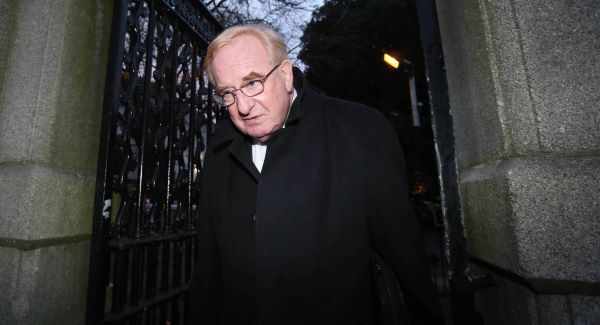
Nugent told how he’d been at a meeting in the Berkeley Court hotel with Ahern’s then solicitor, Gerry Brennan, and Des Richardson, who was a close confidante of Ahern’s and a Fianna Fáil fundraiser.
According to Nugent, this meeting, in late 1993, was arranged by Brennan to ask Nugent to contribute £2,500 to a fund for Ahern’s legal bills. At the time, Ahern also had £50,000 in savings.
“I clearly understood that, for reasons of confidentiality, we would do it in cash,” Nugent told the inquiry.
He had the cash handy. No paper record was generated. Beyond sworn testimony from Nugent, and other pals of Ahern, there is no record that there ever was a whip-around.
In March 2012, the tribunal reported that no such whip-around took place. “The tribunal rejected the evidence of Mr Ahern, Mr Richardson, Mr Charlie Chawke, Mr Michael Collins, Mr David McKenna and Mr Jim Nugent in relation to their involvement in a collection for Mr Ahern, of £22,500, in December, 1993,” the report found.
Effectively, the whip-around story was found to be a fiction. By inference, those involved conspired to a greater or lesser degree, including giving false evidence under oath.
When the report was published, Nugent’s role on the board of the Central Remedial Clinic did not become a matter of public concern. Nobody made the connection.
There was no mention of public morality. Nobody wondered aloud whether or not it was appropriate for a man in whom so much trust was placed, in a vital area of disability, to continue, given what had emerged about his character. After all, the tribunal findings suggested that Nugent placed loyalty to Ahern above the truth and the law.
Could such a man be trusted to prioritise the interests of society’s most vulnerable in the CRC?
Huge trust and responsibility are vested in the chair of an organisation like the CRC. Children and adults who have disabilities depend on the centre for the alleviation of pain, and to attain the most basic comfort possible within the parameters of their disability. Some parents regard the clinic as all that stands between them and despair.
For anybody who thought about it at all, it’s an awesome burden to be in charge of a centre so integral to so many lives.
Yet nobody associated with the CRC wondered whether Nugent was the right man to have in that role.
Some of this can be attributed to a paucity of any concept of public morality in this country.
But there were also other forces at work. Most of the people associated with the CRC are primarily concerned with the immediacy of relieving pain and improving quality of life for people who have a disability. As long as the staff were maintaining their excellent service, as long as families were seeing results, why would anybody rock the boat? This was borne out on RTE’s Prime Time programme last Tuesday. One of the panellists was Tom Clonan, a man who is frequently on the media analysing the military and global politics. On this occasion, he was speaking as a parent.
His son suffers from a serious disability that required attendance at the CRC three or four times a week.
Clonan spoke passionately about what he termed “this so-called controversy”. He said that it had been whipped up by the HSE in response to criticism from hospital CEOs. (In terms of how the information about top-up payments came into the public domain, he was most likely correct).
What was obvious, though, was Clonan’s plaintive wish that all of this would go away. He just wanted to ensure there was no damage to the centre where his son was receiving vital treatment.
Clonan is no apologist for top-up salaries, and, in another context, it would be easy to envisage him on the airwaves berating the greed and sense of entitlement that this controversy has exposed.
But, in this case, he was answering a higher calling — that of a parent concerned for the future of a vulnerable offspring. His demeanour demonstrated the savage betrayal of clients and parents at the CRC by those bestriding the organisation.
While the staff did their tireless best, while the parents fell over themselves in gratitude, those in charge had different priorities.
The heightened loyalty to pals, above all else, that Nugent displayed in the whip-around fiction was also evident in the CRC.
At the Public Accounts Committee hearing last Wednesday, there was much talk of entitlements, and employment contracts that had to be honoured. Nugent told the committee that in the throes of deep recession, as cuts were being implemented against people with disabilities, it never occurred to the board to ask their chief executive, Paul Kiely, to consider taking a hit on his €242,000, topped-up salary.
To do so might have had minor implications for Kiely’s obscene €100,000 pension, and that was more important than any fidelity to the cause they purported to serve.
Nugent, as chairman, saw no problem in raiding money raised through charity to gift Kiely a €200,000 lump-sum when he retired, last year, at the age of 58.
Kiely, another member of Ahern’s Drumcondra mafia, was entitled to it, and that entitlement, as far as these men were concerned, received priority in an institution operating for the most vulnerable. Services may have to be cut, parents’ and clients’ stress and worry increased, but loyalty to mates, and their entitlements, would always get priority.
These men saw no conflict of interest in serving as directors of both the CRC and the fundraising charity, the Friends and Supporters of the CRC. Control, rather than transparent probity, was what it was about among the mates.
When Kiely retired, they saw no problem in filling his shoes with another board member, Paul Conlon, with no outside consultation or advertisement. The board, as Nugent told the PAC, was self-electing. It was nothing more than a lucrative little fiefdom, wrestled into the domain of Ahern’s cabal, in order to feather nests.
The damage done is incalculable.
There were reports last week that the annual Santa Bear appeal for the centre was faltering, with Santa Bears being handed back from schools and shops.
Such a scenario would have been unthinkable before this scandal. And beyond the CRC, the charity sector is now being regarded, in many quarters, with suspicion, nearly all of it unfounded.
Throughout this recession, as tales of greed and excess competed with requirements to rein in spending, it is the most vulnerable who have consistently got it between the eyes. The song remains the same in this case, but the CRC scandal is further sullied by the betrayal of the staff and clients. It is that betrayal that makes this one of the more sordid episodes to tumble out in recent years.