Tracking nature by the book
I was walking beside a river the other day when I came across a bank of firm mud with a perfect set of footprints in it.

Tracking nature by the book

For some reason there’s always something exciting about finding tracks like this. I suspect it’s a very ancient thing, dating back to the days when being able to track wild animals was vital to our survival.

But these were the footprints of a bird, not an animal. Quite a big bird because each print was 7cm or 8cm from front to back. It had four long, slim toes ending in quite sharp claws — some only have three. One pointed straight ahead, one straight back, the remaining two were at 45 degrees to the one pointing forward — a bit like a letter Y with an extra stroke in the fork. Definitely a heron.

If you share my interest in wildlife tracks you should look for a newly published book called Tracks and Signs of the Animals and Birds of Britain and Europe by Lars-Henrik Olsen. It’s by far the best book on the subject I’ve ever seen and is beautifully illustrated with a combination of drawings and photographs.

There’s one slight disadvantage — it deals with 175 species and, because of the small size of our island fauna, most of these are not found in Ireland. But all our wild mammals and most of our domesticated ones are fully covered, along with a lot of our birds. You may feel you have no immediate need to know the signs left by a wolverine or an Algerian hedgehog but it’s when you’re abroad and you’re confronted with something unfamiliar that a book like this can be useful.

There are sections on mammal scat and bird droppings and a fascinating chapter on the feeding signs left by animals and birds on things like nuts, cones, rose hips and even turnips. Each species of small mammal and bird seems to have a different solution to problems like how to get at the kernel inside a hazelnut. With the help of this book you can pick up a gnawed nut shell off the woodland floor and come to a pretty accurate conclusion about what ate it.

There are reports the dormouse has recently arrived in the part of the country I live in. They’re secretive animals and I’m not familiar with them but my copy of the book should help me to know if a pair has arrived on my land. The final section of the book is an excellent field guide to European mammals with information on size, behaviour, habitat and similar species. There are distribution maps and excellent photographs of each species, worth buying for this section alone.

* Tracks and Signs of the Animals and Birds of Britain and Europe by Lars-Henrik Olsen, Princeton University Press, £17.95.

Nature Table

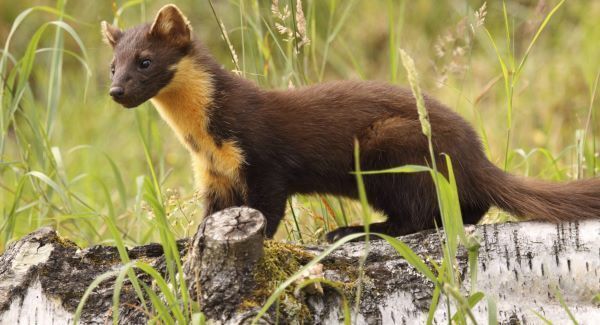
PINE MARTEN(Martes martes)

Pine martens are rapidly increasing in numbers and extending their range. Thirty years ago they were rare and confined to a few locations, mostly in the west of the country. They’ve spread eastwards and are now being reported practically in every county. They are roughly cat-sized relations of the stoat and the otter. The only animal they can be confused with is the American mink, which is much darker in colour and has smaller ears. There are also behavioural differences — mink like to swim but are not great tree climbers, pine martens dislike swimming but are excellent tree climbers. They are normally shy and nocturnal, though they quite often make their dens in buildings. The most likely sign of their presence is their droppings which they leave in a prominent place, often a tree branch. Another may be the disappearance of grey squirrels — pine martens prey on them.

More in this section

Revoiced

Newsletter

Sign up to the best reads of the week from irishexaminer.com selected just for you.

Cookie Policy Privacy Policy Brand Safety FAQ Help Contact Us Terms and Conditions

© Examiner Echo Group Limited









