Exploration of a purrfect enigma
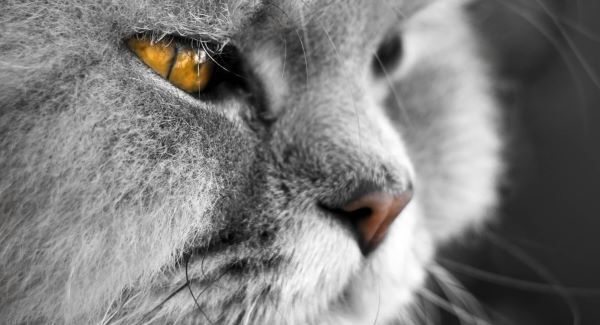

John Bradsha, of Bristol University, quotes an Irish legend at the beginning of his new book on cats; ‘a cat’s eyes are windows enabling us to see into another world’.

Exploration of a purrfect enigma

Cat Sense: The Feline Enigma Revealed, an exploration of the domestic pet’s biology, tries to enter that world.

Cats have extraordinary senses. Their ears, tuned to locating rodents shuffling in dense vegetation, working independently of each other, detecting sounds two octaves higher than ours. The eye, though ideal for night vision, has its limitations; objects immediately in front of the cat can’t be seen clearly. The whiskers move forward, using touch to compensate. When pouncing, these long hairs act like a radar antenna, guiding the cat’s mouth to the prey. If falling, a cat will twist itself upright, spread its legs and claws parachute-style, limiting its speed to around 80km per hour, less than half what a human would attain. Cats, plunging from great heights, have survived, thanks to this, and their shock-absorbing legs.

The world’s most popular pet outnumbers ‘man’s best friend’, the dog, by three to one. Wild kittens, Bradshaw thinks, were tamed for their mouse-hunting services when people began storing grain in the Middle East 11,000 years ago. The early domestic cats were working animals, not pets.

When the cat first became a pet isn’t known. French archaeologists found one buried with human remains in a 9,500 year-old grave in Cyprus. Felines were kept as pets in Egypt 4,000 years later. Our ones are most likely descended from them, rather than from local European wildcats, although both belong to the same species. The Egyptians, who deified cats, bred them in special catteries to be mummified as religious offerings. Prolonged confined living changed behaviour, producing a docile sociable strain of a creature whose lifestyle in the wild is solitary. Female domestic cats will live in colonies which may include males.

The cat’s religious associations changed with the arrival of Christianity. Although monks drew cats lovingly on the pages of the Book of Kells, the Church turned against them. In 1233, Pope Gregory IX’s Vox in Rama identified cats, especially black ones, with Satan. ‘Over the next 300 years, millions were tortured and killed, along with hundreds of thousands of their mainly female owners, suspected of witchcraft’, Bradshaw writes. ‘On the Scottish island of Mull, one black cat after another was roasted alive for four days and nights in an exorcism referred to as the Taigherm.’ The dog is totally domesticated; it can even read human body language. The cat, however, remains at heart a wild animal, living with us on its own terms. Your family pet will breed with a wild cousin if it gets the chance; analyses of DNA from wildcat populations, including those of Scotland, almost invariably reveal tell-tale signs of domestic liaisons. However attached to home comforts, a cat observes the customs of its ancestors. A domestic mother, for example, still moves her kittens from den to den just as she would in the wild. Why she does so isn’t understood. Bradshaw thinks she wants to outwit hatching fleas. They communicate by waving their tails but ‘tail language’ has yet to be deciphered.

It’s been suggested they cynically trick owners into caring for them by bogus displays of affection. Bradshaw disagrees. He thinks their behaviour isn’t merely utilitarian. Members of feral colonies, he points out, lick and preen each other in affectionate displays. The pets in our homes show similar feelings for us and regard humans as colony members. A wild kitten must be nurtured and cuddled between the ages of three and eight weeks if it is to become an affectionate member of the family. It can’t be tamed if not handled before its 11th week. One raised with puppies accepts them as litter-mates and does not seem to ‘know’ it’s a kitten. A fascinating book every cat owner should read.

* Cat Sense: The Feline Enigma Revealed. John Bradshaw. (Allen Lane).

More in this section

Revoiced

Newsletter

Sign up to the best reads of the week from irishexaminer.com selected just for you.

Cookie Policy Privacy Policy Brand Safety FAQ Help Contact Us Terms and Conditions

© Examiner Echo Group Limited