Assessing the political winners and losers of the referendum campaign
No matter what you might think of their respective positions, and the way you have voted, politicians from both sides have impressed with their delivery during debates while others have suffered, especially when put under pressure to say what we should do when pushed beyond complaining about how banjaxed the economy is.
Some have been more notable by their absence from the debate. Here’s my assessment of the performance of some of the main political players in the debate.
ENDA KENNY
The public perception of a heretofore popular Taoiseach is weaker as a result of his decision not to take part in media debates. There was a good reason for him not to engage: He has not done particularly well in such head-to-heads in the past and had the potential to do serious damage to the yes campaign with a gaffe. However, a modern leader cannot be seen to lack confidence in his communication abilities. If he cannot cut it in a television or radio studio then how does he perform when in the company of heavyweight and intellectual European leaders at summits and the like? By the end of the campaign, the Government’s oft repeated claim that he was debating regularly in the Dáil and was meeting the people on the streets was becoming somewhat pathetic. An address to the nation while reading a teleprompter may cut it in tin-pot dictatorships, but not in Western Europe.
SIMON COVENEY
Being made Fine Gael’s director of elections was considered something of a potentially poisoned chalice, but even if the referendum outcome goes against the Government he should escape most of the blame. Coveney has been earnest and passionate in taking a position in which he clearly believed — rightly or wrongly — and his relative youthfulness is an advantage too, as is his likeability and genuineness. He did not shirk from the fight and made only very minor mistakes.
MICHEÁL MARTIN
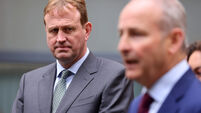
Clearly growing in confidence in recent months, having seemingly decided that it can only go so far with self-abasement, Fianna Fáil avoided the temptation to offer opportunistic opposition — for which they would have been pilloried — and instead took the risk of supporting the Government’s position. Martin, as a former minister for foreign affairs, understood the brief and ran hard with it. He was as combative as ever, but in command of the facts when required and argued ably. His problem was that nobody in his party was anywhere near as prominent or effective in other debates. But being on the same side of Fine Gael in this debate raised the intriguing question: With Fine Gael implementing what are effectively Fianna Fáil policies, are the two getting nearer to forming the next government, with the more like-minded Fianna Fáil replacing a failing Labour?
EAMON GILMORE
Facing crisis as Labour slumps in the polls, in the face of the Sinn Féin onslaught, Gilmore is looking out of his depth, especially by comparison with all of the other Labour party leaders over the past 40 years. His pre-election comments of “it’s Labour’s way, not Frankfurt’s way” will haunt him forever politically and he seemed to confuse the notoriously unreliable Wikipedia with Wikileaks when he queried the accuracy of the latter’s publication of US embassy documents about his attitude to re-running the Lisbon treaty referendum. (Five days after telling the public he would not countenance a re-rerun he allegedly told the US embassy he was just saying that for public consumption, though he denies making the comments.) Credibility is a major issue for him now.
MARY LOU MCDONALD
Measured and deliberate, yet absolutely firm in debate, McDonald was one of the standout performers of the no campaign. She empathises with those who are suffering because of the austerity, but interestingly she went out of her way not to be seen as anti-business in offering solutions, emphasising her commitment to maintaining the 12.5% corporation tax rate “in the short term” if Sinn Féin ever got to power. Her lack of republican baggage is a definite advantage.
GERRY ADAMS
Whereas McDonald has engaged with the economic issues and attempted to put forward solutions, her leader Gerry Adams has been more populist and blatantly obvious in his opportunistic knocking of the Government. He remains utterly unconvincing when offering solutions, however, and was hard to believe when he insisted that Ireland would be able to access finance from the ESM even after a no vote. Sinn Féin activists may remain in thrall to him but should remember two things: His record in securing what he wanted through negotiation is poor (all he achieved in Northern Ireland after 30 years of violence was a form of power-sharing) and it is the performance of southern TDs with no known links to the IRA that appeals to voters south of the border.
DECLAN GANLEY
The Frank Sinatra of Irish politics, with his now regular retirements and comebacks to deliver his latest rendition of ‘My Way’, and his allegedly shadowy connections (although, pointedly, nobody has delivered any proof that he is a front for anyone). At least this is one businessman who prefers to debate publicly instead of pulling the strings of politicians behind the scenes and for that he deserves credit. He was articulate and often convincing in his contributions, even if the timing of his arrival might have been too late. Even if he ends up on the losing side his future political ambitions remain of interest.
JOE HIGGINS
Possibly the most well-meaning and honest man in Dáil Eireann, but the former seminarian is now a secular zealot when it comes to his devotion to socialism. Higgins is an idealist but with ideas that simply haven’t worked anywhere else in the world, not because they haven’t been tried but because they have and don’t suit the imperfections of human nature.
SHANE ROSS
The Independent TD was correct to argue that this referendum was happening too early and it was a pity that legally it could not be postponed until the autumn when things in Europe might be somewhat clearer. Not his fault that the Sunday Independent — for whom he writes — hyped his decision to vote no last Sunday as a potential tipping point in the campaign. He’s not that influential.
OTHER LABOUR MINISTERS
Joan Burton was thrown a hospital pass by her party leader in being put in charge of a campaign you might think she would not support enthusiastically, but she showed herself to be a firm believer in the yes campaign. It may have lost her some personal support from those who see her as the conscience of Labour (which might not upset Gilmore). Of the others, Brendan Howlin was probably the most assured.
OTHER FINE GAEL MINISTERS
Phil Hogan’s household charge gaffes led to an eight-week media gag being imposed on him by Kenny and it may have been a good thing for the Government. His propensity to arrogance was not missed. James Reilly and Alan Shatter were also noticeably quiet, although Leo Varadkar was trusted to make the arguments. The biggest surprise was when Richard Bruton, supposed to be a safe pair of hands, told me live on radio that there might be a second referendum if the first was lost. His backtrack was spectacular but he remained a key part of the campaign afterwards.
* The Last Word with Matt Cooper is broadcast on 100-102 Today FM, Monday to Friday, 4.30pm to 7pm.