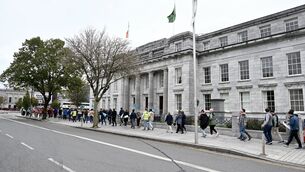
The Dáil resumes - Regulation must be part of recovery
Their primary objectives will be to stabilise the economy, sustain as many jobs as possible and to try to do what can be done to get to grips with our banking crisis. Given frightening job losses, collapsing tax revenues, dismal international assessments of our economy and our management of it and a workforce divided along the public/private fault-line, those concerns are pressing.
Parliamentarians must, however, consider another question. They should ask themselves if our political system, through their actions, is robust and imaginative enough to take the decisions needed to secure our future. They should ask themselves if it has the capacity to constrain powerful forces — domestic or international — when the behaviour of those institutions threatens the wellbeing of so many workers, families and businesses. They should ask themselves if it has the capacity to police the institutions we all depend on to lubricate the enterprises that keep bread on all of our tables.
Sadly, we have all come to know the answers to those questions.
Several business leaders have told us that a recession offers opportunity for the brave. It offers other opportunities too. One of those is to change the rules.
The Dáil must ensure that an Irish banker is never again free to indulge in the behaviour that has led us into this mess. Whether this is through legislation or a real change in culture is irrelevant. It must be done.
Over the weekend discussions surrounding the possibility of breaches of the Companies Act in an alleged €300 million share deal pointed out that courts could only impose fines of €2,500 if anyone was convicted of such breaches. You would not have to be the sharpest pin in the box to conclude that a €2,500 fine on a dodgy €300m deal is not a disincentive. It would hardly pay for the wine at the celebratory lunch after the conclusion of such a deal.
As our 166 representatives gather today, they must not only try to restore confidence and functionality in our economy. They must insist on regulations with real teeth, a regime that will not be deluded into thinking that the banks will “do the right thing”. They must insist on regulations that will make it impossible for anyone to describe Ireland as the “wild west” of European finance again.
There is no point in enduring pain today if we do not move to confront the circumstances and behaviour that led to the crisis in the first place.
Our parliamentarians might ask themselves how differently would our bankers have behaved had they put personal assets at risk by behaving recklessly with investors or depositors funds? Quite.
Though banks must take considerable blame for the mess we are in, it seems that some unions are happy to join them.
By refusing to even discuss pay cuts they are doing just what the banks did; they are imagining themselves untouched by the awful reality unfolding all around them.

CONNECT WITH US TODAY



Be the first to know the latest news and updates