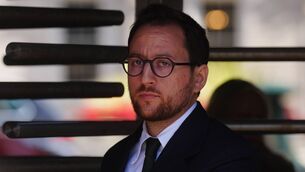
Gilmore leadership - It’s a very tall order but we wish him well

IT IS expected that Eamon Gilmore will be confirmed as the 10th leader of the Irish Labour Party at noon today, continuing the process that began with the appointment of Tom Johnson in 1922.

As Mr Gilmore will be only too aware, he faces challenges that will require vision, patience, energy, an ability to listen, to communicate, to organise, to delegate, to be endlessly optimistic and to inspire.

As well as that he’ll be expected to take on the most successful taoiseach in the history of the state, though his opportunities to do so in the Dáil will be limited. He, and all politicians outside the government cabal, will have to play a role in breaking our undesirable slide towards a single-party state.

Along the way he’ll have to re-energise a becalmed but significant political organisation. Part of that process will be identifying and grooming prospective Dáil candidates to replace deputies who will have reached retirement age at the next election. He will have to engage in a similar process for the next European elections, which will be held in less than two years — in June, 2009. Local elections are also due then.

And all of this without a guarantee of success of any kind. Not even the merest hint that your ambitions might be translated into government policy.

If that were not enough he must constantly look over his shoulder at the prospect of a dusty skeleton, no mater how irrelevant or insignificant, no matter how imaginary or contrived, being dragged from its place of rest to undermine and embarrass him, his family and his party.

All of our political leaders face a level of scrutiny that political leaders even two decades ago never imagined possible. Whether this has enhanced the political processes or just offered the world’s Monica Lewinsky’s their 15 minutes of fame remains contentious.

One of the consequences of the “Lewinskyisation” of how our leaders are scrutinised — for them and for us — is the acceptance of a fallacy as conventional wisdom.

Suggesting that a person’s public and private lives are completely separate is a principle that all of those in public life are keen to see enshrined in our mores but it is one that does not survive scrutiny.

Because a person’s private behaviour is as much a reflection of their character as any public pronouncements on policy, it is a factor. This may be unfortunate but it is irrefutable.

It is unlikely though that this thought is foremost in Mr Gilmore’s mind today, he has far, far bigger fish to fry.

His succinct exposition of his credo — “not only me but others too, not only here but elsewhere too, and not only today but tomorrow too” — suggests that he has a vision informed by the humanity needed to encourage faith in a jaded and suspect political system.

In the fine traditions of all strong democracies we may not always agree with him but we will always wish him well.

More in this section

Revoiced

Newsletter

Had a busy week? Sign up for some of the best reads from the week gone by. Selected just for you.

Cookie Policy Privacy Policy Brand Safety FAQ Help Contact Us Terms and Conditions

© Examiner Echo Group Limited