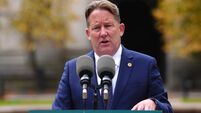
EU translators at work to answer céist na teanga
This is something of an achievement given that those responsible for the service had only months to prepare and recruit, compared to Bulgaria and Romania, whose languages also came on stream on January 1. They had at least ten years to prepare and set up training and recruiting processes.
Ireland, on the other hand, was at a disadvantage as the Dáil and Seanad must be about the only other places in the world where translation and interpretation is required on a regular basis.
The Government, despite having pushed 30 years after membership, to have the language as a working one in the EU, were not willing to part with any of their Oireachtas staff and did not appear to have done any preparatory work on what might be required to train people for the EU.
As a result while the Union has 2,800 accredited freelance interpreters worldwide, none of them were accredited with having Irish although at least one is a native speaker accredited to work with three other languages.
But now, just two months after the introduction of Irish, there are six freelance interpreters available, while four staff and freelance interpreters are currently being trained to add Irish to their list of languages, and five students are being trained with EU financial support at Westminster University in London.
One of those adding Irish to his languages is Brendan Woods from Cork, who has been working for the European Commission for 12 years. He already interprets French, Italian and Dutch into English.
“I had Leaving Cert Irish and had forgotten it having not used it for almost 20 years. But it is coming back, and, at this stage, I would do a standard political speech. But, if a native speaker really let go on a specific topic I am not sure I could keep up,” he said.
He is attending classes two mornings a week, paid for by the Commission, and given by native Irish speaker Valerie O Flaherta, from the Aran Islands. “It’s much more fun than Leaving Cert Irish – we use a lot of newspapers, the radio and other sources. I am enjoying it,” he said.
“It’s also a very up to date language with words for all the modern devices and ideas, which was a nice surprise,” he added.
But, he points out, they have had no time to prepare for it.
“The first we heard of Irish becoming an official language was in mid-2005.
Other countries like Hungary knew for the past ten years and were working on it,” he said.
Mr Woods said the only negative reaction he has got to Irish being included as a working language has been in Ireland and admits that he was a bit cynical at the start too, but is now very much in favour.
“A language is about culture and a nation’s status as well as communication,” he said.
Many people in Brussels were surprised to know that Irish was a separate language, and not just Hiberno-English, he said.
As well as interpreting what people are saying, the EU also translates documents into Irish, but recruiting has been difficult as they are competing with the Dáil and Seanad for a small pool of qualified people. Three translators, an assistant and a manager are now in place, and it’s hoped to have another two on board later this year.
CONNECT WITH US TODAY



Be the first to know the latest news and updates