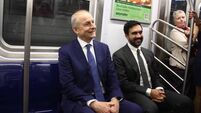
You saw it as it happened — an honest man mugged by the media

NOTHING illustrates the cruelty of modern politics like the stitching up of Royston Brady in the run-up to the European elections, and his eventual vindication when it was too late to do him any good.

You saw it as it happened — an honest man mugged by the media

Royston had given an interview to Hot Press last November in which he claimed that his late father, a taxi driver, had been abducted the night before the Dublin/Monaghan bombings in 1974. His father's taxi was used as a getaway vehicle by the bombers, he believed.

He repeated this story in a Sunday Independent interview a week before the election. And then the avalanche happened. The story dominated Joe Duffy's RTÉ Liveline programme on the Wednesday before polling day. A family member of one of the bombing victims accused Brady of trying to make political capital. Liveline introduced an unnamed former garda, 'Michael', who claimed to have been involved in the investigation of the bombings.

'Michael' said there were no garda records to suggest the hijackings had occurred.

The Evening Herald published criticisms of Brady for not responding to the Barron inquiry's request for more information after his Hot Press interview. The Irish Times reported that Barron "uncovered no evidence to back up Mr Brady's assertions about links between the abduction and the bombings".

But these were side issues. The central plank of Royston's story his father's abduction was never accepted as factual. The Irish Times quoted Ed O'Neill, whose father was killed in the bomb attack, who attacked Brady's "unfounded, untruthful and insensitive and callous remark".

Yet, all that time, the evidence to support Royston's story was publicly available.

On May 17, 1974, the Irish Times had carried a front-page story about the hijacking of two Dublin taxis the previous evening. Edward Brady's statement in Terenure Garda station was included. But later that day, the bombings happened and they of course dominated the news.

Those unsympathetic to Royston Brady will say he was asking for it.

For months previously he had pulled every kind of media stunt to get himself noticed. In the run-up to the elections he refused to give interviews and made an enemy of the media. And finally, the media re-ran the hijacking story in such disbelieving tones that Brady got portrayed as a cynical opportunist.

But Brady had not made up the story. He had simply retold a story about a remarkable personal link to a terrible public event without understanding much of the details.

If there is a lesson here about Royston, it is that he was careless not to shield himself from attack. But there is a much greater lesson concerning the media, and how callous, insensitive and irresponsible they can be. Why was it that not one single journalist, not one, took the trouble to check Brady's story against the archives?

Liveline, in particular, profited insofar as the controversy was good for their ratings. They must have known that he was losing votes by the bucket-load with each minute that passed.

Their interview with the mysterious 'Michael' did the most damage. Yet they did practically nothing to ensure that they weren't destroying the reputation of an honest man. It is no defence to say that they allowed Brady's family members on air to back up his story.

Liveline's obligation was clear. Since they were giving airtime to people whose comments suggested that Brady was a liar or an idiot, the onus was on them to do the fact-checking beforehand. At the very least, they should have checked the files. There are paid archivists in RTÉ who do that sort of thing.

And what happened when Brady was finally vindicated? There was no apology on Liveline, none in the Evening Herald, and the Irish Times merely reported him to have "claimed" that the archive clipping proved his story.

Things have moved on, you see. This week we're talking about Bertie and the European Commission, and the protests against George W Bush. The fact that the media interfered with the democratic process a fortnight ago and wrecked a political campaign, without any significant facts to justify it, is not news.

The Justice for the Forgotten group, which is campaigning for a public inquiry into the Dublin/Monaghan bombings, doesn't have much sympathy for Royston. They feel he handled the affair badly. That he had no evidence to back his suggestion that his father's taxi was used as a getaway car by the bombers. And that he should have held a press conference to clarify matters.

But Royston's version of events may yet prove entirely correct. His mother claims that her husband's stolen taxi was eventually retrieved, north of the Border, and returned to the Bradys in a damaged state.

That would make a link between the hijacking and the bombing quite probable.

OTHERS don't come so well out of the controversy. Justice for the Forgotten itself made submissions to the Barron inquiry investigating the bombings without alluding to the hijacked taxis. Their primary research only began with May 18, 1974 the day after the bombings.

The Barron inquiry, which was set up to investigate the Dublin/Monaghan bombings, was also in the dark.

The gardaí had supplied no information about the stolen taxis and Barron only found out after the Hot Press interview. At this stage the report was with the Government.

The biggest questions must be answered by the gardaí. Back in 1974, did anyone make the link between the hijacking of the Dublin taxis and the Dublin/Monaghan bombings? If Mr Brady's stolen taxi was eventually retrieved in the North, were any forensic tests done to check the car for fingerprints or the residue of explosives? And why did the Barron inquiry never hear about any of this?

The Barron report has raised other concerns about the Garda investigation. The gardaí received a tip-off about a suspicious-looking van and its driver which they allowed to return to England. Independent evidence exists that a British army uniform was found in the van and that the man was armed. This information was not in the Garda files given to Barron.

The Garda report also claimed that they were unable to trace a particular individual who stayed in the Four Courts Hotel, and who left on the day of the bombings. This person had connections with well-known Portadown-based paramilitaries and they had been exchanging telexes and telegrams. Yet, according to Justice for the Forgotten, the man in question was well-known and could have been easily located.

And what of the failure of the gardaí to provide any significant player in the investigation of the Dublin bombings to give evidence to the inquest held earlier this year? If Liveline's informant is genuine, there are serious questions to be raised about Garda co-operation with the Barron inquiry and the inquests into the deaths.

The affair rumbles on. An Oireachtas committee has called for an investigation into the Garda's handling of the case, the missing files and the incidents which were not properly investigated.

Justice for the Forgotten is initiating proceedings against Britain in the European Court of Human Rights. It claims that there is a stateable case that the British colluded in the bombings and that the British are in breach of their obligations by not co-operating with the Irish inquiries.

It will be a long time before the truth is known. But Royston Brady may have the satisfaction of knowing that he gave new impetus to the search.

More in this section

Revoiced

Newsletter

Sign up to the best reads of the week from irishexaminer.com selected just for you.

Cookie Policy Privacy Policy Brand Safety FAQ Help Contact Us Terms and Conditions

© Examiner Echo Group Limited