Yes campaigners find positivity on the doorsteps but doubts too

The man who answered seemed distracted. He was surprised to see the family pet outside. But upon being told by Martha the canvasser that she was with the Together for Yes campaign he immediately replied: “Oh we’re a yes in this house.”
She offered him a leaflet, whereupon he told her he couldn’t chat further and had to go: “The wife is upstairs going into labour.”
A few doors down in the middle class estate of Glasnevin Downs in Dublin an older man was out working on his car.
He told Martha himself and his wife had raised six sons in the house “although we never really talked about this sort of thing”.
He was a “strong yes” but disclosed that “the wife isn’t sure, I have to work on her”.

Martha was one of around 15 people, two of them men, three of them new, who made up the canvas group in Dublin North West (DNW) on Tuesday night.
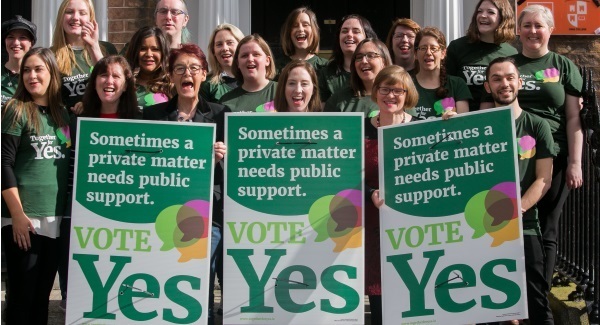
The group met at 6.15pm outside a local pub where they donned their branded blue bibs and took their leaflets.
They were handed a tally sheet to record the name of the street and how they thought the person at a particular house might vote on May 25 — either yes, no, maybe, or won’t vote.
They set off with purpose with Eimear McBride, the Ballygall canvas leader giving instructions on which route to take. Ballygall is between Finglas and Glasnevin.
Eimear, who previously campaigned in the same sex marriage campaign, explained the DNW group hoped to get around to the 40,000 or so households in DNW at least once by the end of the campaign.
They’ve been knocking on doors since mid-February. Canvassers are from all political backgrounds and none but Eimear stressed that together they are “very much a non-political group”.
The information gathered tonight on the forms will later be fed back to the Together for Yes national campaign by a local data entry team.

Now one canvas does not a campaign make, but after the criticism that the yes side had been slow off the starting blocks, I was curious to see their level of organisation and the response on the doorsteps.
In this particular instance anyway the answer was very highly organised. As to the responses, well there were a high number of yeses, but equally a high number where it was obvious people were uncertain, or if they did know they did not want to say, and that would possibly indicate a ‘no’ vote.
Obviously there are a significant number of houses where people simply refuse to answer the door to the canvassers.
It was ever thus but it’s more clear than ever now they are at home with the massive wide screen TVs visible through the window.
The lengthening evenings are a blessing given that those who do answer can see who is at their door, although the default door answering position is to half open the door and semi curl their body around it, keeping half of themselves inside.
You’d have to wonder how much of this semi defensive crouch had to do with the sensitive issue at hand; people being reluctant to be drawn on their private thoughts on this most controversial matter.
What was really notable though was the lack of aggression or anger or finger wagging.
One woman who took a while to answer the door and missed the canvassers does appear belatedly and run out to her gate to shout — in a resolute, rather than an aggressive way — “It’ll be a no vote here”.
Early in the canvas we’re at Glasanon Road in Ballygall. At one doorstep a woman in her 50s says she has made her decision and it’s a yes.
The canvasser speaks about compassion for women and women’s healthcare needs and the sense of shame women can feel “as if they have done something wrong even though it is right for them”.
The woman agrees, and then says: “I mean it’s not for everyone.” The canvasser immediately concurs: “Oh Jesus no, of course not.”
At each house the patter is virtually the same. The canvasser gives their first name, saying they are from Dublin North West Together for Yes.
They ask if the person on the doorstep has heard about the upcoming referendum? Do they have any questions or anything they can help them with?
Even in a house that is a definite yes they leave a leaflet and ask the voter to talk to family and friends about the upcoming vote saying it is going to be close and every vote will count.
Canvassers have received training (and you can tell) on how to approach voters at the doorstep, where, from what I overheard, they stress, in moderate tones, the healthcare issues for Irish women, how women have to travel for abortions and the failure in adequate healthcare for crisis pregnancies.
Sometimes they mention how this will likely be a one in a generation chance to vote on this issue. I witnessed no zealousness.
One of the most regularly brought up issues nationally by those who are unsure of how they will vote is the proposal to allow abortion up to 12 weeks.
The Together for Yes campaigners talk about how this is the only way to ensure that cases of rape and incest are included.
Asked about negative canvassing experiences Aoife Traynor, co-convenor of the DNW group, said there had been one house where the woman “took the stairs two at a time and nearly took the door off the hinges” when she realised they were Together for Yes canvassers outside.
But she just wanted to tell us she was voting no and wouldn’t have our leaflet in her house.
Asked her sense of how the campaign is going Aoife feels that it will be a yes vote. But later in the evening another young member of the team says she worries about the outcome.
“In general there are a lot of strong yeses, but then you also get a lot of undecided, so I do worry that they are actually no voters.”
A lengthy chat is held with a woman in her 30s in the Fairways estate. Her 10-month-old baby can be heard gurgling to his dad (a yes voter) in the kitchen. His wife says she would have been a definite yes before getting pregnant, but is unsure now.
“It’s when you’ve been pregnant,” she explains. “You know when you get to 12 weeks it’s so real. I’m finding it very hard.”
The canvasser acknowledges where she’s coming from, but raises the issue of fatal foetal abnormalities and women having to travel.
I don’t have kids myself and if I did I don’t know what decision I would make in that situation but I’d like to have a choice.
The young woman is quick to acknowledge the difficulties with that situation. “It’s just that niggling thing... I think it will be very narrow in the end.”
It’s still early days in the campaign, and momentum could swing either way, but as of now I think she’s right, it will.
CONNECT WITH US TODAY



Be the first to know the latest news and updates