Chapter closing on independent shops is a bad deal for everyone
Local shops are every bit as important as parks, waterways, raised bogs and woodlands, writes Victoria White

Chapter closing on independent shops is a bad deal for everyone

THERE’S just nowhere else like Liam Ruiséal’s bookshop on Oliver Plunkett St, I told my husband when I got home from Cork last weekend.

There’s no other bookshop you could wander into and find rare books you’ve been searching for like Peter Somerville-Large’s The Coast of West Cork and Liam Deasy’s Towards Ireland Free as well as a cut-price True History of the Kelly Gang by Peter Carey.

Yes, we’d enjoyed sipping our coffee in Rant with a view of St Luke’s and we’d done some damage in the clothes shops on St Patrick’s Street. But it was the visit to Ruiséal’s which gave us enlightenment and a plumb-line into the history of the city we were in.

Are you living under a stone, my husband asked? Ruiséal’s is closing down later this year.

It told him he was talking nonsense because there was no sign of it. A private reccie on the internet proved him right.

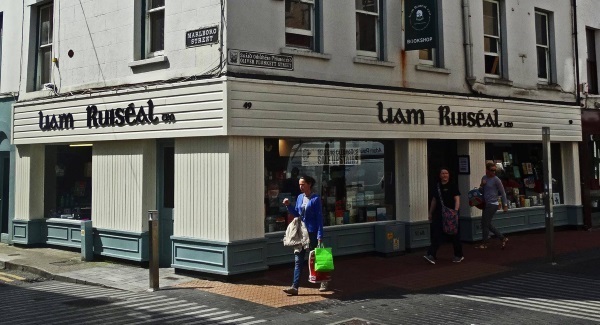
After 101 years, Ruiséal’s Bookshop, which like so many others I visited nearly every time I came to Cork, will be soon be closed. With it goes three generations of family history and a staggering degree of expertise on books in general and in particular rare books about the south of Ireland.

Breda Casey, grand-daughter of the founder Liam Ruiséal, is blaming high street competition and internet sales.

Meanwhile in Dublin, Walton’s Music, which first opened in North Frederick St 95 years ago, announced this week it was leaving its South Great Georges St shop due mostly to rising rent.

Famous as the location where ‘Falling Slowly’ in the film Once was filmed it is slightly less well known as an important component in the budding relationship between myself and the husband. He bought a fiddle and I bought a mandolin. Sweet harmony was envisaged but the clamour had to be stopped by friends and neighbours on medical grounds.

After listening to me moaning, my local independent organic greengrocer at Eco Logic in Dublin’s Windy Arbour warned against sentimentality: “Walton’s is not closing, it’s still open in Blanchardstown. If you buy a double bass you want to load it into the back of your car,” said John Dunne.

Yes, but what happens to city and town centres if retailing moves out of them?

“Maybe places become different”, he says. “Maybe Clery’s is a gym. People want to keep gathering in areas so maybe let them gather for open-air shows. People love walking. Give them something to walk around.”

He doesn’t see a role for national or local government in helping to retain independent shops in our cities, towns and villages. He says what’s important is providing service which can’t be replicated in a big chain.

The essential ingredient is your relationship with the customer, he says: “Can you get me such and such?” or even “I’ll pay you on Friday.”

Exceptional customer service and depth of knowledge couldn’t save Walton’s or Ruiséals in their city centre locations, though. Obviously books and music are in a different space than is food, one which is far more threatened by online sales.

Nobody sane would support any attempt to keep shops from moving with the times. But if all our independent shops interpret moving with the times as moving to the burbs or closing down, what will be left of our city and town centres?

When Walton’s opened its music shop in Dublin’s South Great George’s street the place was semi-derelict. Now it’s an extension of Temple Bar. Similarly, Ruiséal’s must have played a big part in the development of Cork’s Oliver Plunkett St so that it beat off rivals in London and Liverpool in 2016 to win the Great Street Award from the Academy of Urbanism and is now evolving as the hub of the new Plunkett Quarter.

Without shops like Waltons and Ruiséal’s, you’re left with strips of bars and coffee bars and restaurants. If that were enough to provide a satisfying experience of urban life Cork City Council would not have moved to restrict the stall-holders in the English Market to encourage artisan food producers. In return, stall-holders get long-term, favourable leases.

Retail Excellence Ireland cites the market as an example of what a controlled zone favouring the independent retailer looks like. I think it looks great. It not only looks great, it hugely facilitates local urban dwellers. The thing we’re not factoring in here is what quality of life is left for people who don’t wish to drive or can’t drive if they can’t buy decent food in city, town and even village centres.

It was facing into this abyss which led a group of residents in the village of Courtmacsherry in West Cork to found Courtmacsherry Community Shop 18 months ago after the only local shop had closed down. The group did research which told them there would be a good market for shares in a local shop. When the shares were taken out, they got a team of volunteers in to refurbish the old post office.

They stocked it with fresh baking, daily essentials, second-hand books, crafts and more. They bought an ice-cream machine, put chairs outside, sold coffee and provided information with a smile to tourists. The shop is described as “the community hub.” For what is a village without a local shop?

A staff of volunteers is a wonderful thing and perhaps a necessity in a small village but it is clearly not a business model you could repeat indefinitely.

People must help themselves, of course. There have been good experiments internationally with town and city collective branding, loyalty cards and vouchers. But surely there should be more help from Government to keep independent traders in city, town and village centres?

I THINK national and local authorities must explore strategically capping rents and limiting rates for independent retailers in city, town and village centres.

These shops are essential for sustainable living, as envisaged in the National Planning Framework. They are also essential in lots of intangible ways. They offer occasions for communication. They offer a sense of community.

They are every bit as important to our tourism industry as parks and waterways and raised bogs and woodlands. They are part of the human eco-system.

Maybe Ruiséal’s, with its wonderful frontage onto Oliver Plunkett St, should have become a book-café hosting regular events but officialdom should have worked harder to keep them there too.

Their business is their business but what’s gone is much more than a shop and that’s our business too. If, as Niall Walton said this week, independent shops offering personal service can no longer trade in city and town centres, “People have to think about what they may lose.”

x

More in this section

Revoiced

Newsletter

Had a busy week? Sign up for some of the best reads from the week gone by. Selected just for you.

Cookie Policy Privacy Policy Brand Safety FAQ Help Contact Us Terms and Conditions

© Examiner Echo Group Limited