National Planning Framework should seek to end a legacy of poor development

e was only doing my hair but I’m that annoying that I told him where to go with his life: “Waterford.” It wasn’t as blunt as that. I offered alternatives, such as thriving towns like Killarney and Westport.
The main thrust of my argument, as he attempted to assert control over my locks in a downtown Dublin salon, was: “Get out of this city. You won’t be able to afford a decent standard of living here. There are other wonderful cities and towns in Ireland and they all need hairdressers. Go there.”
He’s been loving Dublin since he arrived here from the US last year on a passport achieved by way of a granny from Ireland. No argument there. Dublin’s a fabulous, diverse, lively, exciting city — to visit.
It’s not a place where a young person on a relatively low wage should consider settling down and starting a family with his partner who, as a masseuse, is also on a relatively low wage. Particularly as they have no roots in Dublin, which is lucky for them, because that’s when the pain of separation bites.
The young couple enjoy their work because they enjoy the one-to-one relationship with clients. They know, however, that because you can never treat two, much less 100, customers at the same time, it is inevitable that they can never earn really big bucks if they stay in their careers.
The upside of their jobs is that their skills are needed everywhere and can’t be centralised or globalised. I saw them renting a lovely flat in Waterford for perhaps €800 a month and if they liked the city, perhaps saving to buy a home for less than €200,000.
I saw their children going to wonderful local schools. I saw them spending their weekends on the beaches of Tramore and Annestown and exploring the Comeragh mountains. I saw them popping up to Kilkenny to wander around of a Sunday. I saw them hopping down to Cork for a dose of shopping and culture. Meanwhile Dublin is only two hours away by train.
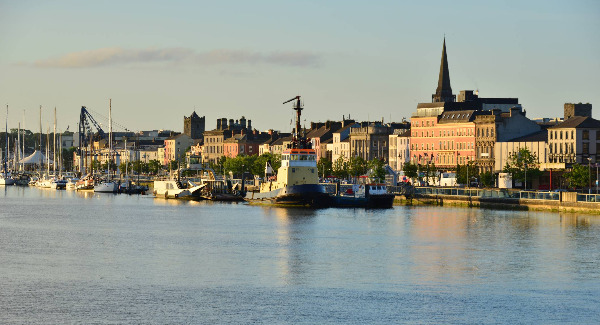
Waterford is beautiful. It is sitting there on its impressive docks, with its medieval quarter and its Georgian grandeur, just waiting to happen. It is still waiting to happen because of poor infrastructural planning since the foundation of the State, particularly in the last couple of decades when we could have made different choices.
I mean, look at the magnificent Waterford Institute of Technology, just over 4km away from the city centre, where there are numerous potential sites and vacant buildings? Look at the Déise Greenway, which opened last year and runs from WIT the whole way to Dungarvan but not yet from Waterford city to WIT?
This legacy of poor development is why we need the National Planning Framework, Ireland 2040, to be adopted in full by the Government tomorrow. The plan is bang-on in planning for the development of our “second-tier” cities and particularly what you could call our “third tier” cities — Waterford and Limerick.
Without a network of thriving cities, the wealth of this country is going to continue to be concentrated in Dublin, leaving young workers like my hairdresser with few attractive options.
It is the essence of idiocy to say that strong regional cities will impact negatively on rural Ireland. The opposite is the case.
We need concentrations of resources because concentrations create synergies which create jobs. We need concentrations of people because that is the only way we can economically provide adequate services, such as schools, hospitals, cultural activities and public transport.
In the words of the DCU economist, Edgar Morgenroth, one of the researchers who worked on Ireland 2040: “Without big cities in the regions, those areas that are not close to Dublin are simply going to continue doing quite badly and that’s what they’ve been doing.”
We can’t continue to rely on transport by private car because that would be socially unjust, particularly in ageing society, and environmentally unsustainable, in a country where transport emissions went up by 13% in the last four years, and will cost us dearly in fines exacted by the EU for busting our 2020 emissions targets.
The draft development plan, Ireland 2040, proudly and bravely faces this country into a future in which the population of the island will grow to pre-Famine levels.
It plans for 40% of new building to take place on brown-field sites in existing built-up areas, concentrating our people first in our cities, then in the existing centres of our towns and villages.
It proposes a new National Land Agency, which with any luck will be instituted tomorrow, which would be empowered to use State land to progress the framework and legislative changes to make compulsory purchase orders easier in the national interest.
Ireland 2040 mounts a full-frontal attack on sprawl. But sprawl is embedded in our culture.
When Minister Michael Ring professes himself happy with changes to the plan to favour rural Ireland because “people want to see jobs in rural Ireland and people want to live in rural Ireland”, we should be very afraid. Wanting to “see jobs in rural Ireland” does not create any, except for politicians representing rural interests.
The fact that Leo Varadkar went against the advice of the plan and announced the new M20 motorway between Limerick and Cork should make us very angry. Experts like Dr Morgenroth say developing the motorway before the cities are sufficiently scaled will create sprawl between them and undermine the National Planning Framework from the start.
A network of thriving cities must be the main focus of job creation if there are to be any new jobs in rural Ireland.
Cork, “emerging as an international centre of scale”, needs to grow by about 115,000 inhabitants by 2040 and a new innovation park to the west of the city is envisaged. Galway is already growing rapidly.
y contrast, Waterford and Limerick need to be turbo-charged. The plan would deliver for Waterford a new regeneration scheme for the quays, a link from the city to the Déise Greenway and perhaps a much-needed new technological university. Limerick’s city centre would be regenerated and linked to its docks, the city would have a public transport system and a major cycling network and the university, wrongly placed outside the centre, would expand and link with other third level provision and the city itself.
We await our fate. Tomorrow’s announcement of the finalised National Planning Framework will tell us whether or not this Government and the opposition on which it depends put no higher price on the sustainable future of this country than their own comfort in office.
People like my hairdresser and his wife, if they are prepared to work hard, deserve to be able to settle down and raise children with ease in a country as rich as Ireland. They deserve politicians who stand up for them.

CONNECT WITH US TODAY



Be the first to know the latest news and updates