Body language ‘analysis’ is a futile gesture with nothing to tell us
Ivan Yates reaches over his head with his right hand and then pulls his hand back down.
“But what about that?” he asks, doing it again. He looks like he’s pulling the overhead chain of an old-fashioned toilet.
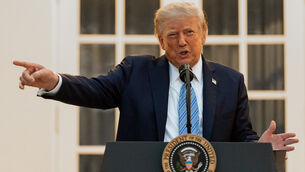
The point he’s making is that this is a Donald Trump gesture. A gesture of some significance. Body language, he says.
He is suggesting that Trump, a man whose right hand doesn’t know what his left hand is doing, might nonetheless be a master of the subtle dark arts of gesture.
Bit like suggesting that Michael O’Leary might do nixers as a mindfulness counselor.
I indicated that Trump’s use of the chain-pulling gesture during his State of the Union address wouldn’t make a ha’p’orth of difference to the outcome.
Ivan wouldn’t let go of the chain, though.
People who believe in body language are like people who believe in homeopathy.
Doesn’t matter how far against them the scientific evidence goes, they’re converts, tattooed with beliefs they cannot relinquish without damage to their self-esteem, although, to give him his due, Ivan’s self-esteem seems pretty impregnable.
Which is just as well, because advancing the idea that the State of the Union speech could, or should, be judged on body language is barking mad.
Of course, if Trump’s incongruously small hands repeatedly performed the same gesture during his speech — which they didn’t — this could have distracted from its content, thrust, and memorability. But that’s about the height of it.

‘Body language’ is the elevation of basic observation and subjective judgment into pseudo-science. The covers of any of the popular books on the topic sum up just how far they are from science.
While promising purchasers that they will never be lied to again (implication: The book will teach the reader to spot ‘tells’ that will reveal every time anybody utters an untruth to them) they are riddled with whatever-you’re having-yourself question marks.
One of the funnier visuals on the cover of a hardback currently on sale shows people in a number of poses.
The guy in the middle has his hands clasped in front of his scrotum.
‘Protecting his manhood?’ asks the caption, beside the illustration.
To which the answer has to be: “Well, yes, if you must ask the bleeding obvious.” Most of the deadly tells explicated in these books are simple, obvious, and usually wrong.
One of them is the guy with folded arms. This appears in one of those videos that pop up on the web, promising to improve your pitches and presentations.
The minute you see your boss seated, arms folded, with a face filled with thunder, you need to stop and ask him why he is so hostile, as revealed by his body language.
According to the pseudo-science of body language, the minute you see folded arms, you are doomed. Folded arms are a dead giveaway. If members of an audience fold their arms, you’re done as a speechmaker.
Never mind that, at any given time, some members of every audience fold their arms. Never mind that it may be caused by a myriad of factors unrelated to you, like the air conditioning being too cold.
Never mind that looking out for arm-placement may distract you from much more relevant information, like the
mutual glance between audience members that says: “Did you ever hear such a load of...?”
Any good actor will look askance if asked in rehearsal to first assemble their character’s body language, because body language is an inevitable outcome of character, not the precursor.

The late Donal McCann, playing a British officer in a Boucicault melodrama, conveyed his formal shyness on the first night by rising slightly on his toes when his character was under pressure. It was odd, idiosyncratic, funny.
Nobody had ever seen a shy person do it. It simply emerged from his understanding of the man he was playing.
It showed up on the first night to the fury of the other actors in the show, not because McCann was a scene stealer — although the other performers clearly believed this was the reason — but because it was only then that the totality of the character came together for him.
Communications consultants tend to find body language surfacing in two areas of their business — or I do, anyway.
The first is where customers want to be taught it. For example, someone who has little real confidence in themselves will want to know how to enter a room or behave at a meeting in a way that bespeaks authority.
This is where the consultant can refer the client to a therapist to address their self-esteem issues, or simply train them in the behaviours that will help make others take them seriously.
“Stand up straight, meet their eye, shake their hand firmly, don’t fidget, and stop licking your lips,” would summarise most of these behaviours, but, oddly, getting people to internalise and deliver takes time and practise.
The second area where body language turns up is when the media want to prove that someone — usually, but not always, a politician, is lying — and use any number of readily identifiable ‘tells’ that will reveal all.
Up goes footage of the subject inserting a finger inside their shirt collar, clearly discomfited by their own lying. Gotcha.
Or footage of the subject’s leg bouncing as if they were listening to a Sousa march. Or footage of the subject putting her hand over her mouth.
A ‘body language expert’ will always be available to claim any one of these indicates that the subject is lying. Which is complete nonsense.
Men insert their fingers inside their shirt collars, as if to loosen them, for many reasons, including recent weight gain.
Each one of us knows someone who has a rhythmic leg we’d love to amputate. Its constant jiggling has no relevance to the verity of what its owner is saying.
Putting a hand over your mouth is a similar irrelevancy.
Even if someone demonstrates all three simultaneously, then what is illustrated is that the person is nervous and under pressure — as is likely when a politician goes on mainstream mass media.
That’s not to say that a physical behaviour cannot be outed as false.
The 19th century neurologist Guillaume Duchenne worked out that when someone is only pretending to smile, they don’t get bunching under the lower eyelids, as the cheek rises and creates pressure.
It is possible, therefore, to state with certainty, when examining a series of photographs, which are genuine and which are false smiles. Useful? Not terribly.
The other revealing body language was identified by the FBI.
Looking at closed circuit footage of accused individuals in prison cells, and matching the footage to the history of each case, they found an odd and interesting pattern.
Innocent people, left in a cell for a couple of hours, paced and fidgeted and even cried.
Guilty people went to sleep.