Lewis Hamilton forced to make a quick U-turn after post about nephew
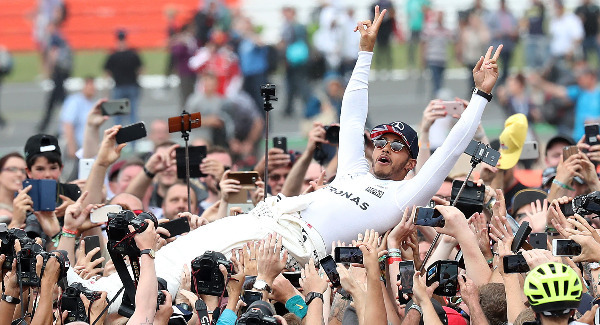

Poor Lewis Hamilton. I hardly knew who he was up to a few days ago but then the Formula One world champion hit global headlines for an interaction he had with his little nephew on Christmas Day which he posted online.
I suspect he’s taken himself off to an exclusive retreat for the New Year to recover from the mental trauma caused by the monsoon of rage — “disgrace” and “a moron”, are just a few of the insults directed his way — when he asked the small boy, on camera, why he was wearing a princess dress.
Immediately the outrageometer hit a peak reading. A gender shaming alert went out around the online world which exploded into a paroxysm of outrage. It’s didn’t help poor Lewis that the “incident” occurred during the slow news period that usually surrounds Christmas Day.
Of course he shouldn’t have said what he did, and if it were my child he’d said it to I’d give him a good clip around the ear and an advisory chat about children and gender development. It should be stated that while he said the wrong thing, the exchange was conducted in a friendly and affectionate manner. As it is, he seems out of kilter with his sister’s approach, since she clearly has no issues with her son exploring where he stands on the gender spectrum.
But there’s no such thing as a quiet word in this digital age of exposing and shaming. It’s a competition for who can get the most viscerally outraged — where the self-righteous rage goes round and round in ever increasing digital circles.
After bringing so much opprobrium down on his head, Lewis had the good sense to immediately call in the professional apologists to draft up not one, but three tweets of apology. I only wrote a few weeks ago about the shocking quality of the non-apology apologies given by the men caught out in their serial sexual harassment of women this year, but in sharp contrast Lewis gives very good apology.
He began with: “Yesterday I was playing around with my nephew and realised that my words were inappropriate so I removed the post. I meant no harm and did not mean to offend anyone at all. I love that my nephew feels free to express himself as we all should.”
He followed it with: “My deepest apologies for my behaviour as I realise it is really not acceptable for anyone, no matter where you are from, to marginalise or stereotype anyone.”
And finally: “I have always been in support of anyone living their life exactly how they wish and I hope I can be forgiven for this lapse in judgement.”
Now that is an apology that will be included in crisis management manuals in years to come. Sadly for Lewis he went on to spoil the impact by favouriting tweets that gave out about the “PC Brigade” who had gone after him.
This episode came hot on the heels of the news that US president Donald Trump had spent an estimated 40 hours tweeting in his first year in office. That’s an average seven posts a day. The Boston Globe, which analysed the US President’s time spent tweeting, estimated that if he only spent one minute on each post that would be nearly 40 hours — a solid work week for most Americans.
In the UK, the Brexiteers and the Remainers remain at each other’s throats in an argument that looks as if it will never have an end.
The outragers never try and persuade or tempt the other side towards their own view — it’s a case of disagree with me and you’re digitally dead to me.
As former US president Barack Obama told Britain’s Prince Harry in an interview released this week, one of the dangers of the internet is that people can have entirely different realities and they can be cocooned in information that reinforces their current biases.
“The question has to do with how do we harness this technology in a way that allows a multiplicity of voices, allows a diversity of views,” said Mr Obama.
“The truth is on the internet everything is simplified, but when you meet people face to face it turns out it is complicated.”
Funny I’m not sure I’d fancy meeting some of the raging ragers I’ve come across on the internet. During 2017, I felt the sharp brunt of the self-righteous brigade when I had the temerity to express sympathy for former tánaiste Joan Burton and her adviser, Karen O’Connell, for what happened to them during the anti-water protest in Jobstown.
Back in November, I was really happy to see Barry Walsh, a member of the Fine Gael executive council, resign from his position, given his penchant for his offensive tweets with a strong misogynistic overtones. But, whisper it, I also found myself feeling some sympathy for him in the end.
At the time, he accepted that he had caused serious offence and apologised unreservedly. He also hoped that the “trial by media” which he had endured and which had placed “intolerable pressure” on his family and friends would now end. I don’t think I’d ever fancy sitting down and having a coffee with Walsh. He needs to take a long, hard look at himself. But to bring a little perspective to the situation, he didn’t kill anyone.
We’ve a serious challenge facing our digital selves in 2018 though and that is the upcoming abortion referendum.
There is nothing that matches this issue in terms of bringing out the absolute worst in us all, as we shout down the other side. It would be a truly fabulous thing if we managed to remain in some way civil in our online discourse on the matter.
But to end on a far more positive note, and to prove that the world of social media can be a wonderful place to inhabit at times, it was a stunning thing to see the recent outpouring of love and hope for Cystic Fibrosis campaigner Orla Tinsley. Orla finally got her double lung transplant over Christmas in New York.
This amazing woman, even while on a life-support machine, kept reminding us via tweets of the importance of being an organ donor with the great hashtag #recycleyourself. The Irish Kidney Association tweeted that it has been particularly busy sending out organ donor cards in the run up to Christmas. Here’s hoping her recovery goes without a hitch. She deserves every single moment of good health she gets.

CONNECT WITH US TODAY



Be the first to know the latest news and updates