Abortion headache will contribute to political stability until next year
Imagine either of the two parties finding themselves with abortion as an election issue, writes Alison O’Connor

Abortion headache will contribute to political stability until next year

WHAT would happen if it was now Fine Gael was in the throes of a general election campaign using the slogan “Keep the Recovery Going”? They would do far better, that’s what. But Fianna Fáil would also do better.

The mood in the country has changed, and that isn’t as a result of this week’s budget, although it has contributed to the feeling of lift. We have been in a process of moving on emotionally. The scars remain, but we are beginning to trust in the future again, and feel less rage against the political establishment for the austerity years. This is clear from the opinion polls and the steady rise for the two main parties.

The mood outside of the country has also contributed to this seeming out of the familiar. Our politicians are benefitting from the contrast between themselves and our near neighbours. Sandwiched between Trump’s increasingly mad America, and what looks like the daily unravelling of the Conservative government around Brexit, they are made to look like political giants.

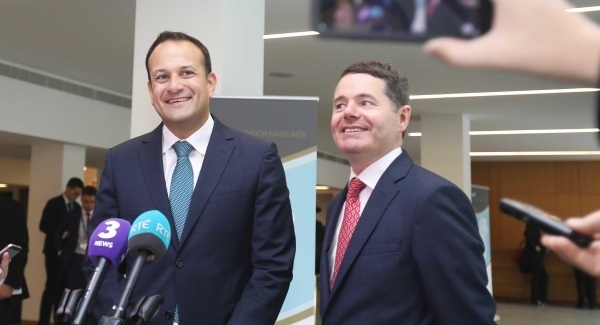
It is still too soon to tell what sort of political leader Taoiseach Leo Varadkar will make, but he, along with Finance Minister Paschal Donohoe, certainly passed his first budget test. Alongside that, Fianna Fáil and Micheál Martin passed their second one in this confidence and supply arrangement.

There is one more budget left in that arrangement. The pledge to hold a referendum on the Eighth Amendment next May or June makes it as politically certain as it can be that neither Fine Gael or Fianna Fáil will pull the plug before that. Imagine either of the two parties finding themselves with abortion as an election issue?

Given the two leaders in question — Varadkar and Martin — both would rather be poked daily with pins than face detailed questions on pregnancy terminations from journalists during a campaign, even a short one. In this they would have the full backing of their election candidates.

So, in a funny way, the issue which has consistently caused so many political headaches for decades looks set to be a major contributor to political stability over the next seven months or so. It will be intriguing to watch the political shapes being thrown during that time, as the reality of a general election draws closer, yet to be kept safely until beyond the referendum on the Eighth Amendment.

In the aftermath of the budget, there was the predictable squabbling between the two parties. Varadkar described Budget 2018 as “an expression of our values and aspirations for our country” and a “valuable statement of how our economy is doing”. Martin, meanwhile, made it clear that it was his party protecting the less well-off and curbing Fine Gael’s worst instincts to favour high earners. The inarguable fact remains though that the two parties were the main collaborators in this Budget and showed great co-operation in working together.

It’s difficult to see the broader electorate having too much of a difficulty with that. Indeed, there is an argument that the manner in which the two parties have worked together since the agreement was struck in mid-2016 is in part responsible for their good showings in opinion polls. The most obvious beneficiary is Fine Gael, since they are in government. However, if matters were to continue as they are until this time next year, Fianna Fáil will be able to claim a serious amount of kudos for behaving responsibly; being seen to make some reparation for the great recession; as well as claiming to have curbed Fine Gael excesses. Last week’s Irish Times/Ipsos MRBI showed Fine Gael at 31% and Fianna Fail at 29%, near enough as not to make a difference. Combine the two and they’re at 60%, a significant improvement from the 2016 general election result, and a further indication that Irish political support is returning to the centre.

Such a scenario makes for an intriguing prospect facing into our next general election. We don’t know that their support levels will keep climbing. How will voters respond as Varadkar lays out more of his vision for his ‘Republic of Opportunity’ but points to the sense of “responsibility” underlying his first budget? Will people continue to warm to the Fianna Fáil message about spending on public services?

If the current political arrangement does last until the budget next year, the major issue facing the Government — and its most significant weakness — will be the housing crisis and how much progress will have been made by then. They will be open to attack, very legitimate attack, from all political rivals, and it would be bound to affect the party’s support. There will be no patience left by then for yet more housing “announcements”.

It was startling to hear Fianna Fáil TD Jim O’Callaghan say recently that he went to the Department of Environment website and, having narrowed down the search options, discovered there had been 230 housing announcements by the Government since February. Extraordinary when you consider the lack of tangible results in finding people affordable homes and the ever growing crisis.

Both main parties claim to be done with our traditional economic approach of “boom and bust”, and while admirable budget restraint was shown this week, next year’s budget will be framed with a general election in mind. If things keep going as well as they are the fact that we will have balanced our budget means there will be lots of room for manouvere under the EU rules. It is then we will see the sincerity of their words on the importance of fiscal responsibility.

That aside, this time next year it’s quite likely that the lunacy will be ongoing in the US and the UK. We can prepare to hear lots more of that talk about the importance of the centre holding. Of course we cannot rule out how things might change during a general election campaign, which we saw most recently with UK prime minister Theresa May and the Conservatives, and in our own 2016 election with former taoiseach Enda Kenny and Fine Gael. Other smaller parties would also get a profile boost during a campaign.

But, from this vantage, it is looking as if our flirtation with Independents was just that. Their success in the 2016 general election was as much about punishing the main parties as showing ideological preference. Following the budget this week, Transport Minister and head honcho of the Independent Alliance, Shane Ross, said his group had ensured the most vulnerable in society were protected. It’s clear, though, that as time goes on their political potency is diminishing.

So the two parties are almost even stevens at the moment, both are on the way up, the political moves in the months ahead will be interesting to watch.

x

More in this section

Revoiced

Newsletter

Sign up to the best reads of the week from irishexaminer.com selected just for you.

Cookie Policy Privacy Policy Brand Safety FAQ Help Contact Us Terms and Conditions

© Examiner Echo Group Limited