Budget is in the past — now it’s time to focus on the election

f the centre is growing, the feeding frenzy for more cake and eating it, is full-on. On Friday the Government led by Leo — in permanent campaign mode since he was in short pants — heads to Cork for a day-long cabinet meeting. The Fianna Fáil Ard Fheis opens in Dublin’s RDS.
Yesterday’s budget was well, yesterday. Politics is always about tomorrow.
The budget, apart from the facts of the matter, was a unique political achievement. The second in a series of three, encompassed by the confidence and supply arrangement between Fine Gael and Fianna Fáil, it represents the widest degree of political collaboration on core economic policy in the history of the State. Social partnership, excluded not just the opposition, it overrode the legislature and in the end marginalised much of the elected government. The Tallaght Strategy facilitated by Fine Gael under Alan Dukes did enable Fianna Fáil’s three budgets to pass between 1987 and 1989. But they were entirely on the outside. This is collaboration on agreed lines, if a lethally wary one.
The current political construct arises from one of three fundamental political decisions made since election day on February 26, 2016, by Fianna Fáil. Those decisions were not to enter government; not to allow for water charges; and come hell or high water not to go into Government with Sinn Féin.
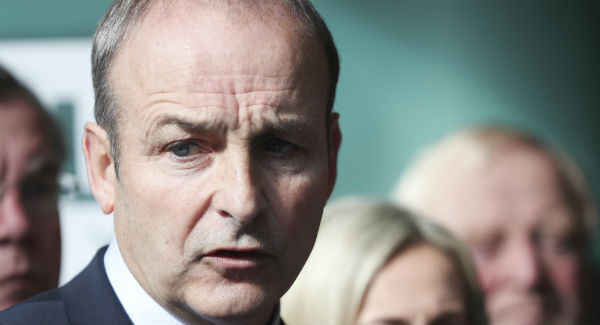
None were unanimous within Fianna Fáil but all are the choices Micheál Martin has made and will reckon with. In the way in which little things sometimes point to bigger ones, when Paschal Donohoe sat down yesterday, Áine Lawlor on the News at One said that Michael McGrath, Fianna Fáil’s “finance minister”, was speaking next. She was right. He is a quasi-minister. After a few perfunctory sentences about the budget, McGrath laid into Sinn Féin saying they are hurlers on the ditch. They had their chance at the formation of the Dáil but walked away.
The budget, of course, was moved forward to 1pm yesterday so that Paschal could occupy Áine Lawlor’s prime slot for an hour. From 2pm it was a battle to dominate the conversation and move ahead. There may be collaboration on the budget, but there is deadly political competition between the two big centre parties. The fact of Fianna Fáil’s central political decision not to go into government after the last election, and that the intervening period has been one of economic recovery means the political centre is a growing space. In opinion polls at least, Sinn Féin has been contained. Indeed it has paid the centre ground the compliment of applying for a clubhouse membership. That was rudely refused by Martin.
Fianna Fáil’s calculation, underlined by McGrath’s swift rebuke yesterday, is not that his party is in direct competition with Sinn Féin, though to some degree it may be. It is that there is no appetite, indeed little tolerance at the centre for Sinn Féin in Government. Therefore, to be on their case, is to be in more effective competition for votes which there is real rivalry for. That rivalry is directly with Fine Gael and some independents. The latter may well prove to be the meat in the political sandwich, which is a larger Irish political centre after the next election.
The third fundamental decision to walk away from water charges, is to allow Fianna Fáil compete again in urban constituencies especially Dublin. In the general election of 2011 the party was on 11% in the capital. A recent opinion poll had them on double that. An equivalent election result would put them in competition for a seat in the five of the 11 Dublin constituencies, where they currently have none. Dublin North West, a three-seater, will be challenging, but Fine Gael’s Noel Rock has lost red brick houses in Glasnevin and Drumcondra to Dublin Central. It’s all about positioning, about the terms of the conversation and candidate selection.
On Saturday night Micheál Martin will address the Fianna Fáil faithful. His personal ambition is to stage the greatest political recovery since Charles Haughey’s comeback after the arts trial. I doubt he thinks of it in those terms but the leap from the armageddon of 2011 to the taoiseach’s office would be no less a feat. Fine Gael have put their money, and as of yesterday, yours and mine too on Leo. In an election campaign which they say, probably rightly, will be presidential, Leo can out-debate and confound Martin, who they will portray as old hat and tainted. Leo resounds with a new Ireland, and is clearly a magnet for attention, the accentuation of which he attends to assiduously. Translating attention into political affinity is a metamorphosis that will be tested on Election Day.
For the first time, I think there is as high as a 50% chance of this Government, with Fianna Fáil’s help, bringing in a third budget. There is the fact that there is no public demand for a general election, and the likely consequence of serious blame attaching to the party or independents who cause one prematurely. This changes the game for Fianna Fáil and Micheál Martin. Time is an instrument of insidious potency in politics. By late 2018 or early 2019, Leo Varadkar will be either blooded by events or simply a figure of less novelty or both. The difference between old hat and new won’t be as clear. That will be doubled down on by the fact of a partially shared responsibility for government in the interim.
There is the question of which of either Fine Gael or Fianna Fáil ultimately benefits most from economic recovery. Everyone back in a job is potentially a recruit lost to the Left. People in work have a different perspective. The recovery of the political centre says as much. Catastrophic loss of reputation and seats in 2011 means Fianna Fáil is still behind the curve and Fine Gael remains ahead.
Time, I think, suits Fianna Fáil to play the game of catch up. Fine Gael actually had a good election in Dublin. Electorally it’s maxed out in the capital. It needs to recover its second seat in Munster constituencies and across the West. This is the effective challenge for Leo, to translate all that attention into affinity in Macroom, Mitchelstown and Bantry to regain seats around Cork, Tipperary and Kerry. That’s his mission on Friday. If there is no election until 2019, people will have plenty of time to think about it.
There is probably a year to go now before an election. No party will want one before an abortion referendum. Neither will want to be blamed for one whenever it happens. Micheál Martin, now has a real chance of becoming Taoiseach. That in itself is a remarkable feat. It is not that time is on his side, but politically he may be lucky enough to make time his friend.
Keep in close, tighten the margins, wait, and see.

CONNECT WITH US TODAY



Be the first to know the latest news and updates