Coalition in Dublin would be seriously damaging for Sinn Féin
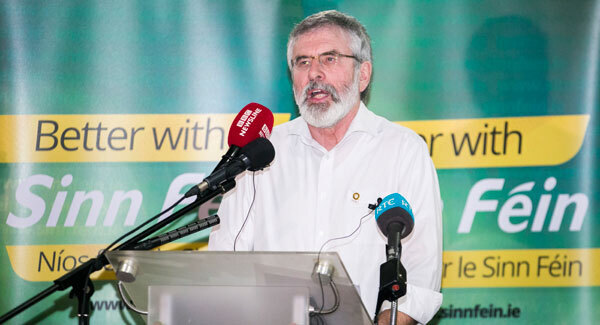
That’s about where Syriza in Greece was once. But that was then and this is now. It’s not simply that no battle plan survives contact with the enemy, and Adams understands that. It is more profound.
Sinn Féin is really a nationalist party, but not really a socialist one. It may have policy differences with the system so-called but it is fundamentally part of it, and is expert at operating it. Sinn Féin in 2017 is capitalist, careerist and compromised enough for government.
Out on the tundra of a self-defined left which either puts socialism before nationalism or eschews nationalism entirely, feeling runs between antipathy and disillusion towards Sinn Féin.
The antipathy is straightforward. Sinn Féin is not a left party in any sense. It is simply set to replace Labour as the next prop for the system Adams vows to change. His lines are Eamon
Gilmore’s rosé recycled as green.
Social democracy as a political tendency is now characteristically old, upholstered and irrelevant to the discomforted.
“It’s not possible to implement left policies when in coalition with establishment parties” was Joe Higgins’ immediate riposte to Adams yesterday.
Remember Right2Change before that last election? It was a shared platform for some trade unions and politicians.
It politically crystallised Right2Water and closely overlapped in personnel with Home Sweet Home which occupied Apollo House and much of the media for Christmas.
Sinn Féin wasn’t the leading light but it was politically the biggest entity and probably the leading electoral beneficiary. Some, including Solidarity, stayed out, distrusting Sinn Féin’s bona fides on coalition.
That sky to our left is now darkening with the wings of chickens coming home to roost.
If Sinn Féin’s left credentials are disputed, its nationalism is not. It may not be republicanism in a sense others could recognise, but it is their DNA.
It has decided, or those who make decisions within it have, that there is no imperative to resuscitate the institutions at Stormont.
They don’t feel an electoral pressure to do so in the North. They believe that Brexit creates an alternative dynamic.
A majority in Northern Ireland voted to remain. Unionism no longer has a majority. There is another longer game within the six counties and between that statelet and the United Kingdom it comprises part of.
Pushing within for a border poll as provided for in the Good Friday Agreement while waiting simultaneously on events that over time will loosen the internal bonds of British unity is their new long-term strategy.
The push for coalition in the south, is both a continuation of long evolving policy and accentuated by the lessening attraction of power at Stormont.
The DUP, reacting to its own imperative requirements, may ultimately make it practically impossible for Sinn Féin to stay out. But it is now a matter of tactic not strategy for Sinn Féin.
The peace process for complex reasons — and some were reasons of necessity — was and remains a sincere commitment for Sinn Féin.
The Good Friday Agreement was always a more refined calculation. It should be remembered that on the day it was arrived at, Sinn Féin did not immediately assent.
They had to consult. That process of consultation within a movement of which the party and its structures are not the full summary, continues.
Deepening equivocation about power sharing runs parallel with solidifying intent on a border poll; as provided in the Good Friday Agreement.
That was repeated yesterday by Adams, as something sought now within five years.
The problem, however, is fundamental. It may be tenable over a longer term and in different circumstances, but now and in the foreseeable future it would be a sectarian headcount.
It would, like the IRA campaign waged over 30 years, push back the prospect of a United Ireland.
It would deepen unionist fear and hostility. It would be a fundamentally wrong turning away from the methodical engagement required over a generation, in power sharing institutions.
It would rashly ignore the value of time, in changing circumstances. Tragically and perhaps dangerously it would rashly misinterpret current circumstances themselves.
The loss of a unionist majority is significant but not itself transformational. For a border poll in the future to be tenable, it is not sufficient to have nationalist votes, there must be a significant body of unionist votes too.
That is not possible now, and would deepen the trenches rather than coax anyone out of them. A view of Ireland as a 50% + 1 politic, is the ingrained but malformed lesson of living too long in a nationalist ghetto.
It profoundly misunderstands how working majorities are found and kept together.
In a party that decries partitionist attitudes in the south, to the extent that in reverse it comically questions the bona fides of those having a mandate only in the republic presuming to comment on the North, it replays the attitudes which once underpinned Articles 2 and 3 of the Constitution.
Their removal and the abandonment of irredentist claims were not simply foundational for the Good Friday Agreement. Their removal was intended to be the basis of a new conversation on the island. A border poll now would be the abandonment of that conversation, not a meaningful engagement with it.
It is probable that Gerry Adams wants to step away, as distinct from go away. The untimely death of Martin McGuiness must have changed circumstances. But my view is that Adams will be sorely missed by Sinn Féin.
The structures of the party are not coterminous with the leadership of the movement. Talk of taking orders from an army council is nonsense.
But the overhang of history continues in the sense that the importance of some personnel is not underpinned by any important office they hold.
Those elected to public office are not necessarily important people at all. Keeping this intensely disciplined ecosystem together in very different political habitats north and south will be very challenging.
Electoral success means that the future inevitably slips into the hands of people who have no share in the past which defines the movement and the party. That may offer more electoral success, but it insidiously replaces mimicked military discipline, with the careerism natural to politics and now evidently emerging in Sinn Féin.
And Adams had electoral appeal. The whiff of cordite was perfume for the base. There is no certainty that, that this base can be held intact indefinitely.
Coalition in Dublin would surely fray if not fracture it. That is certainly the view and the hope of those competing on their left.
What is more puzzling now is the reticence, and lack of opportunism, of either Fianna Fáil or Fine Gael in dealing with Sinn Féin. I can’t imagine anything more damaging than government for them.