Marriage of convenience could see Michael D return to the Áras
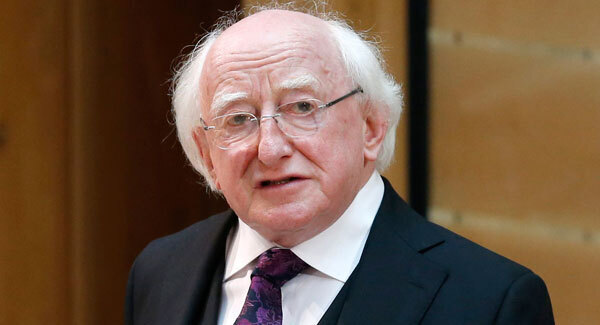
‘IT ISN’T my intention to serve a second term, I look forward to this one that I am beginning,” came the response from the stage to my question.
Deep in the bowels of
Dublin Castle on Saturday, October 29, 2011, newly elected President Michael D Higgins took to the podium to address the media in his first press conference, just moments after his election victory was announced.
After an overall race that had been bruising, nasty, and at times puerile, and which had seen the earlier frontrunner Sean Gallagher implode just shy of the line, I asked the new President what his toughest moment of his own campaign was.
I also asked him whether he intended to stand for one term or whether he was considering a 14-year stay in Áras an Uachtaráin.
He gave the answer quoted above and ever since, the political system and the
public at large has accepted that Michael D would be a one-term incumbent.
But, with the end of his term just over a year away, questions are already being asked about who is next.
In recent times, there has been increased speculation that Michael D is interested in running again, notwithstanding his initial comments in Dublin Castle.
And as Juno McEnroe and I have reported in recent days, there is growing support for him to do so.
The Labour Party has made it clear it would fully back the President, should he decide to carry on.
Now 76, the President clearly has enjoyed his term of office so far and it is clear a majority of Irish people
consider his presidency a success.
He has humoured us with his casual photobombing, his queuing for the ATM, his continued support for League of Ireland soccer, and, most of all, the eloquence and decency he has shown in the role on occasions big and small.
Young people admire his eccentricity while many older people respect his passion for the arts. He has also won many admirers for being willing to push the very strict limits of his office, appearing at times to criticise government policy without actually doing it.
Let us not forget that more than 1m people voted for him last time out. Yes, one million people.
Opinion polls in newspapers have repeatedly shown a public desire for him to continue in office. One poll in the Irish Times showed a majority of 58% favoured him serving for 14 years, which would see him in office until the age of 85.
When Ryan Tubridy put it to him on the Late Late Show on 2016 about looking like a man who was considering a second term, a warm round of applause from the audience erupted.
In response to what he called “an honest question”, the President said he would not make up his mind until 2018. “When I make up my mind it will be my decision, and my decision is my decision and I am not blocking anyone’s decision. I will make an announcement at the appropriate time,” he said.
The truth of the matter is that the political establishment in Leinster House is convinced Michael D wants another term, but is unsure whether he has the desire to face another election.
This dilemma has led some to say that it would suit both Fine Gael and Fianna Fáil to back Michael D for a second term, rather than put forward one of their own members to contest an election. The main reason for this is money.
Elections cost money and estimates range from €500,000 to €750,000 and beyond, depending on who you ask.
Next year is likely to see a general election and every penny counts, especially when the last election was only in 2016.
Backing Michael D saves a fortune and, given how poorly the Fine Gael candidate in 2011, Gay Mitchell, performed, many Blueshirts are quite happy to skip it when more important things are in the mix.
A further complication is the promise of the referendum on the eighth amendment at some stage in 2018, as promised by Taoiseach Leo Varadkar.
Such a campaign is also likely to drain the resources of the parties less than a year before the local and European elections in 2019.
The bottom line is that a second term for Michael D makes financial sense, and most, if not all, of the parties can live with him.
The feeling is that with Fine Gael, Fianna Fáil, and Labour all backing Michael D, or at least willing to not oppose him, then the other parties will fall into line, as none are likely to put
forward a candidate who could win.
Just look at the very flattering things Varadkar said about the president when the issue of him seeking a second term was raised recently.
One fly in the ointment is the recent declaration from Independent senator Gerard Craughwell that he would stand as a candidate in order to force a contest.
Insisting he would stand in the glorious name of democracy, Craughwell said the presidency should not be
the exclusive choice of the political parties.
“Seeking nomination for President. I have no money, I was late to education, I’ve struggled all my life. Yes I’ve no chance but democracy, yes, democracy demands that all presidents should be elected not agreed between political parties,” he wrote on Twitter.
Craughwell later told RTÉ radio that while Higgins was doing a good job as President and he admired him, the President had stated he would remain for one term.
“Promises were made during the last election. Politics are being debased by broken promises. A promise was given — one term,” he went on.
While Craughwell’s pitch is understandable, most within politics are not buying his commitment to democracy, choosing instead to see it as a stunt motivated by self-interest.
“Always beware a politician who claims to be acting in the name of democracy, it is normally horseshit,” one rather cynical minister told me this week.
Whatever his motivation, Craughwell’s demand for an election is certainly not the consensus view among the political class, which has been rightly annoyed by his announcement.
He will probably feel that is the reaction he is looking for, but just how serious
can he actually be if, as he says, he has no money and no chance?
The other major attraction for not blocking Michael D was just how bitter the
overall 2011 campaign got. The attacks on Mary Davis for being a “quango queen” were mild compared to what Dana, David Norris, Sean Gallagher, and Martin McGuinness were subjected to. Gay Mitchell escaped as he was utterly irrelevant to the campaign, despite being the choice of the most popular party in the country at the time.
If that can be avoided, then most, not all, would be quite OK with that.
Democracy may demand
a full and open contest in 2018. But between Michael
D Higgins’s apparent desire to continue on (according to the widespread belief in political circles) and the clear desire among the
major parties to avoid an election, then a marriage
of convenience may be
arrived at.