From Charlottesville to direct provision, racism still persists

When President John F Kennedy entertained Nobel Prize winners at dinner in 1962, he remarked: “I think this is the most extraordinary collection of talent, of human knowledge that has ever been gathered together at the White House, with the possible exception of when Thomas Jefferson dined alone.”
Regard for Jefferson runs deep in the US. He is a primary author of the Declaration of Independence and the third president of the US, but a slave owner. He is also the great claim to fame of the town of Charlottesville, Virginia. The
exquisite taste of his nearby estate of Monticello is a monument to
neoclassicism, a manifesto in architecture of an age of reason. But high principles subsisted in
Virginia on an economy dependent on slavery. When Kennedy spoke
in 1962, much of Virginia was still segregated. General Robert E Lee’s statue was secure on its pedestal in Charlottesville.
There are several strains of
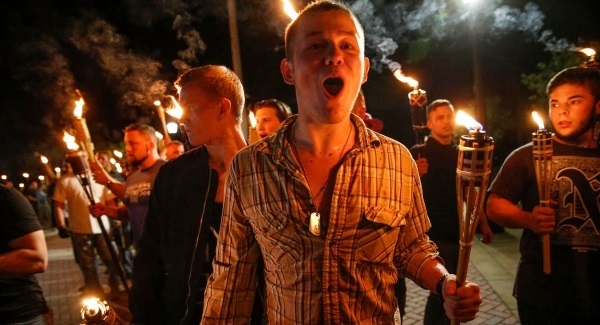
insecurity and hate emanating as neo-Nazism and other pseudo-ideologies in Charlottesville. One underlying question is whether
the political nation and the people encompassed within its territories are the same. For much of history, the answer is obviously not.
Women were systematically excluded. People of different colour or race were often barred. In the US, there is a panoramic history of high idealism, slavery, civil war, and mass immigration from the four corners of the earth, not least from Ireland.
In Jefferson’s Monticello we can see the style of great Irish houses including Castletown, Carton, and, perhaps especially, Lord Charlemont’s Casino at Marino. We might remember, too, that those monuments to enlightenment had foundations in a political system which systematically excluded much of the surrounding society.
Early in the 18th century, William Molyneaux blazed an ideological trail for an independent Irish parliament, based on the rights of nations, but defined that nation in Ireland as that of the conqueror. In his words: “The English and Britains… retain’d all the Freedoms and Immunities of Freeborn Subjects; they nor their Descendants could not in reason lose these, for being successful and victorious;
for so the State of both Conquerors and conquered shall be equally slavish.”
Drafting the Declaration of Independence in 1776 was the summation of Jefferson’s life. “We hold these truths to be self-evident, that all men are created equal, that they are endowed by their Creator with certain inalienable Rights, that among these are Life, Liberty and the pursuit of Happiness” — these are ideals which echo through the ages. They are as fundamentally disquieting in Charlottesville
now, or at least for people who would use its streets as their parade ground.
Six years after Jefferson wrote the Declaration, Henry Grattan
secured an independent parliament in Dublin. Catholics did make
advances under the new arrangement, but universal truths did not equate with radical equality. The political nation and the general population was not the same. Most people do not live in great houses, or in a utopia of high ideals. Life is grittier.
Genuine horror at the blatant displays of racism in Charlottesville is well founded. In an American context, there is a realisation that entrenched forces of nativism and racism have not gone away. In Donald Trump, they have a surrogate. It is unclear how far they may go. It is fearful to think of. It is as much a reaction to the fact of a black president as a decision to remove the statue of Robert E Lee.
Our reaction here is an add-on to apparently general aversion to Trump. It reminds me uncomfortably of Diana-style outpouring of public grief on the death of Nelson Mandela in 2013. The Immigrant Council of Ireland had then recently reported an 85% increase in racial incidents that year. This
increase came on the back of an awareness campaign it ran on
public transport and suggests a latent, under-reported underbelly of hate crime. The council has just relaunched a similar campaign.
A requirement to register all hate crime on the Garda Pulse
system notwithstanding, the strong belief is that there remains a
massive under-reporting of racially based incidents here. We exist in a different historical context, and are, I think, largely free of the
poison of far-right pseudoideologies, but this is a racist society.
Ours is not a country where people of a different colour cannot drink from the same water fountain or sit at the same lunch counter. It’s much subtler than that, of course, but the more pernicious for it.
It is just four weeks ago yesterday since the Child Law Clinic at University College Cork published a disturbing, excoriating report on children aged 8-17 in the direct provision system. We house nearly 5,000 asylum seekers in direct provision, 25% of whom are under 17. They are almost all people of a different race and colour. Like the death of Mandela and the sight of neo-Nazis marching in Charlottesville, there was an explosion of
public feeling. Outrage in this instance. But not so much as could survive in fine weather, or lead to any apparent action.
After the American Civil War, when everything changed so it could remain the same, life went on as it had for a long time in Charlottesville. The civil rights movement was the next American revolution and Martin Luther King’s ‘I have a dream’ speech is that country’s most important statement of principle since Jefferson’s Declaration. What remains contested in Molyneaux’s words is whether “conquerors and conquered shall be equally slavish”. For some freedom is diminished by equality. Molyneaux and Jefferson were enlightened in their time and pushed out the boundaries of liberty. We are, however, heirs to their ambiguities.
By way of postscript to the civil rights which so disturbed the old south, we might especially recall here the 1965 Immigration and Nationality Act. It ended an American preference for white immigrants. President Lyndon Johnson signed it into law at the Statue of Liberty. Nearby Ellis Island calcified into a memorial for Irish immigration but shuttered the reception centre it had once been. Our current issue of illegal Irish immigrants in the US some 50 years later is a carryover of those events. They permanently disturbed a squalid underbelly of the otherwise splendid Jeffersonian settlement.
Last week, that recurring disturbance recalled implacable bigotry to the streets of his Charlottesville. We might reflect, too, that part of the legacy of Irish migration to the US was co-option of institutionalised racism our immigrants found there and which echoed the vicious social calibration we learnt to impose at home.
Kennedy dined with the great minds of his time a year after Tom Murphy’s play A Whistle in the Dark premiered in London. Mush O’Reilly, one of its characters, put it thus about ‘blacks’ and Muslims in Coventry: “One-way tickets back to the jungle for us, too, Har, if they weren’t here.”
It could be us.

CONNECT WITH US TODAY



Be the first to know the latest news and updates