We enter a period where the scale of change is going to outpace events
Grand-coalition would be a selfeating ebola, and leave its advocates more discomforted than ever, writes Gerard Howlin

We enter a period where the scale of change is going to outpace events

THERESA MAY announced on Monday that she will trigger Brexit on Wednesday, March 29. Early yesterday morning Martin McGuinness died; the union he so staunchly opposed is now imperilled at source.

Tonight, Enda Kenny will meet his parliamentary party, but there will be no imminent departure. Any disturbance to the status quo within Fine Gael would likely inflict most damage on those blamed for it. There is likely to be a period now of weeks, perhaps even months, when though apparently everything is changing, not a lot is evidently happening. It is likely to be a time, when unusually the pace of events, does not keep pace with the scale of change. But unstoppable change has begun.

At the lower end of that scale, and perhaps least consequential is a change of leadership in Fine Gael and possibly Sinn Féin. For now, Enda Kenny has control of events in Fine Gael. That will not last. It could be rudely interrupted by events. But barring an event, he is free to choose any point of departure this side of the summer recess in early July. To go further would be heroic but hubristic. It is not just that there would be sniping from the ditches, serious damage to Fine Gael would ensue.

There is a tipping point in the party between the desire for self-preservation, and a willingness to risk self-harm. And there is another consideration. If Kenny does not leave before the summer recess, he not only risks revolt — if he survives he is set to be the Taoiseach overseeing Budget 2018 in October. If he is the Taoiseach in charge of the budget, he could be the Fine Gael leader going into an unanticipated, but not improbable, election.

The death yesterday morning of Martin McGuinness underlines the issues facing Sinn Féin and especially Gerry Adams. Illness forced Mr McGuinness’s hand. But his death has quickened the pace. Sinn Féin may not be in direct competition for votes with Fine Gael, but a change in the leadership of one party changes the context for all in an election campaign. Change from Martin McGuinness to Michelle O’Neill in Northern Ireland has worked for Sinn Féin. The retirement of Gerry Adams from nominal, if not effective, leadership is inevitable and the question now, as it has been for nearly a year, is whether it happens over the coming months to put a new leader in place, before the next election.

He has until the autumn to decide. After that, while possible, it becomes less practical. Clearly, his designated successor is Mary Lou McDonald.

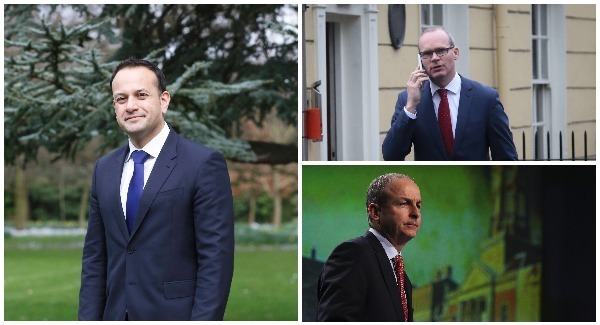
Another consideration for Adams, is not simply when to hand over, it is that in the next election he faces a different dynamic in leader’s debates. Brendan Howlin, if leading a much weaker Labour party, will be a stronger performer than Joan Burton. Either Leo Varadkar or Simon Coveney should put in much better performances than Enda Kenny, and Micheál Martin has form in leader’s debates. It won’t be business as usual.

There will only be two potential taoisigh in the next election, Micheál Martin and the new leader of Fine Gael. In 2016 Martin outperformed expectation. But context is important, and context will have changed.

For now, it seems Simon Coveney is most likely to succeed Kenny. Varadkar has calculated a political career, based on an overestimation of the importance of the media. It is not an uncommon mistake in politics, but it leaves you with more fans on the outside than friends on the inside. His chance to turn the tide will be at the party hustings. This is a new Irish dynamic, when effectively the most important office of State, as distinct from simply a party leadership, is decided in significant degree by the mass membership of a party.

It is highly questionable whether these electoral processes which are now general, will improve the quality of our democracy. But that is another issue. Suffice it to say, for now, it is a dynamic which remains untested.

Either Coveney or Varadkar should be able to put Martin under more pressure. But there would be a particular edge to a contest with Coveney. It’s a contested relationship, now in its second generation, as Martin and the late Hugh Coveney, were electoral opponents. And there is a particular, intimate Cork dynamic. It’s as much social as political. It has the intensity of a contest that is too knowing to be wholesome. Poll figures may favour Martin now, to emerge as leader of the larger party. But will Coveney or indeed Varadkar be able to change that dynamic, and stay ahead of Fianna Fáil on polling day.

Whoever, leads the larger party, will be well short of any easy options when it comes to forming a government. Certainly, the Left’s analysis is that a continuance of, or a flipping of the current arrangement between Fine Gael and Fianna Fáil would be tantamount to an admission that there is a permanent establishment, and elections change little. Therefore an increasingly disillusioned electorate should look to them for real change.

An alternative would be the grand-coalition fervently lusted after, by swathes of ‘responsible’ opinion. I could think of nothing more likely to permanently shrink the centre ground. The cultivated contempt for what is called new politics, apart from being intensely enjoyable to observe, fundamentally misunderstands the actual alternatives. Grand-coalition would be a self-eating ebola, and rapidly leave its advocates more discomforted than ever. It is exactly what is most wanted by the left, and Sinn Féin. For clarity, while there is overlap between Sinn Féin and the left, they are essentially different political movements.

This will be the test of mettle after the next election. Which of Fine Gael and Fianna Fáil is the smaller party, and will it, have the gumption to stay out? If not it will likely enter the food chain to be consumed. That is an objective analysis. The subjective one is that political parties are led by people who are unlikely to want to forgo their one go on the merry-go-round. Remember Eamon Gilmore?

The attendant issue is whether Sinn Féin would be prepared to enter coalition, or support one under terms and conditions. Coalition, I think not. Perhaps, however, specific terms and conditions for a defined period. Remember, the single biggest issue facing that party after the next election, is likely the capacity of a new leader to hold it together as the same intensely disciplined force.

Back in the real world, if Brexit is the big issue and the inherent loosening of union within Britain it signals, it was the star in the sky on the night Martin McGuinness died, the immediate challenge here is the central issue of public sector pay. The commission looking at it will report in May. Negotiations then begin. The outcome is the opening balance on budget day. As I said, the pace of events is not keeping up with the scale of change.

More in this section

Revoiced

Newsletter

Sign up to the best reads of the week from irishexaminer.com selected just for you.

Cookie Policy Privacy Policy Brand Safety FAQ Help Contact Us Terms and Conditions

© Examiner Echo Group Limited