Ireland’s neutrality has a security problem — and Europe is starting to notice
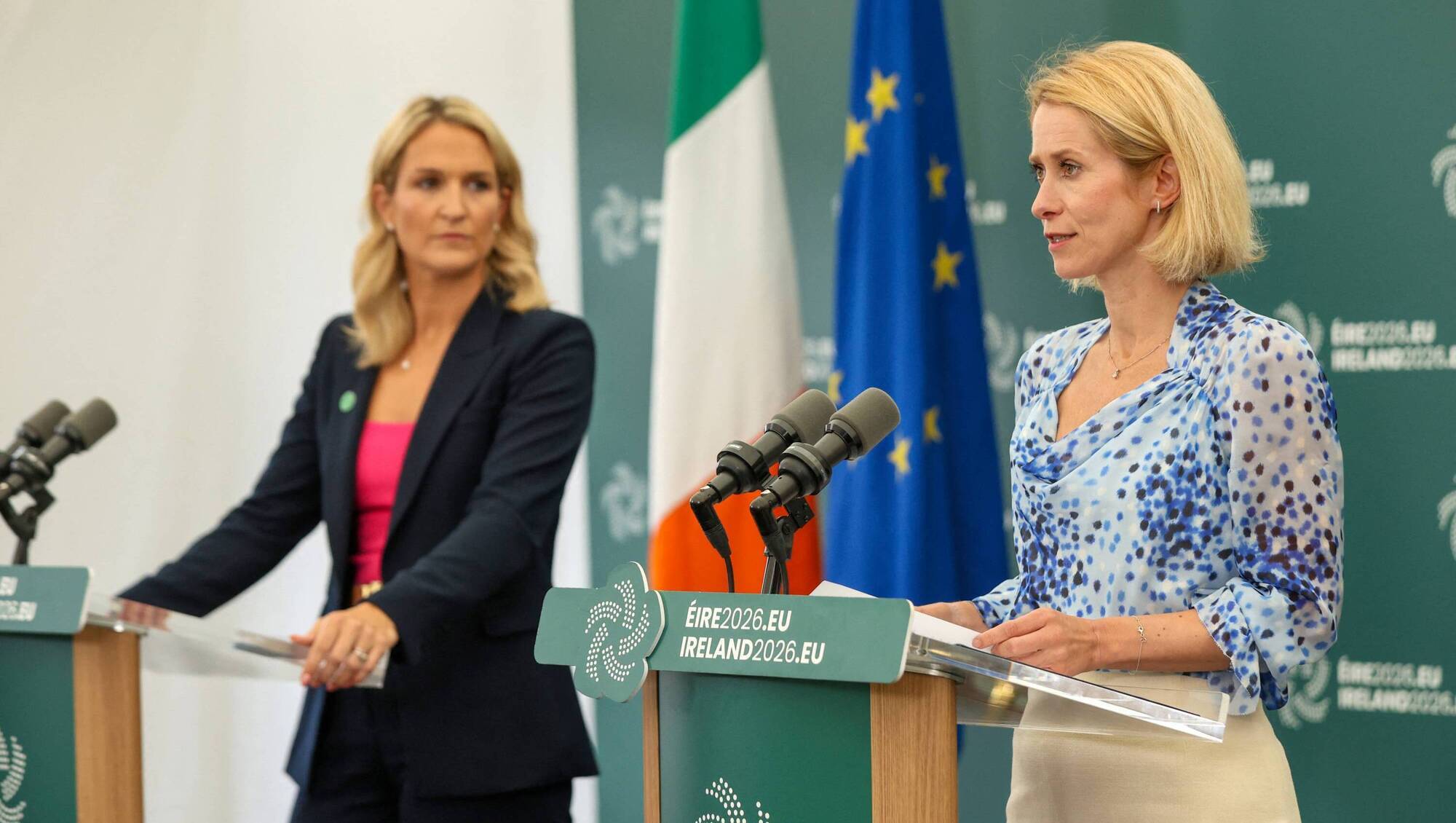
European Commission high representative and vice president Kaja Kallas (R) and defence and foreign affairs minister Helen McEntee during a meeting of EU defence ministers in Wicklow to discuss bolstering Ukraine’s air defences amid growing worries over Russia’s campaign to destabilise Kyiv’s European backers. Picture: Paul Faith/AFP
Being embarrassed by international media at a high-profile event during Ireland’s EU presidency is not what the Government wanted.
Having the EU’s foreign policy chief, Kaja Kallas, trying to bat off the topic as best she could made the embarrassment sting all the more.
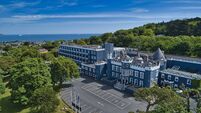
The event last Tuesday was the EU defence ministers meeting at Druid’s Glen Hotel, Co Wicklow, attended by the defence ministers of member states as well as senior representatives of Nato, the UN, the UK, and Ukraine.
The embarrassment coincided with a dramatic worsening of the security situation across Europe, with a succession of hybrid attacks in European countries in the previous 24 hours.
On Tuesday came the formal statement from the German government that Russia was behind a sabotage attack at Leipzig airport.
As they talked to the media before they entered the meeting, both Ms Kallas and defence minister Helen McEntee were questioned by the travelling Brussels press corps about Ireland’s contribution to the security of the EU.
The media pointed out that Ireland had the lowest defence spend in Europe and had to rely on Britain — a non-EU country — to provide military security for the event.
Ms Kallas said : “Of course, the member states are making different contributions to defence. It very much depends on whether they feel that the threat is real or not. I think we have seen all the news that the threat level has risen. So, it also requires contributions from everybody, so that we would be stronger together.”
Pressed by European media was Ireland spending enough, she said: “Well, I have not looked into the island’s budget to be the judge.” Told by the reporter it was 0.2% of GDP, she said: “Well yes, yeah.”

The figures, reported in the last July, came from the European Defence Agency. It showed Ireland firmly rooted at the bottom of the EU defence spend table — with just 0.2% of GDP (or 0.3% of GNI) allocated to defence.
On the British navy providing sea and air security (outside Ireland’s territorial waters), Ms Kallas said: “Well, of course, we know that Ireland is a neutral country, and that is why also the defence spending has been lower, and it is also clear that you [Ireland] have much better neighbours than some of the other European countries have.”
Asked about Ireland’s contribution to maritime security and the protection of cables connecting North America and EU passing through Irish waters, Ms Kallas said: “We will discuss maritime security, and as you say, it is a great concern for all of us because there are cables that are underneath the sea and that are really affecting the everyday lives of people.”
Asked by the Brussels media about Ireland’s budget, Ms McEntee said: “What I can assure people is that our funding will continue to increase. We have increased our budget by 43% in the last four years alone, and we are having discussions as we speak about our budget [for 2027].”
On the Royal Navy presence, she said: “I won’t get into security details, but what I can say is we have a significant security operation in place.”
She said Ireland was “no different” from any other EU country in having the cooperation of other member states while holding the presidency.
Later in the day, after the meetings were concluded, the asked Ms McEntee about the European media highlighting Ireland’s defence budget and what message she would bring back to her Cabinet colleagues.
The minister said: “The understanding of the Government is clear, that in the past we have not contributed to defence as much as we should have, I think that has changed, we increased our defence contribution by 43% in the last four years.”
She said she was getting into budget negotiations and that her ambition — and of her Government colleagues — was to “increase that further”.
Government investment in recent years is based on the second of three recommendations suggested by the Commission on Defence Forces, published in February 2022.
These were options made before the Russian full-scale invasion of Ukraine, which caused a seismic shift in defence spending in most EU states and resulted in two neutral countries, Sweden and Finland, joining Nato.
In response to the commission, the Government went for the middle investment option. This would see the defence budget rise from €1.1bn in 2022 to €1.5bn, in 2022 prices, by 2028 (circa €1.8bn).
The defence budget reached €1.49bn this year. But as a percentage of GNI or GNP, the spend remains stuck at around 0.3% — when most of Europe has committed to 5% in a 10-year timeframe.
Some sources fear Budget 2027 will see a continuation of the annual increases of recent years, in the region of €100m-€140m.
Various security sources the spoke to this week, all said that Tuesday was deeply embarrassing for Ireland, both politically within the EU and, via the media, with much of the EU populace.
This issue is not going to go away.
Next weekend we have the official visit of US president Donald Trump and, in the months after, further EU meetings. They will culminate in what will be the biggest policing and security event in Ireland’s presidency, the European Political Community, in Dublin’s Docklands, in November.
This will see not only EU leaders gathering, but many others, including the UK prime minister and, it’s expected, the Ukrainian president Volodymyr Zelenskyy.
Given the apparent escalation in security attacks in Europe, the security and military assistance from neighbouring countries could be even more considerable then.
What the European media highlighted on Tuesday exposes a deep contradiction in Ireland’s foreign and defence policies: How can a militarily neutral country rely on the military assets of another country — a Nato and non-EU state — to provide security for it?
The minister and the Department of Defence are reluctant to enter into any discussions about this issue, not least during the presidency.
But Ireland has to, at some stage, have an honest conversation with itself.
If Ireland is militarily neutral, then it follows that we need our own military assets and personnel to enforce it and protect the country and its critical maritime infrastructure — including gas pipelines, electricity interconnectors, cables, and ports — and critical land infrastructure, including the global tech sector and data centres.
If we don’t have said military assets or personnel — which we don’t — then we need the military help of neighbours.
And if we do need military assistance from abroad, could Ireland not have an open political debate — a calm, rational and informed one — about that relationship and how we protect the country.
If that relationship requires a change to the policy of military neutrality, and/or the constitutional prohibition on joining an EU military alliance, are we not mature enough to examine that?
There have been polls over the years showing strong majority support among Irish people for neutrality; there have also been polls, including ones by Eurobarometer, that suggest most Irish people want a deepening of EU defence and security.
As any Yes Minister fans will tell you, the answer in a survey all depends on the question and the context set by preceding questions.
Ireland has had citizens’ assemblies on various complicated issues, most recently on the drugs issue.
A similar one on Irish foreign and security policy — including neutrality — could be an option to deal with this issue. Such a body could start by identifying what Ireland’s strategic interests and assets and critical infrastructure are, what are purely domestic and what are shared with the EU, and how we should protect them.
In the meantime, the Government could immediately establish a full-time minister of defence.
Having it as an add-on to a very busy minister of foreign affairs sends an obvious message, domestically, and, crucially, to our EU partners.
It is worth noting that, currently, Ireland has two education ministers and two finance ministers.
The Commission on Defence Forces and a sister body — the Commission on the Future of Policing in Ireland (September 2018) — placed huge importance on improving Ireland’s intelligence and security capabilities. This included powers, budgets, resources, laws, and structures.
One of the policing commission’s key recommendations was to have a high-level intelligence co-ordinating body, to bring together intelligence from various agencies, co-ordinate their activities and provide them with priorities. A full-time director would directly advise the Taoiseach.
A National Security Analysis Centre (NSAC) was set up, but without proper premises. As for the director, it was added on to the work of a very busy assistant secretary.
NSAC did not gain the confidence of the intelligence agencies. It failed to publish Ireland’s first national security strategy, supposed to cover 2020-2025. NSAC has since been downgraded to a civil service secretariat.
Asked if the penny was dropping in the Cabinet and among senior civil servants of the worsening security crisis in Europe and the need to give national security greater priority, one experienced source told the : “It’s difficult to know. The conversations are certainly more open than in the past.
“External pressure is likely to be more impactful than domestic concerns. But a mile of talk and intentions isn’t worth an inch of action.”