Defence Forces Tribunal: Former officer denies mistreatment as brigadier challenges training claims
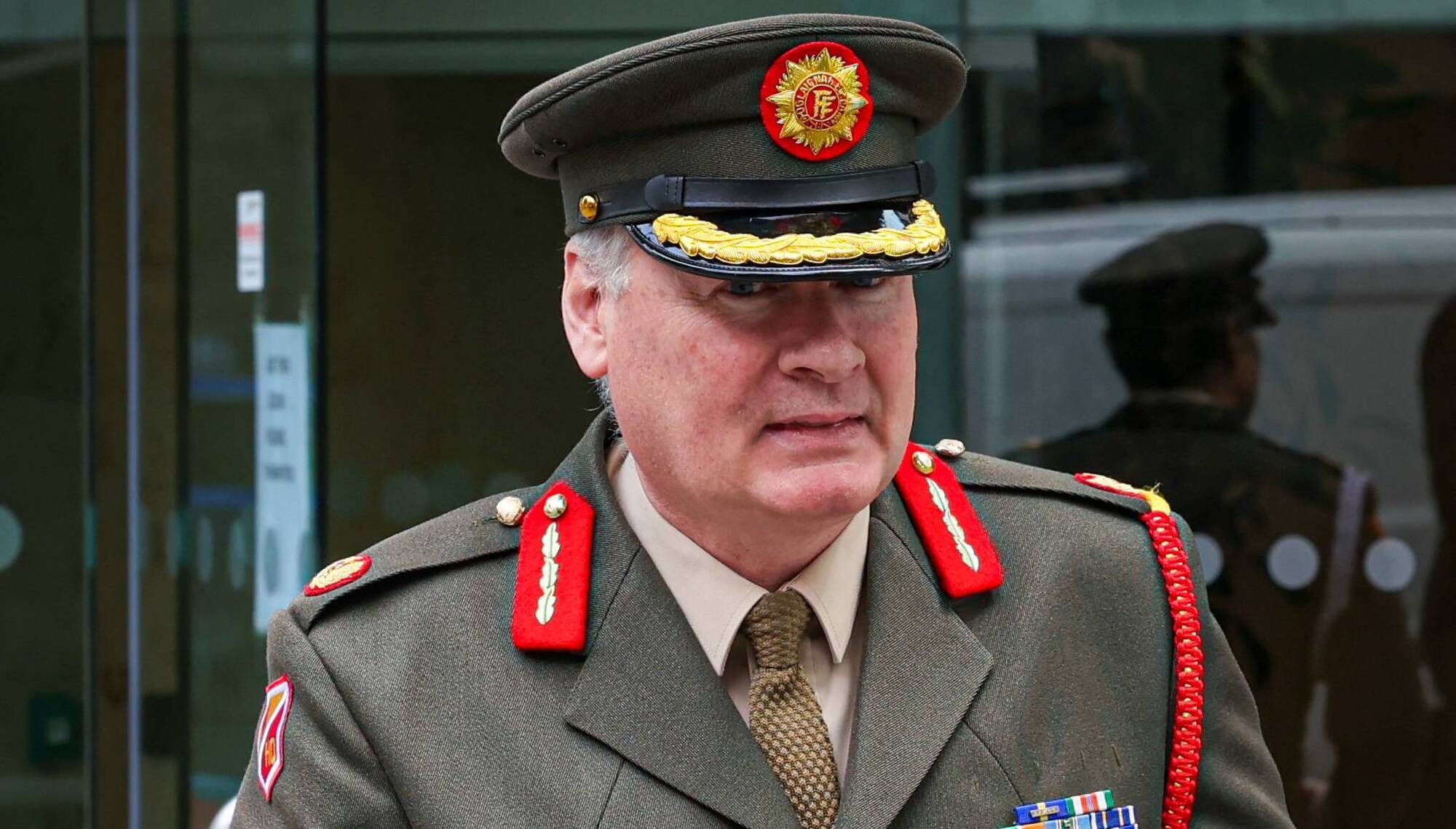
Brigadier General Stephen Ryan after giving evidence at the Defence Forces Tribunal. Picture: Neil Michael.
He features in almost every major allegation of mistreatment involving the approximately 52 apprentices, some as young as 16, who passed through the Army Apprentice School in the two years up to July 1991.
Because he cannot be identified for legal reasons, the former platoon commander is known throughout the Defence Forces Tribunal as 2LT.B.
The most serious allegation concerns recruit Oliver Mullaney, who died by suicide on June 22, 1991. The tribunal has heard claims that 2LT.B subjected the teenager to such humiliation during a training exercise two days earlier that it contributed to his death.
The officer is also accused of humiliating and assaulting another recruit in May 1991. The tribunal has heard the recruit suffered a nervous breakdown after the incident.
His breakdown had come after 20 months of being allegedly bullied, assaulted, victimised and humiliated by 2LT.B.
The tribunal heard evidence that he initially attempted to take his own life and, when unsuccessful, smashed a pool table in a recreation room before being locked in a room for his own safety.
The tribunal has also heard about the flawed investigation into his treatment by 2LT.B before just a few weeks before Oliver Mullaney ended his own life.
Read More
Other allegations against 2LT.B include claims that he ordered teenage recruits to dance with each other, sing nursery rhymes, sleep with flagpoles, and kiss each other as forms of punishment or humiliation.
The tribunal has heard so many allegations of abuse that Tusla has already assessed one former apprentice's account and concluded that it amounted to child abuse.
When 2LT.B finally appeared to give evidence on July 2, the tribunal room was packed for the first time since public hearings began on June 3.
Dressed in a dark blazer and slacks, with what appeared to be a regimental tie, he entered the room through the same door used by the tribunal's sole member, Ms Justice Ann Power.
Witnesses, whether they give testimony anonymously or not, usually sit in the tribunal room and wait to be called. Appearing composed and relaxed, 2LT.B bowed in front of the judge before taking his seat.
He answered questions in a calm and measured manner, rarely taking his eyes off Ms Justice Power.
Little seemed to faze him, including two particularly significant lines of questioning that prompted former apprentices in the public gallery to watch him intently as they awaited his response.
Among those listening was Oliver Mullaney's sister, Teresa, who had travelled from London to hear his evidence, along with one of her nephews.
The first of the questions was about the many allegations levelled against him and the second was in connection with Mr Mullaney’s death in Devoy Barracks, Naas.
There was an almost gentlemanly back and forth with tribunal senior counsel Michael Cush in which they discussed his time in the Apprentice School at Devoy Barracks and the training he received before he arrived there.
Mr Cush then gave him the opportunity to address the allegations “globally rather than individually”.
After a brief moment, 2LT.B cleared his throat.
As he did so, almost everybody in the room stopped what they were doing.
All that could be heard was the tapping of the stenographer’s keyboard and the gentle hum of the air conditioning.
Staring at the judge, 2LT.B began.
He said: “I respect the right of all persons to come to the tribunal.
“It's operating within a particular statutory instrument and persons have come to the tribunal with allegations and complaints of abuse.
“I do not doubt the sincerity with which they hold their views.
“I certainly would regret any perception or any feelings that they have.
“But, at the same time, I do have to deny I ever ill-treated or mistreated any member of the 34th Apprentice Platoon or any other apprentice in that regard.”
While he wasn’t directly asked about Mr Mullaney’s death, he was asked about “the aftermath” — and the view among many apprentices that his actions on June 20 had contributed to his suicide on June 22, 1991.
Mr Cush said: “As you acknowledge yourself, this was a remarkably serious allegation, so far as you were concerned?”
2LT.B replied: “The passing of Oliver is an immense tragedy for his family, for his close friends in the platoon, and those who he was friendly with in the barracks.
“It's immeasurable in terms of its impact.
“To be associated by anybody with his passing is quite a serious matter for me.”
The Irish Examiner has learned the tribunal was provided with a statement 2LT.B made in 1991 about the training exercise on June 20 of that year.
In it, he admitted he had “encouraged” recruits to sing and “some to dance”, but said it was intended as “a local boosting exercise to lift the tension”. He maintained that such activities were a “normal” part of training.
He insisted that “nothing occurred during the night that deviated from any training methods” that he claimed he was “subjected to” in the course of his own training.
If he fell short, he told the tribunal, it was in the failure of his training to adequately prepare him for the role of platoon commander.
Asked at the tribunal on July 2 if he agreed that the training he received didn’t “equip” him for the role of platoon commander, he replied: “I agree.”
When he was reminded he had told the tribunal in an earlier statement that he didn't have “the requisite training or experience to discharge the duties” of a platoon commander, he was also asked if that was right.
He said it was but added: “I didn't know I didn't have the requisite training and experience.”
But if he thought that would be where matters would lie, he was wrong.
This is because the man who took over from 2LT.B at the Army Apprentice School in July 1991 repeatedly contradicted key parts of his evidence.
Unlike 2LT.B, the 6ft 6in Brigadier General Stephen Ryan came in through the public entrance before the judge entered the tribunal room. He was even welcomed by at least one witness when he walked into the room.
Founding Women of Honour member Yvonne O’Rourke, who had been at Cadet School when he was there, went over and shook his hand.
They seemed genuinely pleased to see each other and moved back into the hall outside the tribunal room briefly for what appeared to be a good natured catch-up.
Brig Gen Ryan then took his seat and waited patiently, a few seats away from former apprentices, to be called to give evidence.
During cross-examination by Defence Forces senior counsel Darren Lehane, Brig Gen Rayn was asked about the quality of training he received, which would have been a year or two before 2LT.B was himself trained at Cadet School.
Of his training, he stated: “The cadetship is all about leadership training from day one.
“Every aspect revolves around man management, leadership, and management.
“As far as I'm concerned, when you finish as a cadet, you are the finished product.
“People who finish the Cadet School know how to do their job.”
Brig Gen Ryan was asked if he felt the training he received enabled him to manage people. He replied: “Yes. Definitely.”
Asked what he would think if somebody were to suggest cadet training didn't give them management skills, he replied: “I would disagree with that.”
Asked what he would think if somebody was to say there wasn't “a lot of empathy” in the training during training, he replied: “I would disagree with that.”
One of 2LT.B’s two senior counsels, Tom Hogan, then stood up and reminded him that his client had given evidence that training he received “didn't equip him properly for some of the duties and, in particular, the interpersonal responsibilities he was to have with apprentices”.
He said that, in other words, “the training he received didn't equip him to actually deal with personal problems or to develop interpersonal relationships with the apprentices, and that is the deficiency in his training”.
Brig Gen Ryan was asked if he agreed that in order to "develop a rapport with men”, that was “something you had to bring your own experience to”.
He replied: “Look, I can't speculate on (2LT.B’s) training, but I can definitely say in my training that that wouldn't be an accurate statement.
“Very shortly after my commissioning as a second lieutenant, I went into Portlaoise Prison as the platoon commander with approximately 50 soldiers in the highest security position in the State to secure the people in the prison.
“I was well capable of doing that because of the training I had received in the Cadet School — both to manage those, to lead them in the operational task they had there, but also to manage them if they had any personal problems or any issues with how they carried out that task and everything in between.
“When I finished my training, I was well capable of doing my job as a platoon commander.”
Before Brig Gen Ryan finished, he spoke of the members of the 34th Platoon.
He said: “I feel so sorry for them, that this has been a burden for them for X number of years since those incidents, or alleged incidents, in Naas.
“But I don't accept that what happened there was reflective of what happened in the Defence Forces as a whole.
“I trained platoons in The Curragh just around that time as well, and it didn't happen there.”
Thanked by the judge for his evidence, Brig Gen Ryan then stood up and walked down the tribunal room to the main public door.
As he was leaving, he met former apprentice Max Kennedy, who was also leaving.
They stopped for a chat just beyond the door, and they were soon joined by four more apprentices.
“He recognised us and acknowledged us and asked us how we were,” Mr Kennedy said afterwards.
“It was a typical friendly and respectful chit chat among old army colleagues. There was mutual respect there.”
By contrast, when 2LT.B finished giving evidence, he left the tribunal room alone through the same door he had entered earlier that day.
The room had previously heard repeated the final words spoken by Oliver Mullaney before his death.
At an earlier sitting, the tribunal had fallen silent as former apprentice David McGrath broke down while recalling the remark. Sitting in the same witness chair later occupied by 2LT.B, he recounted the words of his late friend.
“How can 52 lads be so wrong and one man be so right?”
CONNECT WITH US TODAY



Be the first to know the latest news and updates