Feud between Trump and the Pope Leo is much more than just a clash of personalities
Donald Trump’s loud, violent rhetoric smacks of ‘Old Testament’ retribution and infallibility whereas Pope Leo’s restraint and calls for peace are presidential, says Colin Sheridan
Feud between Trump and the Pope Leo is much more than just a clash of personalities

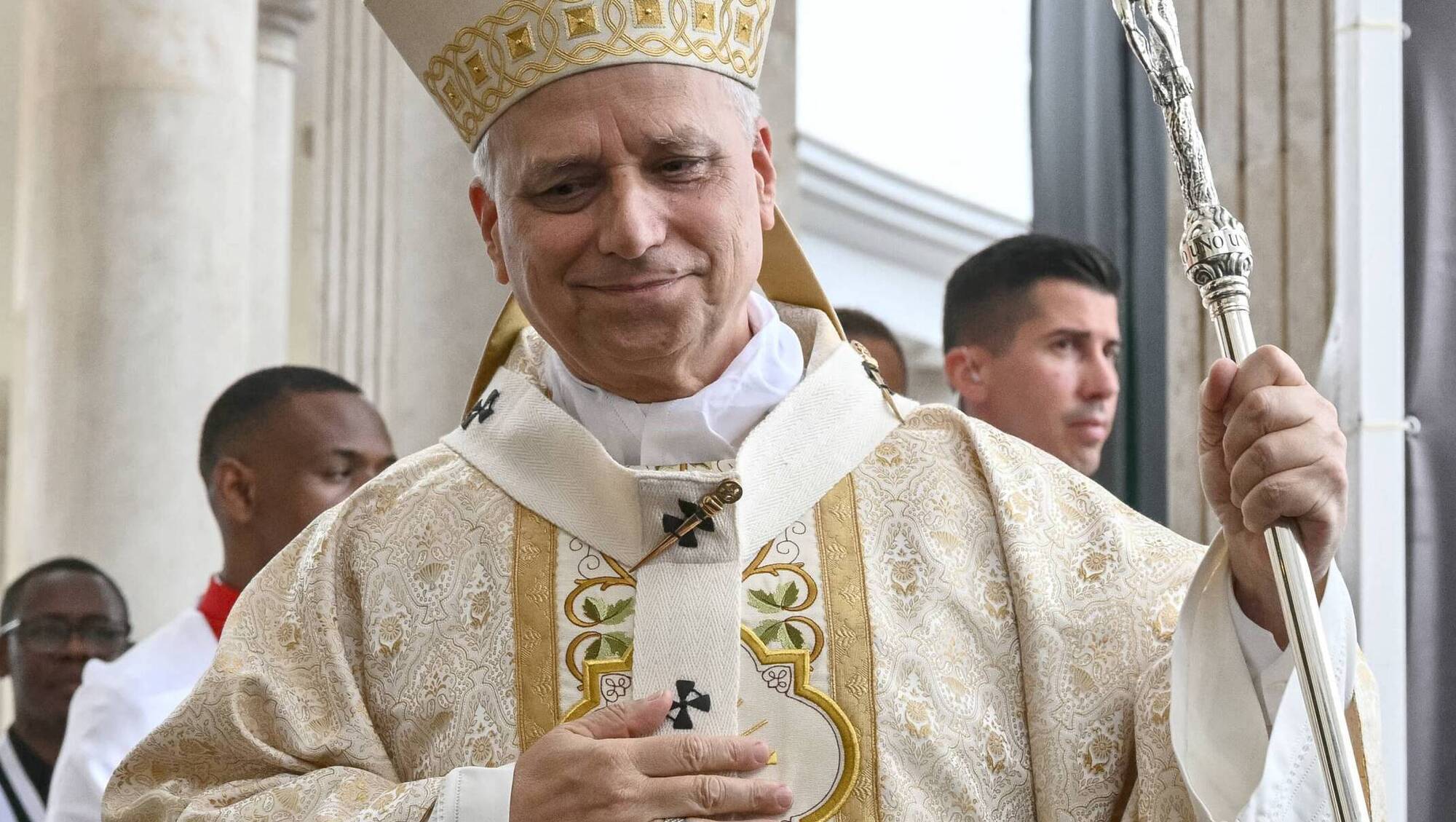
Pope Leo XIV arrives to lead a Holy Mass at the Basilica of the Immaculate Conception in Mongomo. Picture: Alberto Pizzoli / AFP / Getty

THERE was something Old Testament about an American pope and an American president on opposite ends of the day’s great moral argument: To destroy civilisations, or to live and let live? To invade and conquer, or to seek peaceful compromise? To sell division for profit, or give away unity for free? It feels less like geopolitics and more like theology with reality TV stars. And yet here we are.


On one side stands Pope Leo XIV, incumbent in an office that has outlasted empires, revolutions, and more than a few certainties. On the other,  Donald Trump, a man who has always seemed to regard constraints less as guardrails than as insulting suggestions.

The dispute — over  war, over justice, over the language of faith itself — is being framed as a clash of personalities. That is a mistake. What we are watching is something grander: A clash of moral postures.

Because the odd truth is this: The man said to possess infallibility, Pope Leo, behaves as though he does not, while the man who possesses no such thing, Donald Trump, behaves as though he cannot possibly be wrong.

It is, in other words, biblical.

Leo XIV. Illustration: Conor McGuire

There is a parable in Luke’s gospel — of the Pharisee and the tax collector — that feels uncomfortably current. 

Two men go up to the temple. One speaks loudly of his righteousness, certain of his standing, certain of himself. The other speaks scarcely at all, standing at a distance, aware — if nothing else — of the limits of his own claim. One treats the temple as a stage. The other as a place of reckoning. Only one leaves justified, and it’s not the man who lists his virtues, nor the one who insists upon his own correctness, but the who understands that judgement does not belong to him. 

And that, in the end, is the difference: Not power, but posture; not certainty, but humility. Only one understands what he is doing there and why it matters.

The lesson is not subtle. Authority, in the Christian imagination, is not proven by assertion, but revealed in restraint. And this is where the present moment sharpens. For all the noise, what has defined Pope Leo’s response is refusal: A refusal to be dragged into the register of bombast and bluster that defines so much of contemporary politics.

That refusal has been read as aloofness. It is more likely discipline: An understanding that one speaks not from power, but to it. Strip away the personalities, and what remains is an argument about something unfashionably serious: When a war can be justified.

In this aerial handout picture released by the Iranian Press Center, mourners dig graves during the funeral for children killed in a reported strike on a primary school in Iran's Hormozgan province in Minab on March 3, 2026. Picture: Iranian Press Center

The Catholic tradition, articulated by the 13th-century Italian Dominican friar, theologian, and philosopher, Thomas Aquinas, is not permissive. War must meet strict criteria: Just cause, lawful authority, proportionality, and a reasonable chance of success. These are not theological niceties. They underpin modern international law. The difficulty for the US administration is not disagreement with these principles, but failure to demonstrate that its actions come anywhere close to meeting them.

A picture of US president Donald Trump on a screen and an AI-generated picture he posted on his Truth Social platform depicting himself as Jesus Christ after criticising Pope Leo XIV. Picture: Mandel Ngan / AFP / Getty.

And here the contrast sharpens. Where the pope speaks in the language of limit and proportionality, the president speaks in the language of infallible certainty. The war is necessary because he declared it to be so. It is a familiar move. It is also, in theological terms, a dangerous one. Because to collapse judgement into assertion is to claim infallibility.

Which brings us to the theatre of strength. Strength, in modern politics, is often equated with volume: With domination, with refusal to yield. Might over right. By that measure, the president performs strength almost flawlessly. And yet the performance has an unignorable fragility to it. It requires constant escalation. It cannot afford silence. 

The pope has chosen stillness. He has not matched insult for insult. He has returned, instead, to the same point: Moral claims require moral evidence.

What looks like passivity is a refusal to legitimise a different kind of theatre; one where truth is determined by who shouts loudest and last.

Recall Christ before Pilate. The governor had the machinery of the state. Christ had none of it. And yet it is not Pilate’s authority that endured.

There is, however, an irony neither side would welcome. For decades, the Catholic Church has laboured under scandal and failure. Its moral authority, particularly in the West, has been badly diminished, and that failure has been reflected in falling congregations and half-empty seminaries. The youth, especially, wearing the cynicism of their parents’ generation, are less inclined to the habitual cadence the Church once provided.

And yet, in this confrontation, something curious is happening.

By dragging the papacy into a public contest — by attempting to bully and outshout it — Donald Trump is inadvertently restoring to the Church a measure of the very authority he would prefer to diminish. That authority is not institutional trust — that
is slower, harder to achieve — but something more immediate: Moral contrast.

Against hubristic political certainty, the Church’s language of hesitation begins to sound far more weighty. Against the performance of bullyboy strength, its refusal to perform reads as integrity.

None of this absolves its past. Institutions are not redeemed by comparison. But public perception is shaped by juxtaposition.

And in this juxtaposition, the Church benefits. Not because it has changed overnight, but because the terms of the argument have shifted. When power begins to speak as though it were beyond question, even a compromised moral voice can sound necessary.

“Papal infallibility” is often misunderstood. It is narrow, rarely invoked, and less a personal attribute than a constraint. It should not license arrogance, but limit it.

And that may be the most important distinction here. The tradition from which the pope speaks treats authority as something that binds the speaker as much as it empowers him. Political power has a shorter horizon. It is more responsive, more impulsive, and more prone to ego. That would go for any political leader — but with Mr Trump, the pollution levels are amplified to toxicity.

When these two forms collide, the quieter one is often mistaken for weakness, and, as countless Bible verses would surely tell us, that is usually a mistake.

There is a line from Matthew’s gospel: “These people honour me with their lips, but their hearts are far from me.” It points to a widening gap between religious language and political action. To invoke Christianity while discarding its moral constraints is not merely inconsistent. It empties the language. This is why the dispute matters. It is not simply a disagreement between a pope and a president. It is a test of whether moral language can survive a political culture that treats it as branding.

A gardener waters the plants in front of the portraits of children killed in a deadly strike on a children's school in the southern city of Minab on the first day of the war that killed at least 165 people, most of them children, at the Tajrish Square in Tehran on April 16, 2026. Picture: AFP/Getty

There is a final irony. By elevating the conflict — by attacking and insisting on his own certainty — the president has amplified the very voice he seeks to diminish. He has clarified the contrast and exaggerated it.

One man claims authority and demands recognition. The other declines the performance of authority and makes it more visible.

It brings us back to the parable.

Two men go up to the temple. One speaks loudly of his righteousness, certain of his standing, certain of himself. The other speaks scarcely at all, standing at a distance, aware of the limits of his own claim. One treats the temple as a stage. The other as a place of reckoning. Only one leaves justified.

Between Mr Trump and Pope Leo, it was never a fair fight. A rare win for right over might, and an example of how power can be used — quietly and without fanfare — for good.

x

More in this section

Lunchtime News

Newsletter

Get a lunch briefing straight to your inbox at noon daily. Also be the first to know with our occasional Breaking News emails.

Cookie Policy Privacy Policy Brand Safety FAQ Help Contact Us Terms and Conditions

© Examiner Echo Group Limited