For many Irish people, the story of Easter unfolds in a familiar rhythm — Palm Sunday sermons, the solemnity of Good Friday, the quiet joy of Easter morning. Yet the geography of that story is often blurred, its place-names detached from the modern political reality in which they now sit.
To walk the Easter narrative today is not only to trace the final days of Jesus, but to move through one of the most contested and closely watched landscapes in the world. Jerusalem, Bethlehem, and their surrounding hills are not simply biblical settings; they are part of a region shaped by checkpoints, walls, religious tensions, and competing national identities.
It is impossible to follow the Easter story here without also encountering the present.
Palm Sunday: Mount of Olives, East Jerusalem (Occupied West Bank)
During the time of Jesus (1st century AD), the land was not a single country called Israel or Palestine. It was a region under Roman control, primarily known as Judea in the south, Galilee in the north, and Samaria in the centre.
The Easter journey begins on the Mount of Olives, just east of Jerusalem’s old city. From this vantage point (overlooking the golden dome of the rock and the ancient walls) the geography of the story comes into focus. This area lies within East Jerusalem, captured by Israel in 1967 and considered part of the West Bank occupied territory under international law.
For pilgrims, that political reality may not be immediately visible, but it shapes everything from policing to access. On Palm Sunday, thousands still gather here to retrace the path of Jesus’s entry into the city, descending toward the Kidron Valley. The procession is usually vibrant, multilingual, and heavily monitored, a visible intersection of faith and contemporary control.
At the foot of the hill lies the garden of Gethsemane, where ancient olive trees stand beside the Church of All Nations. Here, tradition holds that Jesus prayed before his arrest. Today, it sits just metres from busy roads and constant security presence — a place of stillness smothered by tension.
Holy Thursday: Mount Zion and a Divided City (Occupied West Bank)
Crossing into the old city the narrative moves to Mount Zion, where the Upper Room, or Cenacle, is located. This site, associated with the Last Supper, lies just outside the ancient walls but within a complex patchwork of religious and political sensitivities.
Jerusalem is often described as a city unified under Israeli administration, yet in practice it is deeply divided. Jewish, Muslim, and Christian quarters sit side by side, but movement and access can be uneven, particularly for Palestinians from the West Bank, many of whom require permits to enter.
Holy Thursday liturgies here often unfold under a quiet but noticeable security presence. Nearby, sites associated with Peter’s denial and the detention of Jesus are visited by pilgrims, sometimes as part of candlelit processions that retrace the path from Gethsemane — a route that today crosses not just physical ground, but invisible political boundaries.
Good Friday: The Via Dolorosa, East Jerusalem (Occupied West Bank)
The Via Dolorosa — Latin for the way of sorrows — runs through the heart of the old city, beginning in what is traditionally identified as the site of Jesus’s trial and winding its way to Golgotha. The traditional route is believed to have been walked by Jesus while carrying the cross to his crucifixion.
It is a 600m path featuring 14 stations of the cross, starting near the Lion’s Gate and ending at the Church of the Holy Sepulchre.

Today, it cuts through the Muslim Quarter, a densely populated, predominantly Palestinian area.
Shops remain open, life continues, and the path of suffering is interwoven with the rhythms of daily commerce.
On Good Friday, large processions follow this route, led by clergy and accompanied by pilgrims carrying crosses. Israeli police presence is typically heightened, particularly in periods of broader regional tension.
At times, access restrictions or crowd controls have limited participation, especially for local Palestinian Christians. The juxtaposition is striking: a sacred reenactment of sacrifice and crucifixion unfolding within a living, contested, and combustible urban space.
Golgotha and the Tomb: The Church of the Holy Sepulchre (Occupied West Bank)
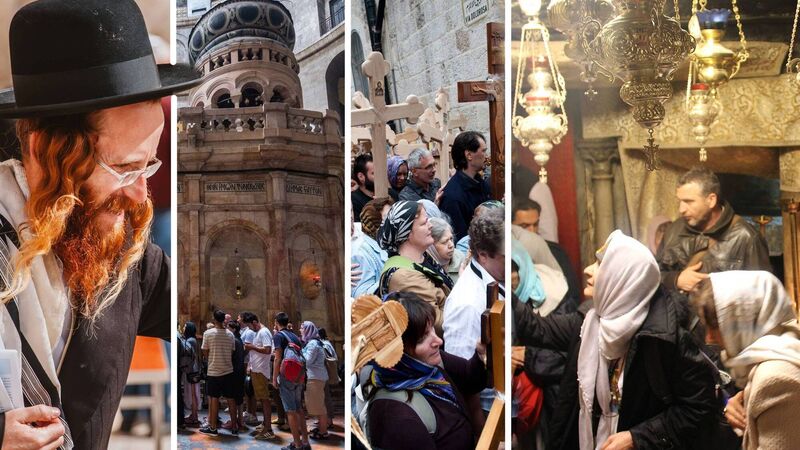
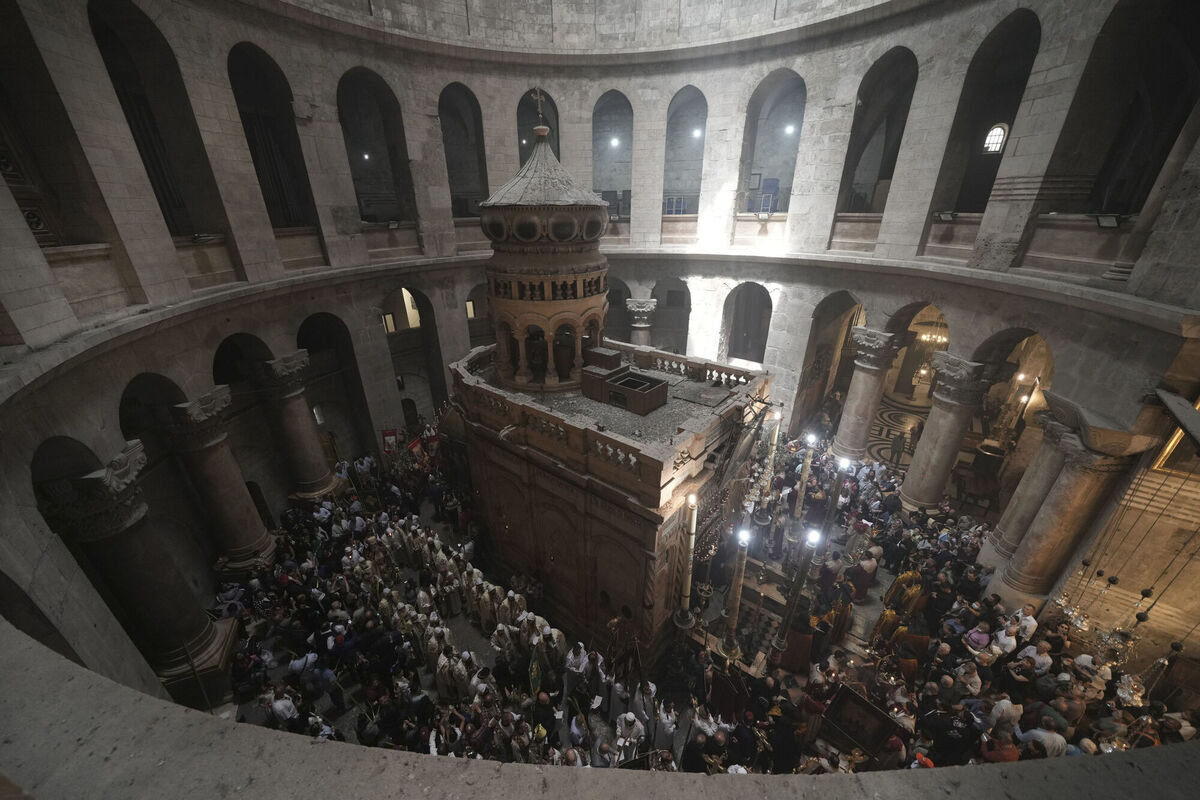
At the end of the Via Dolorosa stands the Church of the Holy Sepulchre, one of Christianity’s holiest sites. It is here that tradition places both the crucifixion at Golgotha and the empty tomb of the resurrection. The church lies within the Christian Quarter of the old city, still part of East Jerusalem.
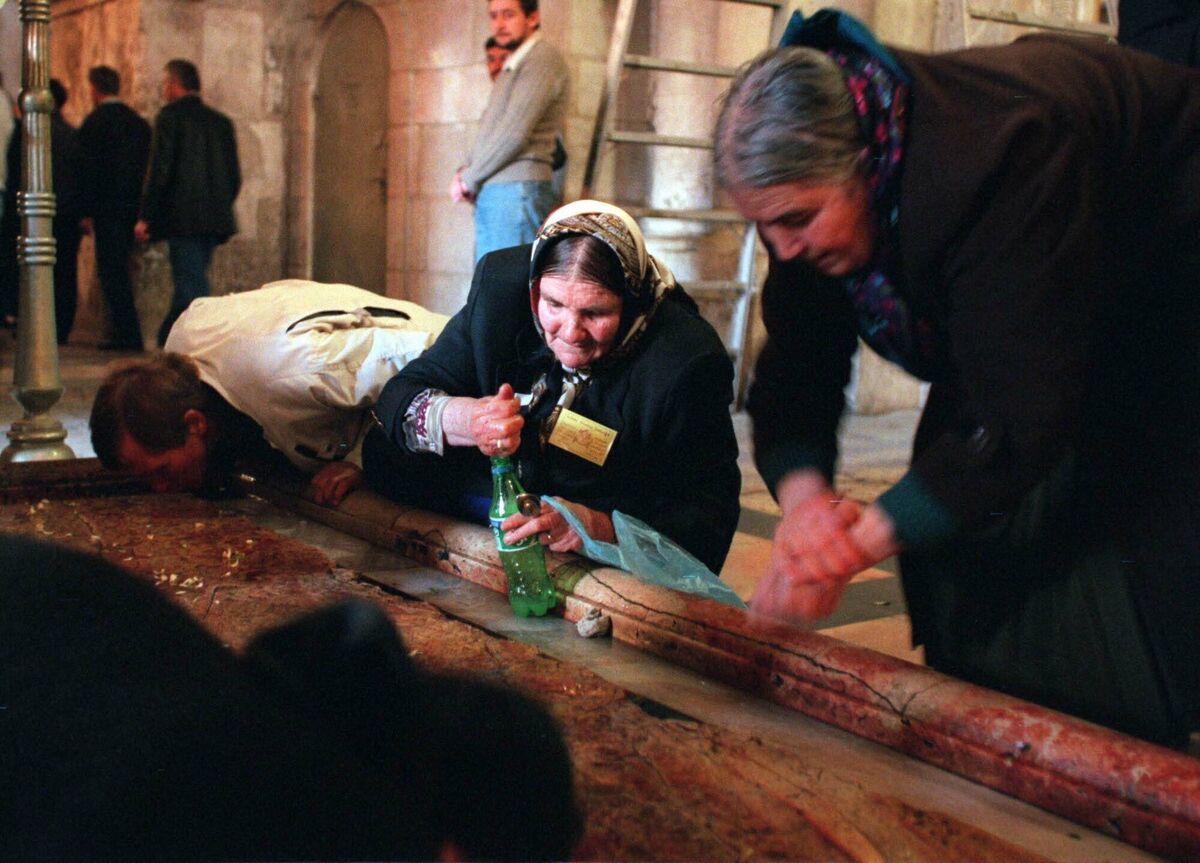
Despite its global significance, access to the church (particularly during major feasts) can be shaped by security measures, crowd limits, and the wider political climate. Inside, the atmosphere is dense with devotion: pilgrims queue to touch the Stone of Anointing, ascend to the site of crucifixion, and wait again to enter the tomb itself.Â
The church is shared among multiple Christian denominations, its internal governance governed by a centuries-old “status quo” agreement. A fragile balance that mirrors, in some ways, the broader region.
An Alternative Space: The Garden Tomb, West Jerusalem (Israel)
Outside the old city walls, in what is now West Jerusalem (internationally recognised as part of Israel) lies the Garden Tomb.
Favoured by many Protestant pilgrims, it offers a quieter, more contemplative setting. Here, Easter morning services often take place at sunrise, with small gatherings marking the resurrection in relative calm. The contrast with the intensity of the old city is notable — not only in atmosphere, but in geography. Within a short distance, one moves between areas of differing legal status and lived experience.
Easter Morning: Light across a divided landscape
Sunrise on Easter Sunday is often marked on the Mount of Olives or at the Garden Tomb, two distinct locations to the east and north of the city respectively.
As the light spreads across Jerusalem, it illuminates a city both unified in appearance and divided in reality. The old city walls, the minarets, church domes, and modern infrastructure all sit within a complex political framework.Â
For some, movement across this landscape is straightforward. For others — particularly Palestinians — access can depend on permits that are not always granted, even during major religious festivals.

Beyond Jerusalem: Bethlehem (Occupied West Bank)
No Easter journey is complete without acknowledging Bethlehem, located just a few kilometres south of Jerusalem in the West Bank. Here stands the Church of the Nativity, marking the traditional site of Jesus’s birth.
Today, Bethlehem is under Palestinian authority administration but encircled in part by the Israeli separation barrier. The short journey from Jerusalem can involve crossing a checkpoint — a routine but often jarring experience for visitors. For local Christians, Easter can be shaped by these restrictions. Permits are often required to travel to Jerusalem for Holy Week, and not all who apply are able to attend. For pilgrims, this reality adds a layer of contemporary significance to a story already defined by movement, restriction, and power.
A story in two times
To follow Easter in the Holy Land today is to inhabit two timelines at once. One is ancient — a sequence of events that has shaped global faith for millennia. The other is immediate, unfolding daily in headlines and lived experience. The sacred sites remain, but they exist within a landscape marked by division, negotiation, and, at times, conflict. Checkpoints, security barriers, and differing legal statuses are as much a part of the journey as olive trees and stone pathways.
For visitors from Ireland and beyond, this can be both disorienting and illuminating. The Easter story with its themes of suffering, injustice, and hope resonates differently when encountered in a place where those themes are not confined to the past. The familiar narrative does not change. But the setting in which it is experienced does.
And perhaps it is in that tension — between the timeless and the immediate — that the story finds a renewed and more challenging clarity.
CONNECT WITH US TODAY
Be the first to know the latest news and updates
More in this section