Abdullah Khan case exposes ‘new reality’ of Islamist extremism and Irish attacks
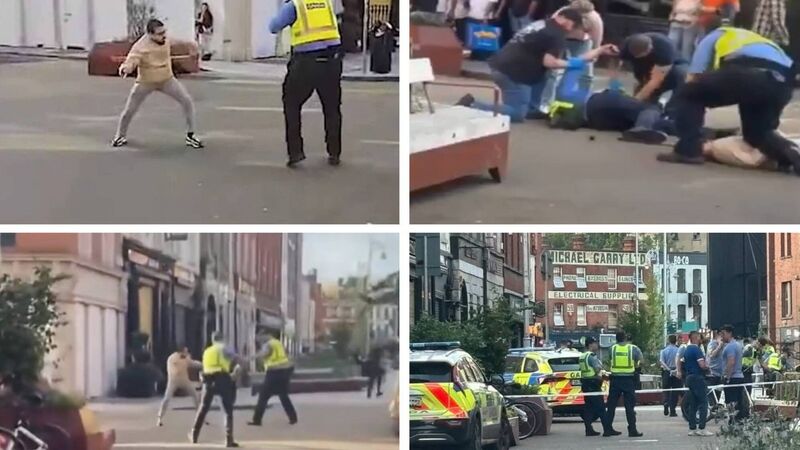
The Abdullah Khan case highlights a growing terror threat in Ireland, with jihadist and far-right extremism now a major security concern.
The case of Abdullah Khan has provided evidence — more evidence, in fact — of the “new reality” facing Ireland.
It is one where terror attacks driven by a violent extremist Islamist ideology are now happening in Ireland, as they have done in neighbouring Britain and the European continent for the last 20 years.
Khan’s stabbing attack on a garda in Dublin 2025 was the second of two publicly known jihadist attacks in the last 19 months — the other one in Galway in August 2024.
In both cases the target was the State, specifically its security services: a garda in Dublin and a member of the Defence Forces in Galway.
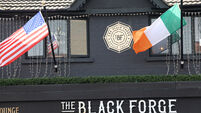
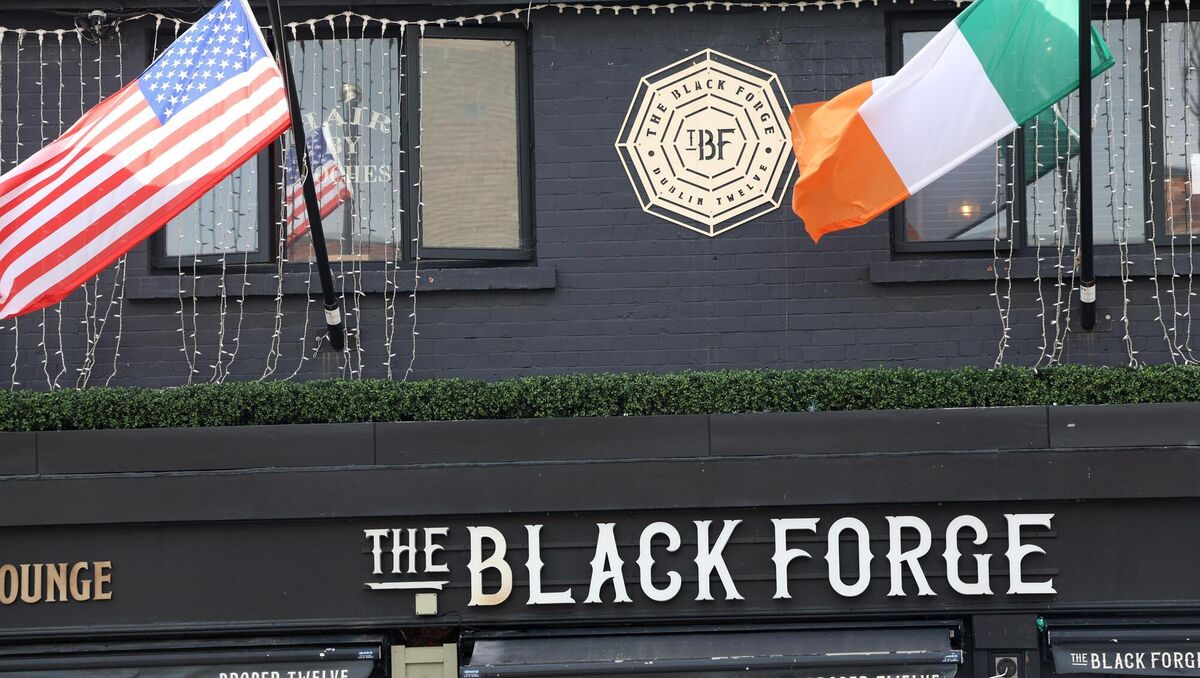
Khan also targeted Conor McGregor, in the form of his pub, the Black Forge Inn, four days earlier in an arson attack — blaming him for helping the far-right and for insulting the prophet Mohammed.
Read More
A third case concerns the murder of a civilian in recent years by a jihadist-inspired man. As it is yet to go to trial, little can be said about it. Security sources also say there is a fourth attack, but details of that are not available at the moment.
These are in addition to two other cases — one of a suspected jihadist stabbing in the North in 2023 by a youth who had lived in Dublin for a year and another involving a man, with jihadist terror convictions in the UK, threatening to carry out a mass shooting in Ireland last year.
“This is the new reality for Ireland,” one security source said. “We are no longer different than other European countries.”
This comes at the same time as Irish security services are grappling with the emergence of a significant threat from the extreme right, including plans to bomb a mosque — part of a larger movement of far-right groups, activists and small numbers of locally elected politicians.
Khan, now aged 24, had pleaded guilty to all charges put against him — of assault causing harm to Garda Gary Lynch, to terrorist offences and to arson of McGregor’s pub.
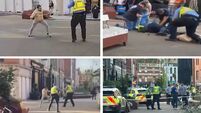
At the Special Criminal Court last Monday, footage from shop CCTVs and tourist mobile phones showed Khan’s attack, which occurred on July 29, 2025 on Capel Street, on the northside of the city centre.
Just after 5.30pm on a sunny day, Garda Lynch and colleague Garda Patrick Nevin were on foot patrol, strolling up pedestrianised Capel Street.
A mother with a buggy, a dad with a son, cyclists and assorted pedestrians were near the gardaí, when a man walking a short distance behind the gardaí ran towards them.
He took a knife out of his pocket and drove it into Garda Lynch from behind and stabbed him quickly several times while to his right.
He shouted “Alluha Akbar” as he knifed the garda — the “God is Great” phrase which has often been used by many jihadists in terror attacks. Prosecution counsel, Gerardine Small SC, told the court the phrase was akin to a “war cry”.
Khan did not flee after the initial attack but stood his ground as the two gardaí flanked him, arming themselves with batons and, alternatively, incapacitant sprays.
The footage showed Khan swinging his knife at both gardaí as they tried to bat him away. At one stage Khan ran at Gda Lynch with his knife raised and sweeping at the garda, who was bleeding, but the officer managed to keep him at bay.
When a brave passerby came from Mr Khan’s right and pulled him to the ground the two gardaí pounced and Garda Nevin brought him under control.
Gda Lynch collapsed to his knees, using the baton to break his fall. Gda Lynch, just newly graduated from Garda College, had to get four large stitches to his right arm above the elbow and two stitches below the elbow.
Neither garda attended the court on Monday and Ms Small read out both victim impact statements.
Gda Lynch’s statement detailed the enormous, and continuing, physical and mental toll of the attack on him: chronic nerve pain; surgery; nightmares; panic attacks; and difficulty doing basic things like brushing his teeth and showering.
He said gardaí were generally able to deal with aggression they confront on the street, but said this was typically in front of you and can be seen beforehand — whereas Khan's attack was from behind, with no warning.
After being arrested, in his first interview at Bridewell garda station, Khan immediately confessed to a separate crime.
“I went to the Black Forge and set it on fire,” he told gardaí.
“My face should be on tape. It would be better to have it over now, rather than it come back to me later.”
When asked by the interviewing garda why he carried out these attacks, Khan said there were “a lot of things going on in my head” and that he thought Ireland was “going down a bad road”.
Asked about Conor McGregor, he said: “It’s fair to say I’m not his biggest fan.”
CCTV footage of the arson attack showed a man, who made no effort to conceal his face, carrying a bag and walking towards the Black Forge Inn.
He lifted a container up to shoulder height and poured liquid over the front of the pub and dropped the container on the ground.
It took the man two efforts to light the liquid with matches before a massive flame shot up and outwards, forcing him to run across the road.
Detective Inspector Gavin Ross of the Special Detective Unit said that, in interviews, Khan said he had filled up a Jerry can with petrol at a garage but said it wasn’t ideal for pouring, so he bought a five litre bottle of water and filled that.
Det. Insp. Ross said that when the SDU — the force's counter-terrorism unit — learned of the knife attack on Capel Street it had the “same MO” — modus operandi (operational method) — as attacks in Europe.
He said the attacker cried out “Alluha Akbar” and, when first interviewed, admitted to the Black Forge arson. He said his motivation pointed to “radicalised Islamic religion”.
In interviews Khan agreed his actions amounted to “terrorism”, saying it was “undeniable”. He said he had shouted “Alluha Akbar” and said that wasn’t something someone said randomly.
He told detectives that he was “always a spiritual person” and that around age 18-19 he started radicalising and that, when aged 20-21, it got “progressively stronger”.
He became a follower online of Abu Musab al-Zarqawi, founder of Isis, also known as Islamic State, who had been killed in 2006.
Det. Insp. Ross said Khan listened to speeches and family songs of al-Zarqawi and that he found the leader to be “charismatic” and that his messages resonated with him.
He said Khan described himself as a “Salafi Jihadi”, with Det. Insp. Ross explaining that Salafism was a puritanical interpretation of Islam and a significant part of the ISIS ideology.
He said Khan cited the core principles of ISIS, including the doctrine of Takfir, which referred to the practice of declaring other Muslims, like Shia Muslims, as not true believers and as “apostates”, but that ISIS extended it to non-Muslims and to democratic countries and their leaders.
“Rulers, such as Ireland’s can all be declared apostate,” Det. Insp. Ross said, adding that gardaí are seen as “legitimate targets” as they are also apostates. He said Khan openly accessed jihadist material online and made a personal pledge to ISIS.
Asked about his specific motive for targeting the Black Forge and attacking the gardaí, Khan said in interviews that it was because prophet Mohammed was “insulted by people with a right-wing mindset”.
He said this was “unacceptable and outrageous” and made him “very angry”. He claimed it was the “catalyst” for what happened.
“McGregor is someone who helped the far right grow in this country,” Khan said in interviews. "I held him responsible and this was a message to him, McGregor, that he is playing very dangerous games when it comes to prophet Mohammed. "
Khan said it was not about freedom of speech but provocation. He said he was “very angry” towards the State, saying it was the “duty” of the State to “denounce” it — adding that this was a “red line”.
He told interviewers:
Khan added: “This was a message to the Irish government that if, under the name of free speech, you insult our prophet, there will be people who will be angry.”
This motivation, cited by Khan, presents security services with the additional threat that violent Islamists and violent right-wing extremists may act out of retaliation to perceived actions by the other side.
Det. Insp. Ross said they commissioned an expert report from Paul Gill, a leading researcher on terrorism and attached to the University of London, to give his assessment of Khan’s interviews, which was submitted to court.
The court heard Khan was born in Ireland and that his family were professionals. He was the youngest of six children. He was educated in Ireland before his father arranged for him to travel to his home country of Pakistan, where Khan continued schooling.
Khan’s defence, Michael Bowman SC, told the court that this was a “difficult period” for his client and that he was “socially isolated” there. When he returned back to Ireland, Mr Bowman said Khan’s mental health “deteriorated considerably”.
He was socially isolated in Ireland and was “withdrawn, paranoid and depressed”. According to his family he “spent all his time effectively in his room”.
Mr Bowman said Khan’s family repeatedly tried to get their son to see a psychologist or psychiatrist. He said his client didn’t trust doctors or psychiatrists and resisted his family's efforts to help him.
At one stage Khan “up and left”, without saying anything to his parents and “disappeared”, Mr Bowman said. He lived a “homeless existence” for a period of months.
The date of the disappearance was not given in court. No details were provided as to where Khan stayed, whether he was sleeping rough on the street, staying in emergency hostels or ‘couch surfing’ in the homes of friends or associates.
Read More
The family said that Khan fell into the company of “other individuals” and that his isolation from the family increased, as did his paranoia. Mr Bowman said his client described himself as being in a state of “mental health crisis”.
With Det. Insp. Ross in the witness box, Mr Bowman said that during interviews with his client, Khan explained to officers that he battled with his mental health and that he said he “just kind of snapped” in the days leading up to the attacks.
Det. Insp. Ross said Khan made “several mentions of his mental health” but added that “no evidence” had been provided regarding any diagnosis he had.
Mr Bowman contended to the three judges of the court that Khan’s mental health condition, as cited by both his family and, what he said, were friends of his client, should be taken into account.
As Khan pleaded guilty there was no forensic examination carried out to establish the nature, and extent, of Khan’s mental health issues and what impact they might have had on his actions.
Det. Insp. Ross gave evidence on Khan’s movements between the arson and the stabbing attack, which raises many questions.
On July 26, the day after setting fire to the Black Forge, Khan travelled from Dublin to Belfast, thanks to a lift he got from an “associate”.
Khan, who was homeless, then got four flights, in the space of three days:
- July 26: Belfast to Valencia, Spain;
- July 27: Valencia to Rome, Italy;
- July 28: Rome to Leeds/Bradford, England;
- July 28: Leeds/Bradford to Dublin
The court did not hear how much these flights cost, bearing in mind it was the height of the summer, or how they were paid and who paid them.
The day after Khan got back to Dublin, he travelled to Woodies in Blanchardstown, west Dublin, and bought a utility knife which he used in the attack later that day.
There was also a brief mention in court about a passenger on Dublin Bus seeing Khan use a mobile phone one hour before the attack, a phone he afterwards threw away.
No more detail was given in relation to that, in particular if the person Khan was talking to was identified and whether or not it was relevant to the attack.
Mr Bowman put it to Det. Insp. Ross his client’s “friends” described him as socially awkward and isolated, to which the garda replied that these people were “associates”.
Mr Bowman said one of Khan’s friends, who knew his client since they were 16, gave him a lift to Belfast. Det. Insp. Ross said the statements of associates were “subject to investigation”.
Mr Bowman continued and said his client’s friends described Khan as “weird”, “mentally unstable” and “delusional”.
Referring to Khan's jihadist beliefs, Det. Insp. Ross said he was “part of a wider group of individuals with this mindset” and said “lines of inquiry are still open”.
In his final remarks to the judges, Mr Bowman said it may come to pass that there were “others in the shadows” and that they had Khan “operating in broad daylight”.
The court will hand down its sentence on April 20.
CONNECT WITH US TODAY



Be the first to know the latest news and updates