SNA protests: ‘My son suffers the same whether it’s a redeployment or a cut’
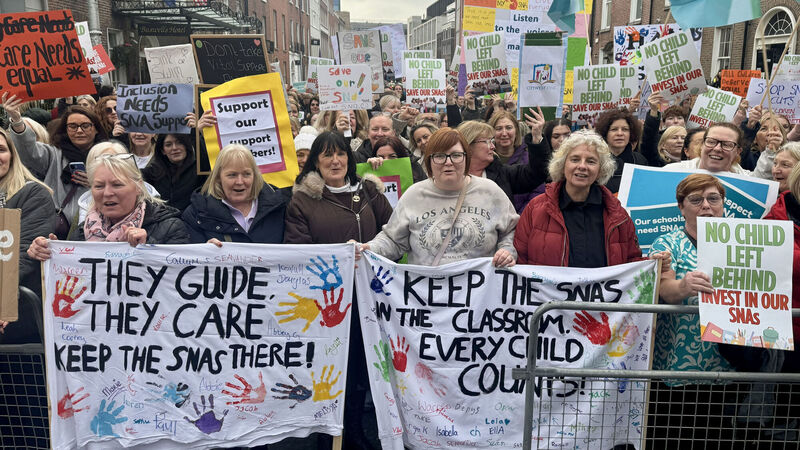
Parents, special needs assistants (SNAs), and their supporters demonstrating outside Leinster House in Dublin on Wednesday. Picture: Bairbre Holmes/PA
Outside Leinster House this week, Emily Kane held a placard reading: “He is six. He is capable. He needs his SNA.”
The Dublin mother was among those gathered to protest amid the fallout from reviews of special needs assistant (SNA) posts.
Her son attends Our Lady’s Boys National School in Ballinteer, one of the schools that were set to lose SNAs next year until political controversy put the brakes on the move.
The school was losing three posts, dropping from five SNAs to two in September, a 60% reduction.
While that cut at the school is paused, it brings little comfort to Emily, or the parents of 30 other children who have additional needs attending mainstream classes there alongside their peers. Emily said: "It’s not happening this year but it’s coming next year, I’ve no doubt about it in my mind, the way it’s been worded."
Read More
Emily's son, who is autistic, is in senior infants.
He is "well able" to keep up with his classmates academically but needs some help with focus and concentration.
Without the support of his SNA, her son would not be able to attend mainstream school. Instead, she would have to consider placing him in a special class — a smaller setting attached to mainstream schools for children with additional needs.
However, these classes in his school are full, and the annual battle parents face to secure special classes for their children is well documented.
Emily asks why her son should have to leave his class when he is bright, engaged, and has the support of a “gamechanger” SNA. “Why are we doing that to kids who are able to stay in mainstream,” she said. “It’s not acceptable, and I am not going to accept it.”
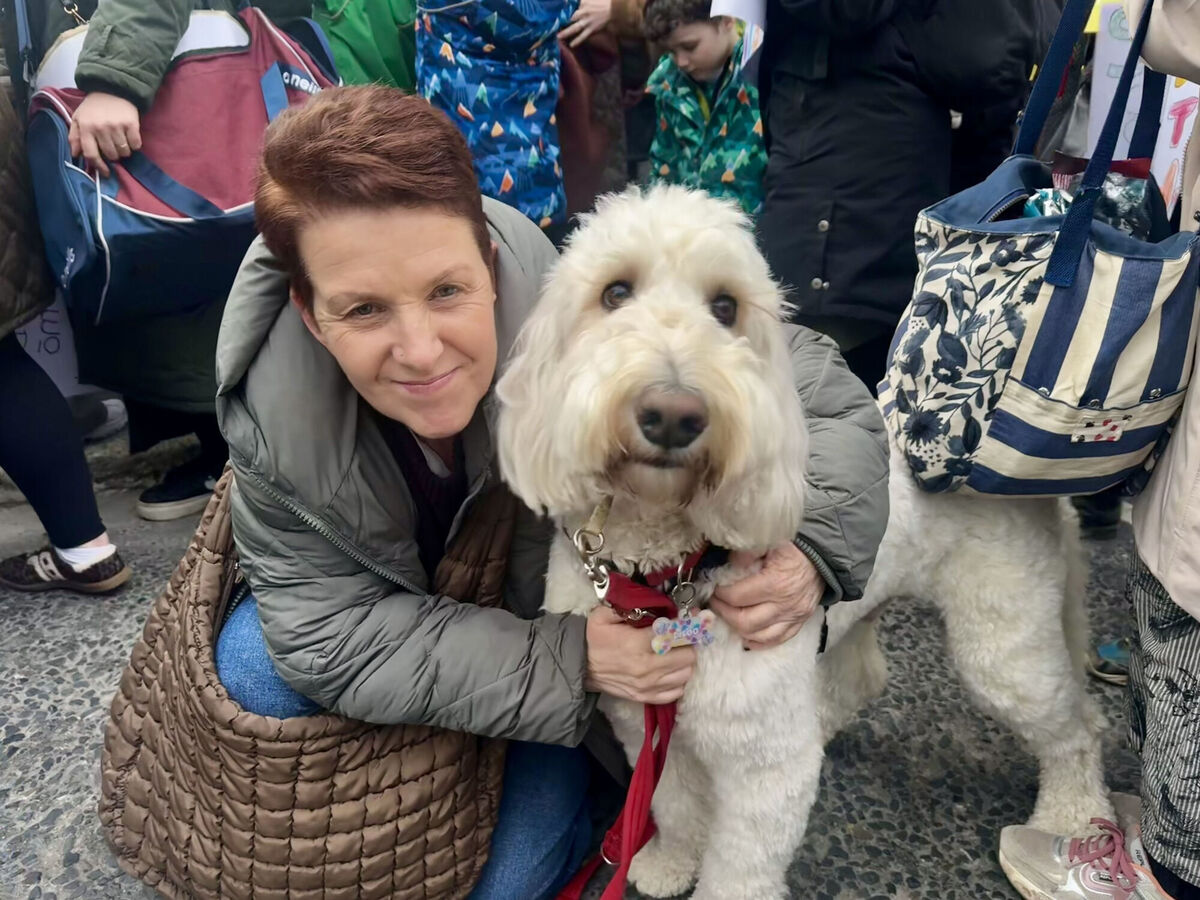
In the Dáil this week, education minister Hildegarde Naughton repeated the Government’s position on the matter: “No cuts are proposed, or will be proposed, to the provision of SNA support to children and young people across our school system.”
She added: “The numbers don’t lie. We are not cutting SNAs.”
The Government and Department of Education have argued this week that the loss of posts from schools following the reviews by the National Council for Special Education (NCSE) do not constitute as “cuts”.
This is because the overall number of SNAs working in the education system is set to reach its highest level from September, and that the posts lost from the schools deemed to have less needs than others would simply be “redeployed”.
“Of course there is a cut,” Emily said.
"My son suffers the exact same whether it's a redeployment or a cut. It is exactly the same.
“They talk about there being 25,000 SNAs, the most they’ve ever had. No one has actually said how many we actually need. We probably need two or three times that amount for all children across the country.”
While the number of SNAs working across the education system has grown each year, so too has the need for such posts. Parents, teachers, and wider society’s awareness of disability have grown, and diagnosis and assessments have improved.
The Department of Education did not provide a figure when asked by the if it had an estimate of how many SNAs are needed at mainstream schools based on students' needs.
Approximately 250,000 students who have additional needs attend mainstream schools, according to the department’s own estimation. These needs could include physical disabilities, medical needs, ADHD, dyslexia, dyscalculia, dyspraxia, or autism.
Based on NCSE data, there are 12,560 SNAs working in mainstream classes. This week’s announcement of an additional €19m will cover an additional 500 SNAs for 2026. This puts the ratio at approximately one SNA to every 19 students at mainstream.
SNAs are allocated to schools, and not to individual children, Ms Naughton said this week, adding that “the NCSE works to retain supports for children".
“But circumstances can and do arise where the same level of SNA support is no longer required, such as where a student or students with highly significant care needs leave the school," said the minister.

“There is also the ideal scenario where children gain more independence and more confidence in their learning and no longer require the same level of support.
"These outcomes are what we all want, and what our system is designed to achieve. These are the measure of success for young people.”
This year, to date, the NCSE had conducted 1,000 reviews of schools’ SNA allocations. The outcomes of these had gone to more than half of the schools when the process was halted last week.
Last year, it carried out approximately 1,400 reviews. The Department of Education has refused to say how many of last year’s reviews resulted in reductions or increases.
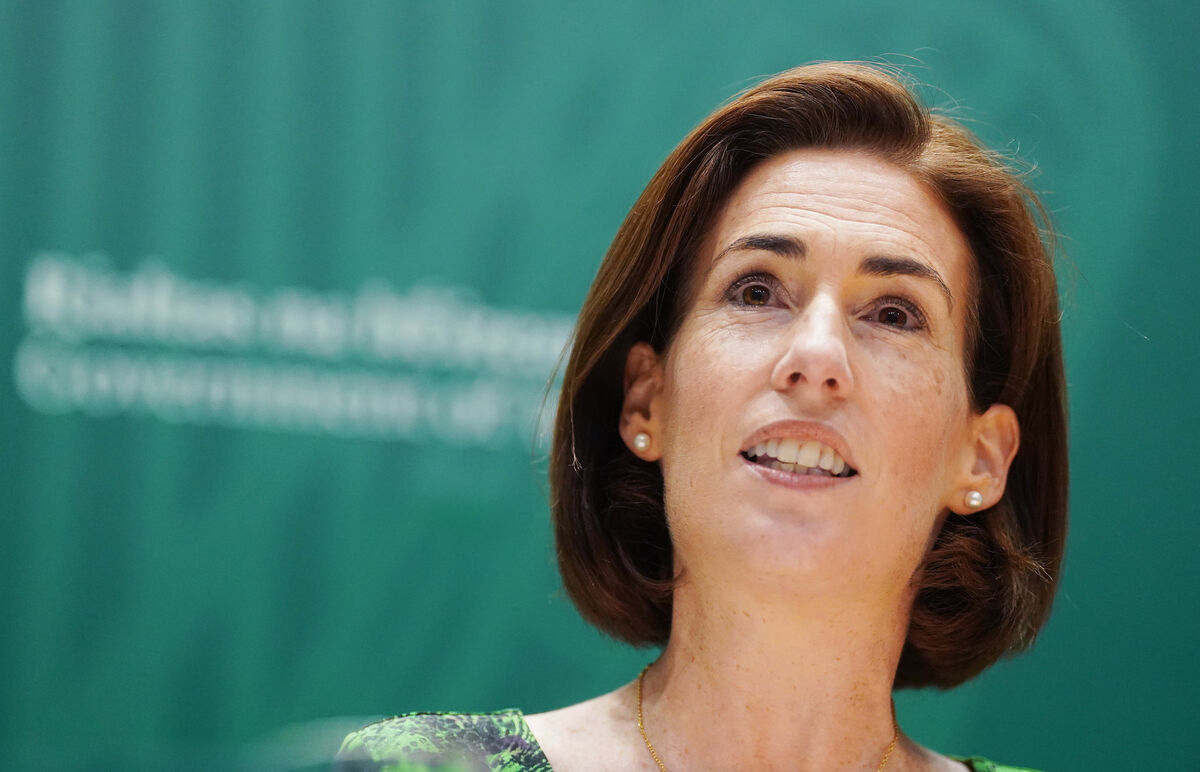
Leigh Fleming, a mother in Cork City, is worried about the impact of repeated “stealth cuts” on the system, which she has been documenting in recent years.
“They are clever with their wording. They’ve said, ‘It's not a pause, it’s stopped for this year’. [That means] it's stopped until June, that’s a matter of months away, the end of the school year.
“Up until last year, a school could ask for a review, get themselves reviewed anytime to ask for an increase if they had the cases there.
"The NCSE could also review at any time of the year. The only change that has happened is that now the review happens at a set time of year.”
This has made the scale of their impact more apparent.
Last April, Ms Fleming put a call out for people who saw SNA support lost following a review by the NCSE. With one Facebook post, she got back 86 responses.
“It goes to show it's affecting everybody,” she said. "It was teachers, parents, SNAs, principals."
One mother wrote to Ms Fleming after her autistic daughter's SNA support was withdrawn with immediate effect "out of the blue".
She had received this support for six years, essential for managing her daughter’s sensory impairment and emotional irregularities. Within just four days of losing it, the impact was “immense”.
“Her self‑esteem is very low. She can’t work out what she did wrong.” Her message was sent in April 2025.
Ms Fleming said: “Schools can end up getting a lot of abuse from parents as well, who have to fight and fight saying, ‘We need an SNA’. But really, schools have no choice in the matter. They delegate the hours where necessary, where the highest needs are and then fill in the gaps where they can, but they are stretched thin.”
SNAs Jennifer Fox, Nicola Kavanagh, and Lisa Fitzgerald believe the disconnect between Government and what's happening in schools across the country largely comes down to inappropriate school places. Children are placed incorrectly within the current system in classes or schools that cannot offer the support they need with the resources they have.
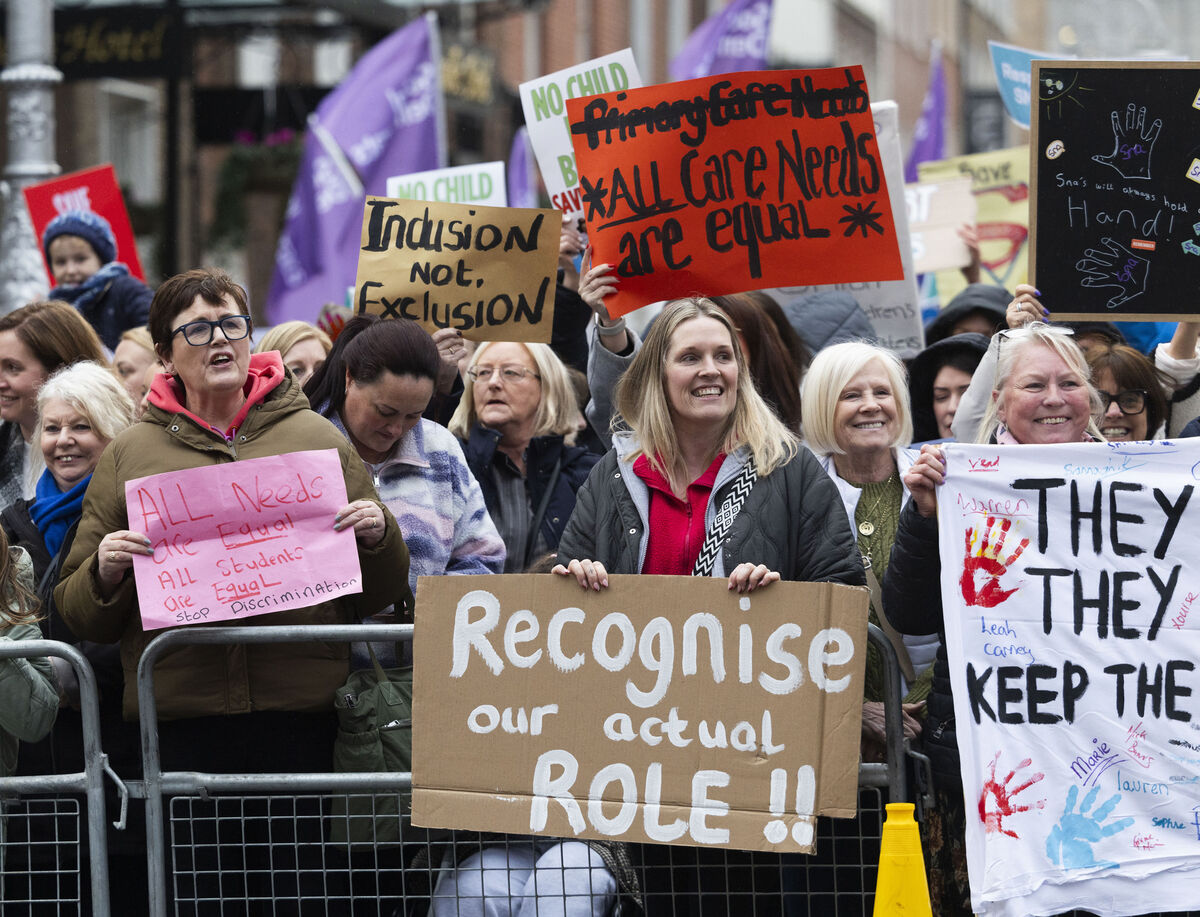
"We're on the ground, so we see the children," said Ms Kavanagh.
"We see how it's impossible for the teachers to teach. There are children in mainstream schools that should be in special schools, or ASD classes. These are children who are non-verbal, or who have behavioural issues because they are in the wrong place.
"The way it is, teachers can't teach, neurotypical children can't get a proper education because of the disruption in classrooms, and the neurodivergent children aren't accessing the curriculum, so none of these children are accessing their right to an education.
Ms Fitzgerald said: “In what other profession would the role change without any discussion? There was no discussion, no documents. What about down the road, and the early intervention we are so important for?”
A spokesperson for the Department of Education said it has worked closely with stakeholders including school management bodies and Fórsa to develop a SNA redeployment scheme which is close to finalisation.
"This provides an additional option for SNAs in a surplus post and was welcomed by Fórsa as a measure that would improve access for children needing those vital supports."
- Jess Casey, Education Correspondent
CONNECT WITH US TODAY



Be the first to know the latest news and updates