Bernard Gloster hoping to make big announcement for Limerick before he leaves HSE
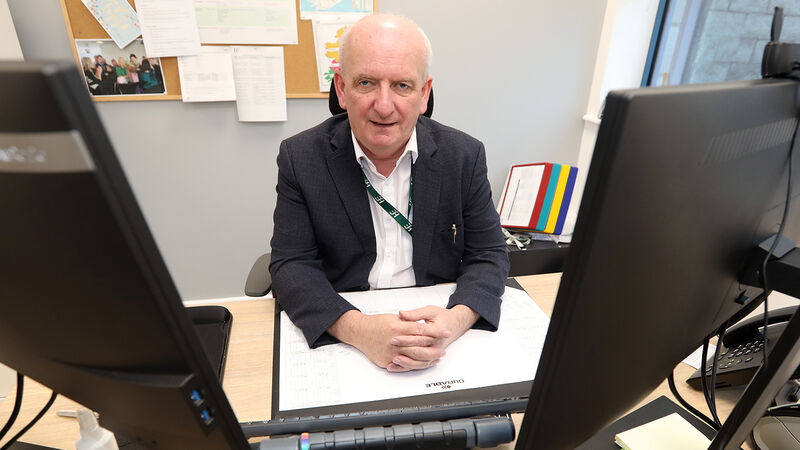
Bernard Gloster: 'I’ve no idea what it will be like when I wake up on Monday morning the 23rd but I’m looking forward to it.' Picture: Brendan Gleeson
HSE chief executive Bernard Gloster is hopeful his final weeks in office will see a significant announcement for his home county of Limerick.
However, his pride in goals reached and regret for others extends beyond his home county.
He occupied the top seat for three years, arriving at the end of the covid-19 pandemic via Tusla. His departure comes as the HSE divides into regions.
A proud Limerickman and previously chief officer for Midwest community under the old health boards, Mr Gloster is hopeful reforms will stick.
“The game changer for the Mid-West was how the minister (Jennifer Carroll MacNeill) decided to consider the Hiqa report,” he said.
Last year, Hiqa advised urgent reforms:
- Option A, expand UHL;
- Option B, a smaller support hospital;
- Option C, a new acute hospital.
“We’re doing Option A, she’s proceeding with B and she’s blending C into the overall plan for the region,” he said.
“I’m hoping that, in fact, the next milestone of that decision might well even come before I leave office in three weeks’ time. I can’t really go beyond that other than saying I’d be really hopeful that the next milestone could be achieved in it.”
Read More
He added: “We will have to wait and see, there’s a lot of sensitivities around that.”
And what should people like Aoife Johnston’s family or campaigner Marie McMahon make of this?
When healthcare goes wrong, he said: "It would be dreadfully patronising of me to say that anybody it has happened to should be satisfied with what comes afterwards by way of correction.
“I think they might feel at least their incident or loss wasn’t in vain.”
He paused, and then said: “I don’t think it’s fair, right or proper for me to say they should ever be satisfied. That type of loss lives with you forever and the impact of it can only be known by the people who experience it.”
At the HSE’s inception in 2005, an aging population seemed far off but now the HSE and private providers grapple with it daily.
“Today 24,251 people are being cared for on the Fair Deal scheme, 72% are in private nursing homes and 4,500 are in public nursing homes,” he said.
“I understand why that came about but the truth is our level of dependency on private provision is too high. I’m not saying we shouldn’t have private provision, but it is too high.”
Private providers can “basically fold up and walk away” if they wish, he explained, or Hiqa can remove registration for failings.
“In either of those circumstances, the HSE is the provider of last resort,” he said.
“We’ve to go in and take it over and quite frankly we have to attempt to clean up a mess and I don’t mean a mess in business terms. But a mess for the people who live in that nursing home.”
He was critical too of a public private partnership model expected to see 530 beds ready by 2024 in seven new nursing homes. None are open including in Cork, Kerry and Tipperary.
“It’s too slow, I wouldn’t go with that model again,” he said. “It’s been far too slow, it’s been highly problematic getting to the end, getting the product delivered.”
Just last week Mr Gloster found himself apologising again. This time to families in Kerry affected by prescribing scandals in children’s mental health services (Camhs). “I stand over what I said last week,” he said.
“I do believe this isn’t just about system failure. I do believe this is an individual practitioner issue and that’s why I think it’s important there’s a referral to the Medical Council and that’s why it’s important the HSEs internal procedures are utilised.”
While he said Camhs has "grown and improved in recent years" he estimated there is "about another three years of an improvement programme in it".
He wants to reassure young people that reforms are starting to take effect. “We’ve 602 people on waiting lists over 12 months which is not good enough, but it’s a long way from what it was,” he said.
“88% of those are in two regions, the northeast and Cork/Kerry and it’s mainly I would say Cork. But Camhs now is seeing about 860 new patients every month, again that’s a long way from where it was.”
About 94% of children are seen within 12 months. "You could say ‘Jesus isn’t that terrible?’ but I can tell you when I first started measuring Camhs waiting lists before I came into this job it was a damn sight worse," he said.
Some 97% of children in crisis are responded to within three days. Staffing is improving, with “only 17” vacant psychiatrist posts out of 144.
The rolling crisis in spina bifida and scoliosis care under Children’s Health Ireland remains a concern.
“Do I think more could have been done, yes, simply yes. That’s the truth,” said Mr Gloster of how they or their parents could have been helped.
He has "great confidence" in the new board and CEO Lucy Nugent, saying this is "a turning point". Culture as much as healthcare was at issue, he said.
“Can it be tackled? Yes it can but you don’t tackle culture by simply going around the soft margins when it is rooted either in resistance or negative power or control. You’ve to hit it head on,” he said.
He added: “There are people in CHI who will never like me for saying this, but I actually believe the decision to bring it back into the HSE is fundamentally a good thing.”
This includes the new hospital — when it opens — offering specialist services supporting paediatric units in Cork, Waterford and elsewhere. “There will be less organisational boundaries to deal with, it will just be more smooth,” he said.
Could there be an intensive care unit for children outside Dublin? “It’s complex and difficult, I’d defer back to the experts on that and see what happens,” he said.
Concerns about “timely implementation” are especially relevant to disability services, Mr Gloster said.
“I think we’re doing the right things, I think we’re doing a lot of good work,” he said.
“We’re just too slow and people are experiencing difficulties because of that.”
He added: “That’s something I carry heavy, because for people with a disability, the difference between having a service and not having a service can be life-altering.”
The tilt towards private car worries him here too, he added: “We buy a lot of disability residential places and again there are some excellent providers but we always have to be careful.”
“What I’m probably most proud of is I think the organisation’s relationships with the public has improved,” he said.
“I think it’s improved because of a change in our disposition, our attitude and our culture. I see that very much as something I pursued.”
Other changes centre on hospitals. “The reality is our demand has grown, every single year that I’ve been here and yet the trolleys have reduced,” he said.
As he spoke on Tuesday 608 people were on trolleys, by the Irish Nurses and Midwives Organisation count. HSE data showed 436 on trolleys and 635 on temporary surge beds.
Acknowledging pressures, he added: “I always underscore that by saying I’m still not happy, because when people are waiting on trolleys who are admitted to hospitals that is not a good thing.”
For non-crisis care, he said: "I went after the longest waiters while at the same time trying to go after the group coming on to get as many people as possible (seen) inside the Sláintecare timeframe."
These targets vary but he points to “phenomenal achievements”. This included an “unheard of” 84% of people seen within 12 months by December.
“I underscore it all by saying I had the privilege of leading, it’s the 150,000 (staff) who did it and that’s the truth,” he said.
Headlines when he started out screamed about four-year hospital waiting lists. He is quick to say lists in some primary care services are still that long despite changes to hospital care.
Anne O’Connor will take on his role, returning to the HSE after a stint with Vhi.
“I do wish her well because for all the great this job is, it’s a very lonely job,” he said.
“It’s a very lonely job at times and you sometimes hold stuff in your head that perhaps you ideally would prefer not to know.”
For now, his wife Mary has a list of jobs in their home.
He may not spend too long there with thoughts already of working for himself as a management consultant.
“On Sunday night, March 22 at midnight my delegation stops and I’m retired,” he said. “And I’ve no idea what it will be like when I wake up on Monday morning the 23rd but I’m looking forward to it.”
CONNECT WITH US TODAY



Be the first to know the latest news and updates