Inside Dublin Zoo: Hippo eye surgery, orangutan birth and elephant herpes battle
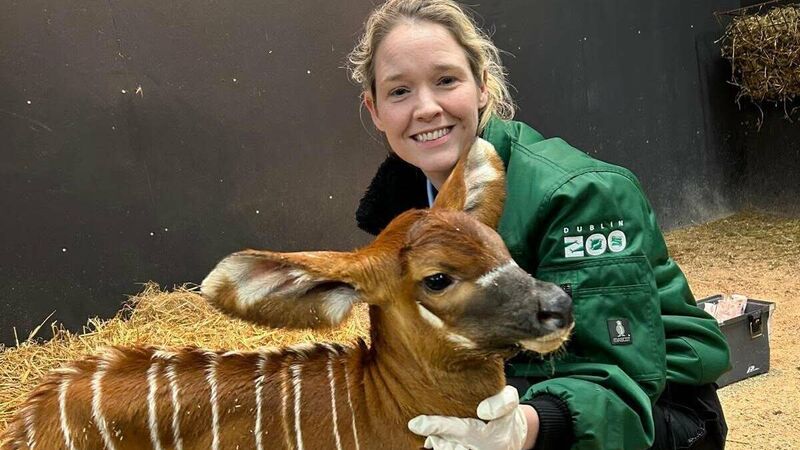
Niamh Gill with eastern bongo calf Nia shortly after her birth. File picture
Whether she’s drawing blood from an elephant or performing cataract surgery on a hippo, Niamh McGill's unwavering dedication to her patients knows no bounds.
During her four years with Dublin Zoo, the specialist vet has seen it all. The mother-of-two opened up about the incredible medical cases she has dealt with, which required both creative and pioneering solutions in equal measures. She also detailed some of the health issues experienced by the animals, including an inflamed uterus in a Humboldt penguin.
“We had a case with one of our older penguins, Kelly, where you could tell she just wasn’t feeling well," she told the Irish Examiner.
"There were reports that she either wasn’t eating or was eating slightly less than normal. We suspected that she probably had an inflammation in her uterus. We actually brought her to UCD Veterinary Hospital and did a full CT.
"Watching a penguin going through a CT machine is an extraordinary experience. She got the full x-rays and the bloods and everything like that. Luckily, we were able to get her the treatment she needed. The biggest concern when it comes to our penguins is avian influenza because it’s such a global issue.
"The main priority is preventing wild birds from accessing their habitat. Penguins are really nice to deal with because they move around in pairs. They mate for life, so have little partners who they are fiercely loyal to.
Orangutan Mujur has also benefited from the support of Niamh and her colleagues.
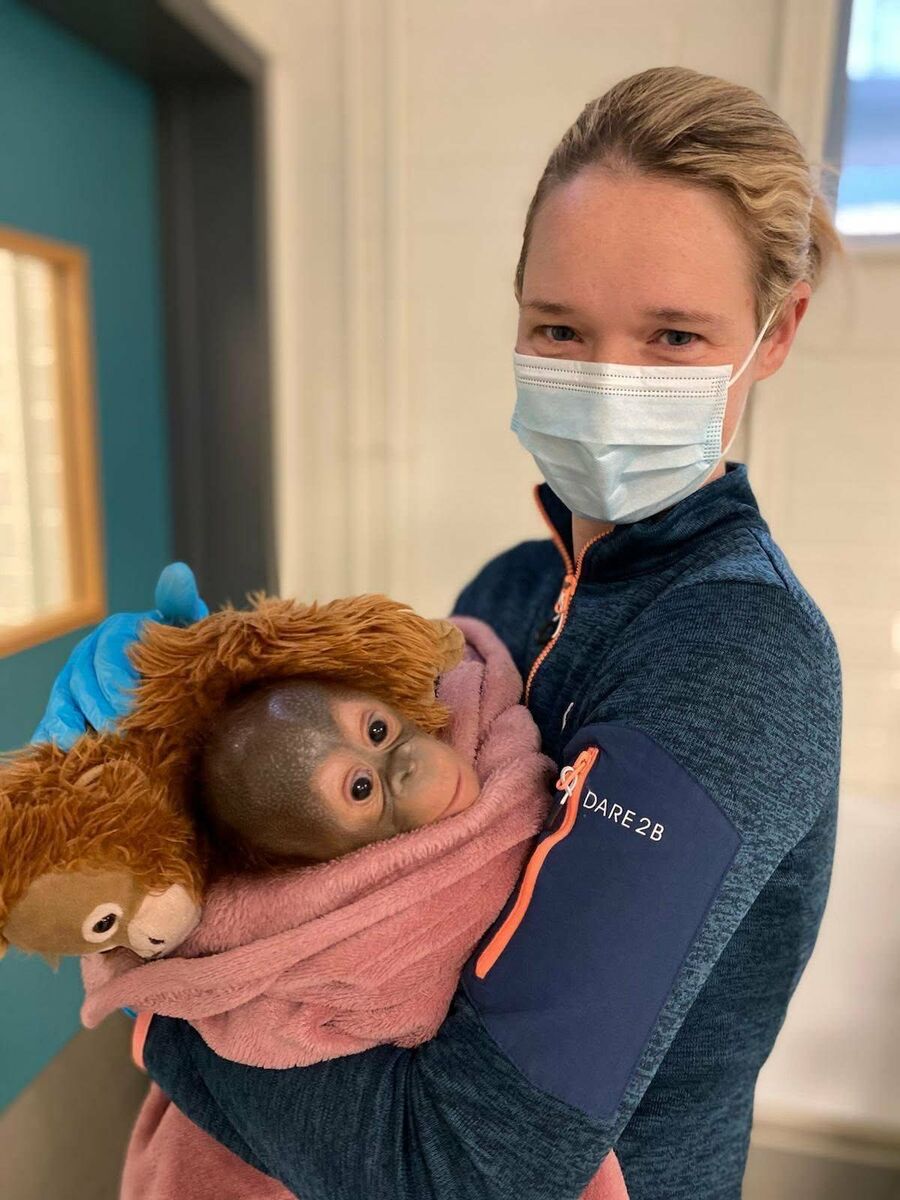
“One of the big events I experienced was the birth of a baby orangutan in 2024 to our 19-year-old female Mujur. She had a baby shortly after I had mine. Sadly, she had lost her first two babies because she wasn’t able to nurse them. So with her third one, we brought in breastfeeding mothers for several months to show her how to breastfeed.
"Our hope was that we could get her to mimic their behaviour. We worked with a lactation consultant who put out a call to a breastfeeding group from Cuidiú.
"It was a really lovely and emotional experience, even if Mujur didn’t get to feed her baby in the end. She was so loving and caring towards her baby, but just like with a lot of human mothers, it never happened for Mujur.
"The baby ended up being hand-reared and has since gone to live in Monkey World. This was probably the most impactful experience I’ve had with a primate. Given it was around the same time I was having my own baby, I was probably on the emotional side anyway.”
Niamh remembers another case fondly that involved the first ever recorded cataract surgery on a common hippopotamus.
18-year-old Imani underwent surgery to restore the sight in her left eye. The operation was a joint effort between the zoo’s animal care and veterinary team and specialist surgeons from France. Imani’s operation was months in the making. However, Niamh insists it was all worth it after noting the improvements to Imani’s quality of life.
"Cataracts in hippos aren’t commonly reported. I don't think any of us had seen them before. Like with all zoos, we encounter a lot of firsts here. Imani came to us from a European zoo and it became obvious to us shortly after she arrived that her sight was causing her a lot of difficulties. They hadn't noticed this where she had come from because she was born into that habitat and had obviously adapted.
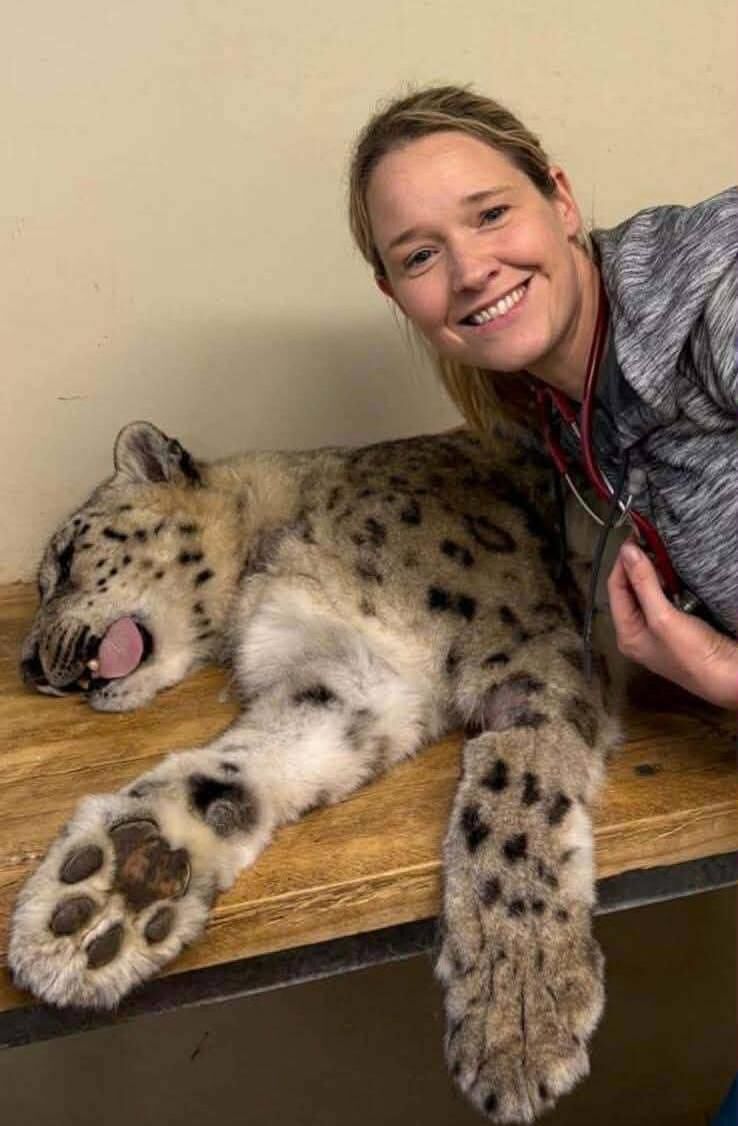
"It transpired that what she had was present from birth. It was only when she was put somewhere unfamiliar that it became obvious that she couldn't see. Her welfare was always a priority for us. She was a bit ginger going places and had difficulties navigating her surroundings. It was important to us that we improved her lived experience.”
Niamh praised the dedication of Dublin Zoo’s zookeepers who refused to give up on Imani.
“The keepers developed a bond and a relationship with Imani to be able to train her for eye drops. We knew this would have to happen before we could undertake any kind of surgery of her eye. It took about three months to train her and she became brilliant. She just let them put in eye drops when they called her. We brought in an eye specialist who brought a big machine, the same as what's used for human cataracts. There was a huge amount of planning and preparation because this was a very big deal.”
Administering an anaesthetic to a hippo was a learning curve for Niamh.
“There are a lot of very difficult things about putting a hippo under anaesthetic. First and foremost, their skin is so thick. There's only a tiny area at the back of their ear where you can actually insert a needle. Obviously, it’s difficult to prevent them from going into the water. Hippos are aquatic, but it would be a disaster having an anesthetised hippo going into the water.
"The eye surgery was just the start, really because, after that, the keepers then needed the next two months to come in every four hours and give her eye drops. They stayed late every evening, coming back at midnight each night. Because of that, we had a successful outcome. This came down to their care and diligence more than anything else.”
She stressed that every day is different.
The job, while rewarding, can often be heartbreaking for Niamh.
"I can remember getting a call to say that one of our elephants Avani was slightly off form after lying down for five minutes in an area where she normally would not be. Animals can't tell us when they're sick so it's the keepers who pick up on these things. That told me everything I needed to know.
"These keepers know everything about the animals they work with. I see on a daily basis just how tuned in they are. We decided to go in with the kitchen sink. We didn't actually dream for a second that our worst fears would come true. We gave her all the medication and took bloods. We gave her fluids and everything she needed. There was nothing more we could do and she died the next morning.”
She recalled how Dublin Zoo was plunged into darkness following the deaths.
Avani, who was seven, had been suffering from the herpes virus, which also took the life of another elephant at the zoo named Zinda who was eight years old.
“The staff who worked in the elephant yard stayed up all night for a week. They moved in to do everything they could for Zinda. That’s how emotionally connected they are to these animals. The elephants died of the herpes virus, which is a massive problem among juvenile Asian elephants. It’s the leading cause of death in the wild as well as in zoos. The good news is that zoos have evolved over the years into conservation hospitals for species that are on the brink.
"I'm really glad to report that there is actually a vaccine that has been developed by a zoo that is now available for use in Europe against the herpes virus. All of this becomes possible through working zoos.”
She hopes that research can pave the way for other animals.
“The plan and the hope is that this vaccine can be administered to safeguard wild populations, because when juvenile elephants die in the wild, that's pretty catastrophic. This is because it leaves a vacuum resulting in the herd declining, and the unravelling of everything in that ecosystem.”
Welcoming new life into the zoo is among the more rewarding parts of Niamh’s job.
“Getting the text message to say that an animal has been born or that a baby has been found never gets old. Getting to be the one who goes down with the keeper to check that mother and baby are doing well is always a privilege.
"You can see the same joy in the animals as you do in people. This promotes very positive welfare for animals. To be a mother, even as an animal, you need to have all your faculties about you. You need to be in a good state of emotional health. We know that when animals are capable of mothering and capable of showing those mothering skills it's because they need to be well for their children.”
CONNECT WITH US TODAY



Be the first to know the latest news and updates