Israeli public is not seeing real horror of the war in Gaza 
The harrowing images of the impact of Israel’s war on Gaza seen around the world are rarely broadcast on mainstream TV news channels in Israel, leading some to say it creates a further dehumanisation of the Palestinian people
Israeli public is not seeing real horror of the war in Gaza 

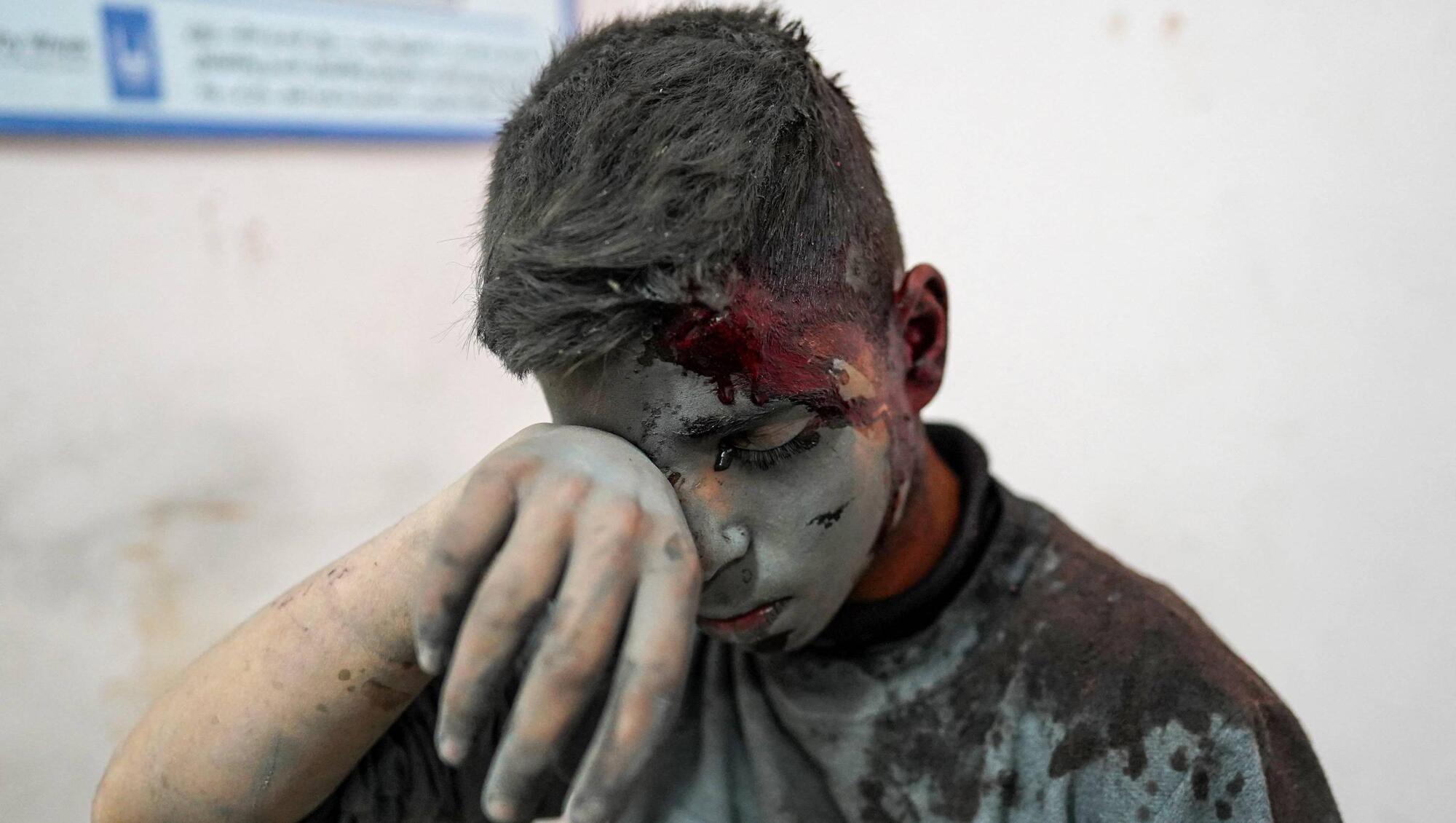
A wounded Palestinian boy at the Al-Aqsa Martyrs Hospital in Deir al-Balah on March 19, following Israeli bombardment in the Nuseirat refugee camp in the central Gaza Strip, amid ongoing battles between Israel and the militant group Hamas; images like these are not being broadcast on Israel’s main TV channels. File picture: Getty Images

As the world’s media continues to report on the harrowing images of emaciated children and a risk of imminent famine facing more than one million Palestinians in Gaza, mainstream television news channels in Israel largely decline to show the full reality of the human misery.

The killing of the seven food charity workers from World Central Kitchen by the Israeli Defense Forces (IDF) did make television headlines, but only fleetingly so.

It is an open secret that Israeli TV news channels since the beginning of the war have, for the most part, refused to show the humanitarian impact of the IDF bombing of Gaza. 

The daily distressing images, carried by mainstream media, of dying or lifeless Palestinian children, bloodied victims in collapsed buildings, and distressing and chaotic scenes in hospitals, are simply not shown to Israeli television viewers.

Any TV footage of destroyed neighbourhoods or cratered bomb sites in Gaza that are shown is almost always devoid of any people at all.

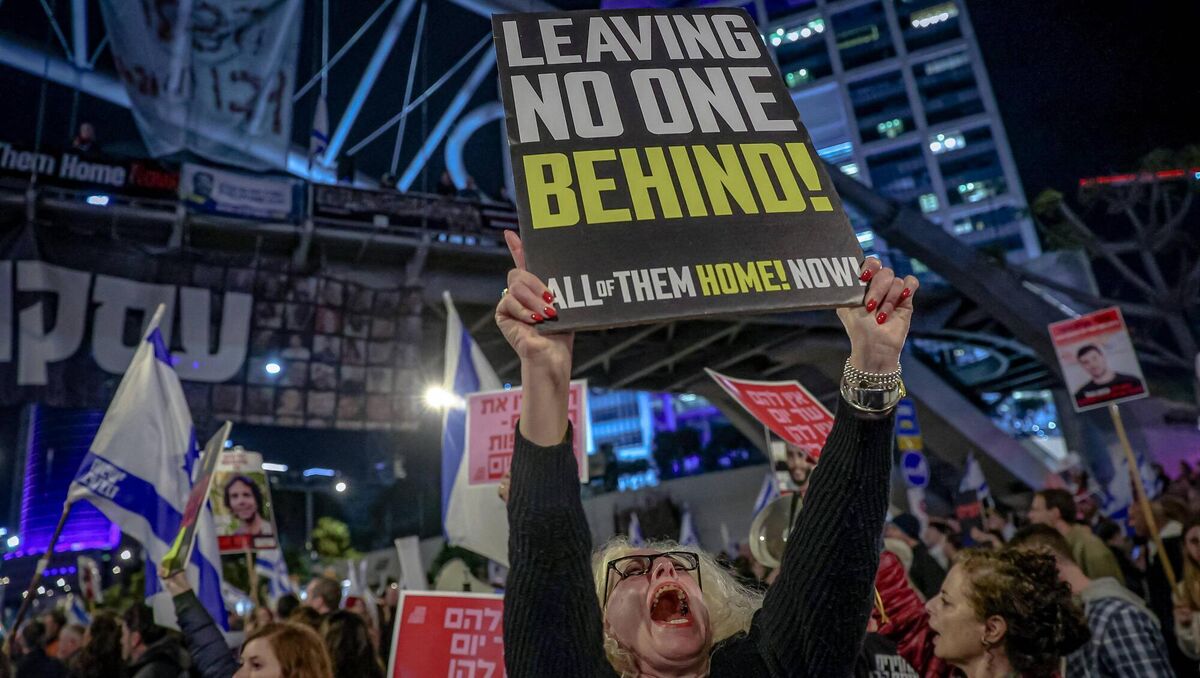
Nightly news coverage of the war for the past few months has been dominated instead by the fate of the remaining hostages, the mounting death toll of Israeli soldiers, ongoing skirmishes with Hezbollah along the Lebanese border, and more recently by the rising military tension with Iran and the resumption of mass street demonstrations against the government of prime minister Bibi Netanyahu.

This week, I sat down with veteran Israeli journalist Anat Saragusti, Israeli parliamentarian Offer Cassif, and family members of Israeli hostages still held by Hamas to ask them all, why, in their opinion, the Israeli television news continues to largely ignore the unfolding human catastrophe in Gaza.

“What you see in Ireland is a different dimension than what we see in Israel,” says Saragusti.
The Israeli public doesn’t see the horrors in Gaza, they don’t see the hunger, they don’t see the dead children, they don’t see the scale of the atrocities.

Saragusti, now 70, was the first Israeli journalist to interview Yasser Arafat, head of the Palestinian Liberation Organization (PLO), back in 1982 in a besieged Beirut.

“The Israeli media is still telling the story of October 7 (when Hamas fighters attacked Israel, killing about 1,200 people and taking 250 hostages),” she says, before adding somewhat pointedly maybe it’s because “some of the rest of the world [only] start telling the story from October 8”.

Saragusti is adamant, however, that there is no state censorship directly or indirectly but rather the mainstream media is engaging in “self-censorship based on the sentiment of the people”.

Yarden Gonen (30), the sister of Romi Gonen (23), now held for more than 180 days in captivity in Gaza, admitted she doesn’t “know why they [Israeli TV] are not showing” the horror in Gaza.

“Hamas controls every move and every action coming out from Gaza, and we know they are lying," she says.

She is convinced Hamas is staging deaths for a gullible international media, “you can see they are holding bodies, but then you see the bodies moving ... you can’t really believe that.”

Gonen is not just deeply sceptical of what she calls Hamas propaganda but is also distrustful of the international media, arguing “the BBC has published a lot of lies so many times, during those five months”.

Israeli protesters hold placards and block a road during an anti-government demonstration calling for the return of the hostages held in Gaza. File picture: Getty Images

Many  Israelis, including Gonen, see the current conflict not through the prism of the decades-long Israeli-Palestinian conflict but rather through the lens of Islamic fundamentalism versus an enlightened West.

“Israel is only the first [victim] because it’s the nearest,” she says.

Gil Dickman (31), whose cousin Carmel Gat (35) was taken hostage on October 7, has been a vocal advocate for the return of the Israeli hostages.

“Many Israelis don’t feel they have the strength to look right now at what’s going on in Gaza.

“We are very much into our own pain; the media don’t want to show it because people don’t want to know this is part of their reality.”

Last week marked six months since the remaining 130 hostages were taken by Hamas.

Ofer Cassif, a left-wing Israeli politician in the Knesset (Israeli parliament), is firmly of the opinion “that in 10 or 20 years, when this era, this war, is analysed, the Israeli media will be criticised profoundly and negatively … they don’t fulfil their real job”.

Cassif, who is Jewish, is a parliamentarian from the small Hadash Party, a predominantly Arab-Palestinian party in Israel.

Recent polls show that while three quarters of the Israeli voting public wants Israeli prime minister Bibi Netanyahu to resign, roughly the same number continue to support the war on Gaza. File picture: Maya Alleruzzo/AP

He narrowly escaped expulsion from the Knesset in a vote of his fellow parliamentarians, on account of his support for the International Court of Justice genocide case against Israel.

Like Saragusti, Cassif argues that media censorship is “voluntary self-censorship in favour of the government policy”.

“They are literally lying, and they’ve been hiding the truth,” he says.

Cassif admits that the failure of the mainstream media cannot be divorced from the fact that “most people don’t want to know, they don’t want to know because no one likes to see a villain in the mirror”.

When asked if Israelis are seeing some of the horrific images from Gaza that the rest of the world sees daily might it affect their attitude and support for the war, Dickman is hesitant.

“I’m not sure that shoving it down their throat is the way to change their mind about it, I believe we are at war right now. People want to survive and win that war,” he says. “Most Israelis would just flip the channel and move on.”

Saragusti is equally unsure. Seeing the true horror, she says, may not change the sentiment of the people. 

But she is unequivocal that it is the responsibility of Israeli media, as professional journalists, to show the whole picture, including telling the full story of “the killing of thousands of small children”.

She would like to believe that if Israelis see and hear this, maybe things will change.

Maybe, they will challenge the government to do something to [end] the war.

But she despairs that the “majority of the Israeli public doesn’t care what’s going in Gaza”.

Cassif says that while exposure to the reality in Gaza, may not “immediately” change political views it may “crack the spiral of silence, that allows alternative voices to be heard”.

Night after night the three mainstream TV Channels in Israel, Channell 11, 12, and 13, devote hours of TV studio time and discussion to the attack of October 7, the plight of the hostages, and the wider current conflict but images of humanitarian horror in Gaza, just 60km from Tel Aviv, are rarely broadcast.

When asked if the journalists themselves might have a different conversation off-screen to the one they present to middle Israel, Saragusti admits “it’s a good question” but adds many Israeli journalists “are fed by the army, so they see themselves as kind of spokespersons of the army”.

“Most of the journalists do know what is going on [in Gaza], they do consume CNN or BBC. They are informed, but they simply reflect the sentiment of everyday Israelis," she says.
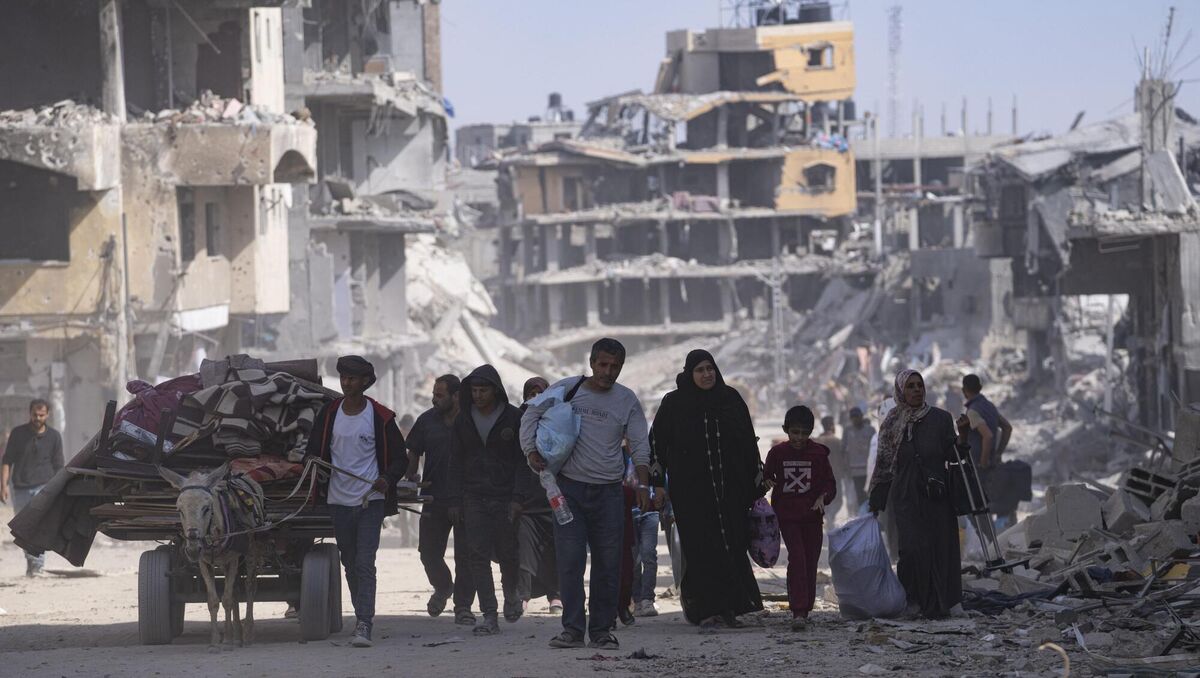
Palestinians walk through the destruction in the wake of an Israeli air and ground offensive in Khan Younis, southern Gaza Strip, on Monday. Picture: Fatima Shbair/AP

Recent polls show that while three quarters of the Israeli voting public wants Israeli prime minister Bibi Netanyahu to resign, roughly the same number continue to support the war on Gaza.

Dickman, whose cousin languishes in captivity, clearly regrets the huge loss of life in Gaza but he, like the vast majority of Israelis is adamant where the real blame for the horror lies.

With his voice audibly rising, he defiantly declares: “We fight for life, while on the other side, there is a terror organisation that is sanctifying death.”

As of this week, the UN Office for the Coordination of Humanitarian Affairs has estimated that 13,800 children have now been killed as a result of Israeli airstrikes launched in response to Hamas-led terror attacks on Israel.

One cannot help but wonder, in ignoring the depth of suffering in Gaza, mainstream television news in Israel has contributed to the dehumanisation of Palestinians and therefore given enormous succour to the government of Netanyahu to sustain the war.

  • Paul Kearns is a freelance journalist living in Tel Aviv

x

More in this section

Lunchtime News

Newsletter

Keep up with stories of the day with our lunchtime news wrap and important breaking news alerts.

Cookie Policy Privacy Policy Brand Safety FAQ Help Contact Us Terms and Conditions

© Examiner Echo Group Limited