Joe McNamee: Can we fix our broken food chain?
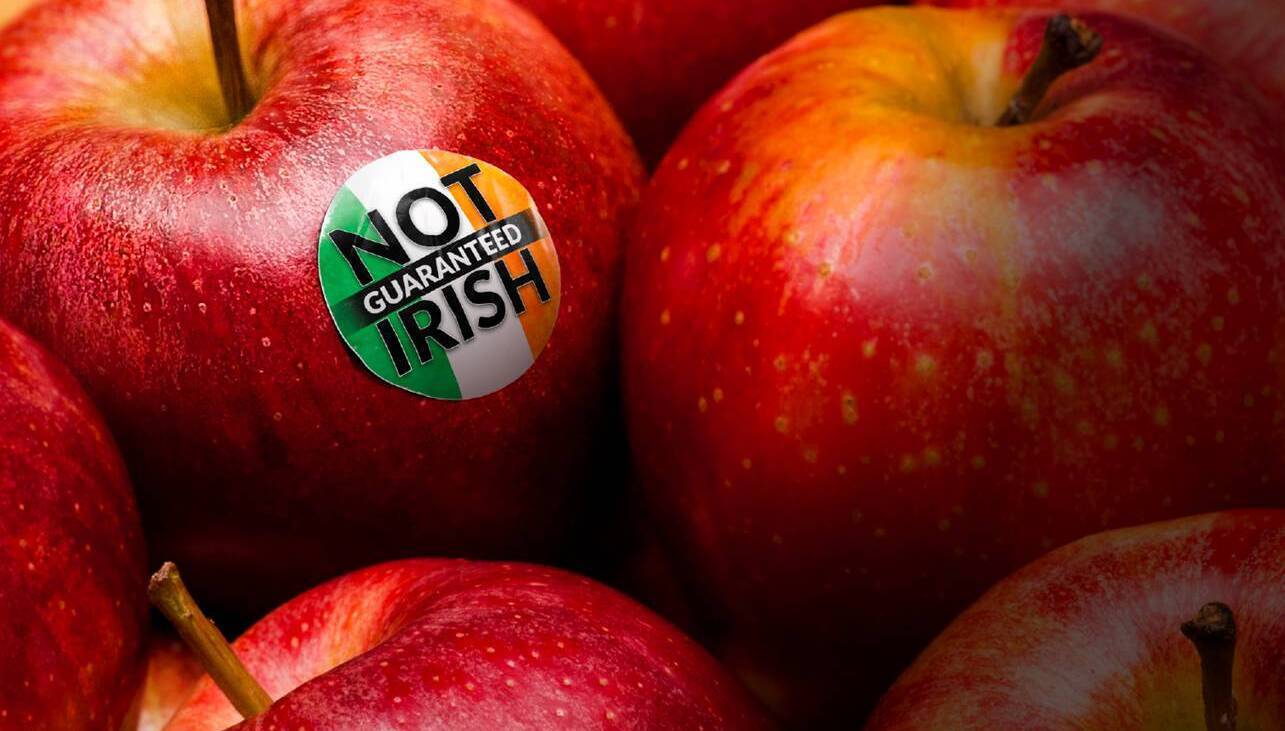
Some 83% of the fruit and vegetables we consume are not Irish. We now import 70,000 tonnes of potatoes each year — as well as tens of thousands of tonnes of apples, carrots, onions, and cabbage. In a Special Report, we investigate where our food comes from and why it matters.
Our domestic production of vegetables, fruit, and food-quality grain has fallen drastically over the last three decades.

Our domestic production of vegetables, fruit, and food-quality grain has fallen drastically over the last three decades.

A nation’s food security refers to its capability to feed itself, to grow and produce sufficiently to satisfy the national appetite, without being dangerously overdependent on imported foodstuffs.

You’d imagine such a concept was moot in a country once marketed globally by Bord Bia as “The Food Island”, a country that has gone from famine to feast over 175 years in such dramatic fashion, that we are now the second most obese country in Europe (26% of the population, way above the EU average of 16%, and second only to Malta at 28%).

And yet our domestic production of vegetables, fruit, and food-quality grain has fallen drastically over the last three decades.

We now import 83% of all our fruit and vegetables and are so heavily dependent that were all routes into the country to shut down overnight, within days, large gaps would emerge in the national diet as serious food shortages kicked in.

However, the real shocker is not that the exotics we now regard as everyday staples — oranges, lemons, bananas, avocados, mangos — would disappear, but so too would local staples produce we grew in Ireland for years, until a combination of State and EU policy ended the growing of so much of our vegetable and fruit requirements — as well as food-quality wheat — and we instead turned to imports.

So, no more cabbage for the bacon, or carrots and onions for the stew. Bread of all kinds would disappear along with most fruit from your typical five-a-day.

In a country utterly ravaged by the Great Famine, we’d eventually be reduced to fighting again over potatoes.

For generations, the Great Famine was arguably the single most defining event in the Irish national psyche. However, the more it recedes further into history’s rearview mirror, the more it seems like a bad dream.

This process has accelerated to warp speed in recent times, finer details growing ever fuzzier as they are supplanted by our modern 21st-century food culture where nothing succeeds like excess, all documented online in an endless digital stream of constantly renewing Insta-fabulous foodstuffs and tasty TikTok treats.

In such an Ireland, the notion of food shortages seems positively outlandish.
Some 10 years ago at public food events or gatherings, I would speak of a profoundly broken food system, national and global, and its inherent potential for generating future food shortages in Ireland.

The most common reaction was sceptical sniggering, occasionally open dispute or derision, and often from experts and even food scientists. That has changed over the last decade.

We have seen food shortages in the developed world: Post-Brexit Britain, in particular, delivering a masterclass in the level of geo-political fumbling required to destroy a native food production sector and leave supermarket shelves bare of imports.

We’ve even had our own brushes with scarcities and shortages.

Causes have been multiple and often intertwined: Pandemic, war in Ukraine (the world’s ‘breadbasket’) and other geo-political turmoil, soaring energy costs, and massive disruption to transportation and global supply chains.

These problems are only getting worse, and it is impossible to ignore the now visible vulnerabilities of the current long supply chain global food system which supplies the developed world.

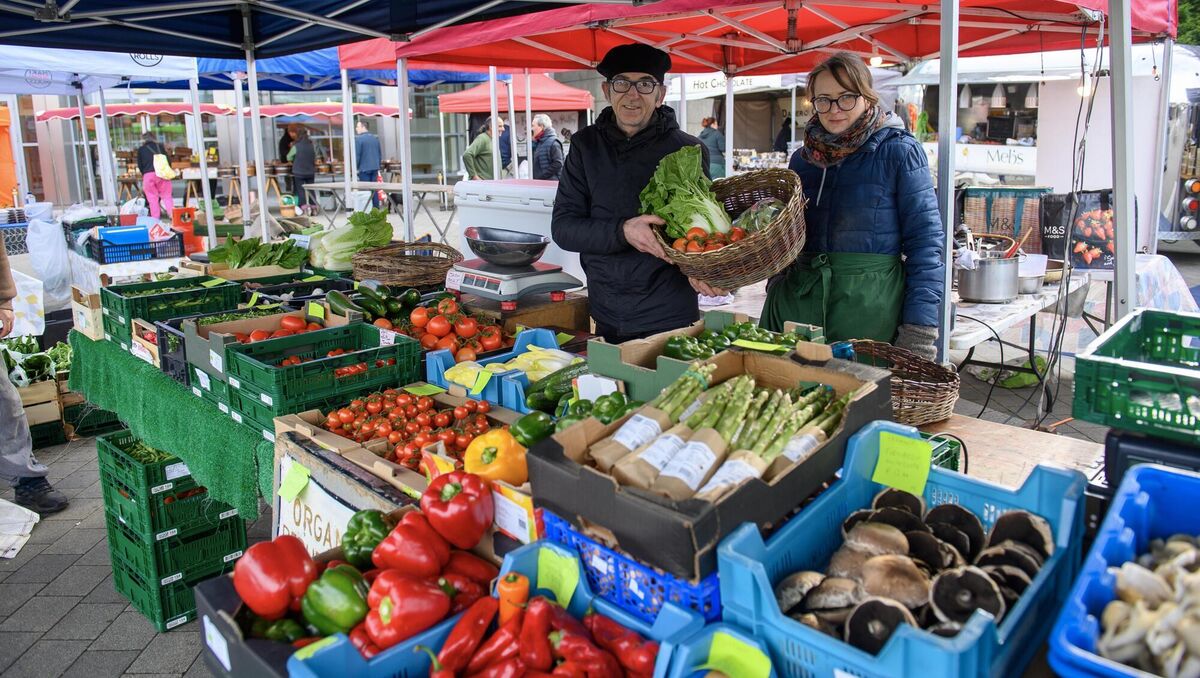
Willie Doherty with Helen Horgan at the Organic Republic stall at Mahon Farmers Market, Cork. Fresh tomatoes at the stall show what can be grown in Ireland. Picture: Dan Linehan

We haven’t even mentioned climate change.
Climate change is already impacting hugely on our native agriculture and growing sector, as it is doing all around the world.

The current global food system is responsible for 35% of all the planet’s greenhouse gas emissions, and that figure doesn’t take into account emissions from transporting that food.

Every person on this planet is part of a food system, the vast majority as eaters/consumers.

Yet, with each passing year in the developed world, we know less and less about where our food comes from and how it gets to our plate.

The industrial food system is very heavily implicated in the rise of obesity, diabetes, and a whole host of diet-related illnesses and conditions.

A recent UN report estimates 19% of food produced around the world, 1.05bn metric tonnes, went to waste in 2022.

The further a society distances itself from the responsibility for growing and producing its own food, the more vulnerable it becomes to shocks and stressors — both natural and manmade — to the food system.

EU membership

Membership of the EU has been very, very good for the business of agriculture.

It has been far less so for farmers, save the very largest.

The EU’s Common Agricultural Policy subsidy system dictates how farming works across Europe.

The former single farm payment scheme was disastrous for Irish horticulture-based farms and only added to the erosion of mixed farms — the most sustainable farming model — as agriculture was substituted for monoculture, the stated condition being as follows: “Farmers receiving the [payment] have the flexibility to produce any commodity on their land, except fruit, vegetables, and table potatoes.” Table potatoes? Ireland?

This situation prevailed until the Scottish Derogation in 2013, after which tentative commercial growing of onions began again for the first time in some years.

Recently speaking to a grower, he estimated there were about four serious commercial growers of onions in Ireland — most of our onions are still imported — roughly 38,500 tonnes annually.

Without the supports available to their livestock and dairying counterparts, growers were further trammelled by commercial relationships with the multiples.

As the large chains imported more and more produce, Irish produce was often used for below-cost-selling — a “loss leader” to draw in consumers, but with growers taking the financial hit.

Most Irish growers receive pretty much the same prices for produce in real terms as they did back in the '90s.

The policy of putting all our eggs in the exports basket hasn’t helped. 

Irish agricultural policy since 2010 has been driven by a policy of vastly growing agri-food exports.

The results have been spectacular as, between 2010 and 2020, the value of agri-food exports increased by 60% to €14.2bn.

However, that has been to the benefit of agri-businesses, not the farmers who continue to struggle.

Teagasc estimated dairy farm income last year would be down 60%, while a poor harvest would drag the overall average farm income in 2023, down 44% to just under €24,800.

There has been much agonised handwringing over the plight of the primary producer, but absolutely nothing of substance has been done to improve their situation.

The best food is always local and seasonal. Selected in its prime, it is usually tastier and more flavoursome than imported produce.

It is always more nutritious as the shorter the distance it has to travel, the fresher it is.

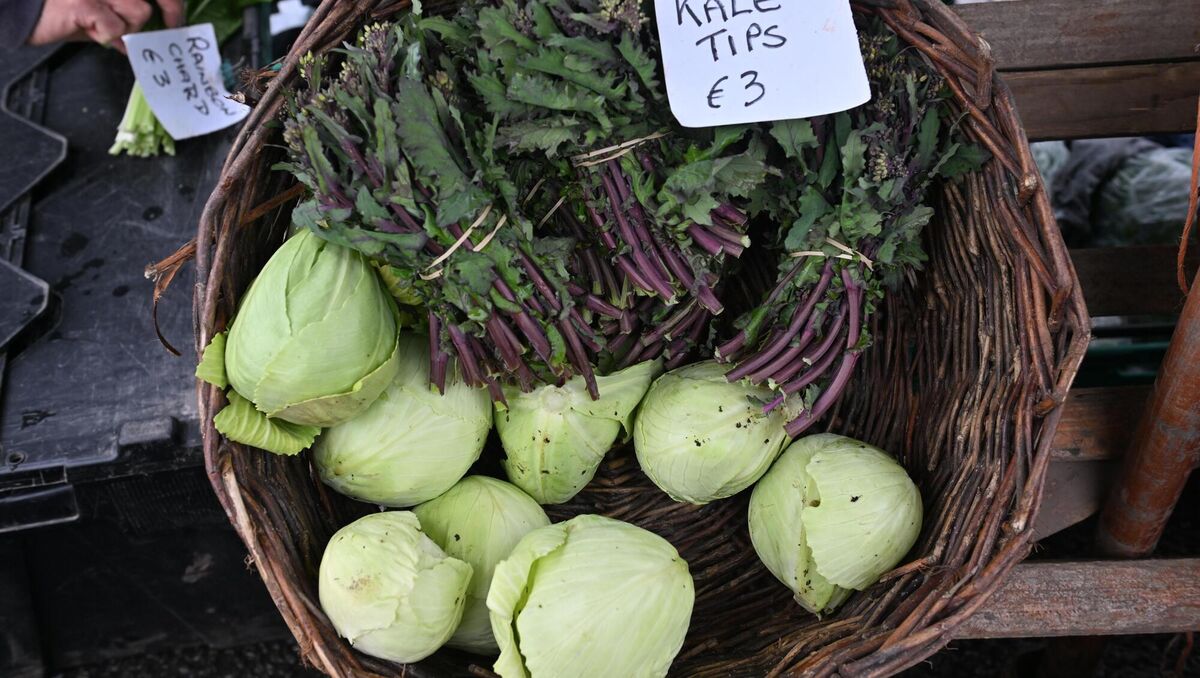
Kale tips at the Robinson's vegetables stall at the farmers market in Macroom, Co Cork. We are able to grow a very wide range of produce in Ireland. Picture: Dan Linehan

Yet we are, bizarrely and repeatedly, told that Ireland is not suitable for growing so much of the produce we rely on.

It has become an accepted wisdom that Ireland isn’t suitable for growing food-quality wheat, to mill for bread and baking.

However, until the end of the 1980s, Irish wheat yields were superb. It simply became cheaper to import foreign wheat and persuade farmers to switch from tillage to livestock and dairy.

Bord Bia’s head of horticulture recently stated that growing apples in Ireland was “tricky”.

We have grown apples in Ireland for thousands of years — cider was once more popular than beer.

The country was once flush with a myriad of heritage varieties, and commercial apple growing was very successful throughout the 20th century.

Of course, there are challenges — hugely exacerbated by climate change — but that is the same the world over, and Ireland remains a unique place in which to practice horticulture.

Trace the line of latitude west around the globe from Ireland, and the next stop is Newfoundland, Canada.

In Newfoundland, it usually begins snowing in November, generally finishing in April — though May snowfalls are not unknown.

During winter, temperatures plummet to between -10˚C and -25˚C. The record low is -54˚C.

In Ireland, anything below -5˚C is a news item.

It rains in Ireland, but we get sufficient annual sunshine which — allied to our prime geographical location, where warming waters of the Gulf Stream first hit Western Europe — means we actually have one of the most clement growing climates in the world, both warm and moist, and a longer annual growing season than any of our European neighbours.

We are able to grow a very wide range of produce, from fragile salad greens to robust earthy tubers, and all points in between — including superlative apples, strawberries, raspberries, carrots, potatoes, cabbages, onions, and what are generally recognised as the best oats and barley in the world. The list doesn’t stop there.

Independent growers

Some of our smaller specialist independent growers have pushed boundaries further still, turning exotic South American and Asian crops and even criminally underutilised pulses into new Irish staples, to satisfy the small but growing band of consumers not prepared to accept inferior imports.

These growers — making a living without any farming subsidies at all — will never feed the entire country as it stands.

They are pathfinders, demonstrating what is possible with the supports and political goodwill that have been so long available to the dairy and livestock sectors.

The concept of food sovereignty was developed at the Nyéléni Forum, in Mali, in 2007, to support the “peasant” farmers who make up the bulk of the world’s agricultural workers.

The focus was as much on environmental, cultural and social issues, as it was concerned with economics.

We need a similar approach to ensure our national food security and provide a guarantee that we really can feed ourselves as a country, should that need come to pass.

One of the best ways of doing that is to upend the current model for our food system, instead placing farmers at the top of the pile, not the bottom where they currently languish.

That includes farmers of all shapes and sizes, from the tiniest holding to the largest, and ideally re-embracing mixed farms, moving away from monoculture and back to agriculture, to create a multilayered and multi-tiered food system that combines short and long supply chains, and that is not solely concerned with profit.

It needs to become a system that builds in genuine resilience to internal and external shocks, and begins to reverse so much of the destruction of the environment which has only added to rising food costs and shortages and created so many of the conditions for our current broken food systems.

Our farmers and growers are not simply another form of “livestock” to be maximised for economic potential, they are the very heartbeat of our largest indigenous industry and deserve to be put to the very front of any future food production model.

Prof Tim Lang, of London City University and the man who coined the term “food miles”, said: “Food isn’t just about nutrition, or the environment, or questions of sustainable farming, or food industry practice, or ethics, or trade justice, or affordability.

“It is all these things.”

More in this section

Lunchtime News

Newsletter

Get a lunch briefing straight to your inbox at noon daily. Also be the first to know with our occasional Breaking News emails.

Cookie Policy Privacy Policy Brand Safety FAQ Help Contact Us Terms and Conditions

© Examiner Echo Group Limited