'Lose the hate, be kinder': Drag queen feels discrimination is pulling country backwards
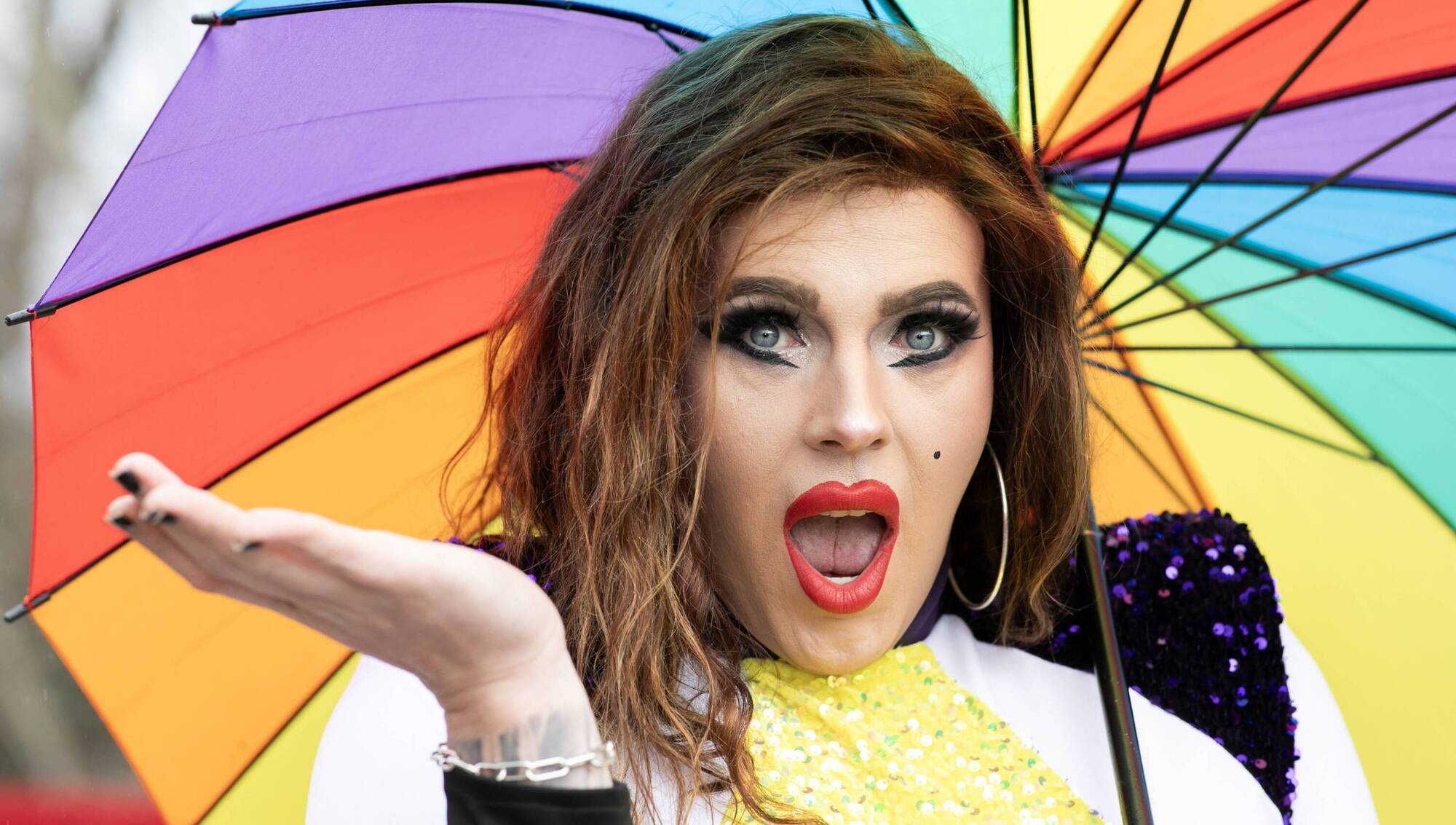
Carrie Déway: “I am a true believer in reaching out and believing that things are meant for you, like the circus, I opened the right door at the right time and met the right person." Photo: Gareth Chaney
Carrie Déway touched up her make-up one last time before taking a deep breath and stepping out onto the streets of south inner Dublin.
Wearing platform shoes, and a black dress with lace tights, as well as a long dark wig, she feared passersby would point and laugh. After anxiously delaying, she felt a rush of power, put one foot in front of the other and began to walk forward.
It was 2009, and the then 19-year-old was making her way into the former well-known LGTBQ+ nightclub The Dragon in Dublin city for her debut drag queen show. Carrie's journey to self-acceptance has taken many turns since then.
During the day, Carrie is 34-year-old Miko Verrecchia, a gay non-binary person who works as an event organiser. Carrie identifies as female and uses the pronouns she/her, while Miko is gay non-binary and uses they/them pronouns.
Miko grew up in Crumlin with their parents Mary and Thomas as well as their two older brothers Anthony and Paul. The entire family has always embraced Miko’s drag queen persona Carrie and has attended most of her shows.
“It was a tough enough time, being gay in the south inner city,” said Carrie as she sat down with the this week and spoke about that moment in 2009. Can you imagine walking out that front door that first night in a dress?
“It was surreal putting on the make-up. I told myself ‘You’ll never get used to this’.
Carrie’s performance that first night in the Dragon was an instant success and she became loved for her singing and dancing, as well as packed-out family bingo shows where young children loved “the princess dressed in sparkly clothes”.
But now, after 15 years on stage, Carrie has decided to hang up her high heels and run away with the circus.
“It’s a very emotional time,” she said. “But it’s also the right time. The queens of Ireland are so hard-working. People don’t realise that our shows are sometimes the first port of call for someone who is trying to figure out their sexual orientation, even though we shouldn’t have to ‘come out’.
“People come in out of curiosity, and that’s often the first step for them. It’s an important part of the community.

“The move to the circus for me came because my best friend Sian has been in the circus as a dancer for seven years. In 2019, she was in Duffy’s Circus here and I was asked to join her and the magician in Paris for one of their travelling shows and then I was offered a six-week contract.
“But I didn’t go. That door closed and I thought the circus was over for me. I honestly believed I’d never get that opportunity again. I did, though, get another offer and I’ll also be in Europa Park for the summer."
Looking back on her career as one of the best-known drag queens in Dublin, Carrie describes the shows as “a form of activism”, hailing Panti Bliss as an inspiration in the field.
Once Carrie changes out of drag, she instantly becomes Miko, who described their alter ego as a “wild woman who is nothing like me”.
Miko said the only time they suffered any sort of discrimination was at the local all-boys CBS Cristian Brothers school. “We were the last of the strict Christian Brother’s schools,” said Miko. “So, you have this strong working-class area with strict Catholic brothers.
“Even though I didn’t come out until I was 17, everyone knew I was gay. I had boyfriends and girlfriends. I was so terrified someone would tell someone else that I was gay, and it would spiral.
“I used to dress up in my mother’s high heels from the age of five when she would go out and Paul always covered for me if I fell. He was so supportive."
But the pressure of feeling like they had to hide who they were, led to a life-changing moment for Miko who first attempted suicide at 16.
“It took some time to realise that nobody actually cared if I was gay or not. I was trapped in my own head, and I was hospitalised and treated for mental health issues.
“I felt I could not tell anyone, and I used to stay wide awake at night worrying over it and bottling it all up. I did get abuse, of course, but in the end, if anyone did start on me in school, the lads would jump in to protect me."
After sitting the Leaving Cert exam at 17, Miko worked at a number of jobs, including a technician in a pharmacy and manager of two stores.
At 23, Miko moved to the UK after receiving a full scholarship at Stella Mann College of Performing Arts in Bedfordshire following an audition.

Tragically however, while living in the UK, Miko’s beloved brother Paul, who was suffering with depression, took his own life by starting a fire in the family home on May 5, 2014.
“He was only 29 and in a very dark place,” said Miko. “He was searching for answers during his depression and studied every religion. He couldn’t get past how bad he was feeling. He locked the whole family out of the house one night before setting it on fire and losing his life.
“I received a phone call with the news. I got a plane and travelled back and never spoke a word for 48 hours. I was in utter shock. Paul was a lovely brother, and I miss him. My mam is a very strong person, but she has her moments.
“We talk about him all the time though. But I couldn’t cope with his death and tried to end my life again. I am grateful to have survived. It was a very difficult time. But it’s about getting help and talking to people.
“I am a true believer in reaching out and believing that things are meant for you, like the circus, I opened the right door at the right time and met the right person."
Despite the trauma Miko has endured over the years, they carried on with their performances on stage as Carrie which they see as expression and healing.
“Carrie is a strong-minded woman, she is my suit of armour, and everyone loves her,” said Miko.
“She is wild, but she has never ever had a partner. No man has ever gone near her, and no man ever will. I often say she’s a lesbian, she loves the women, but I think she is more of a sister or best friend.
“There is great sisterhood among the drag queens."

Last week, Carrie performed at her last LGTBQ+ matchmaking festival at the Dromoland Inn in Co Clare where she sang an emotional rendition of Barbara Streisand’s ‘Send in The Clowns'.
“Everyone was in tears,” said Miko. “It’s coming to the end of her shows, and it is hard. But times are changing, and the circus is for me, it always was. There are new drag queens, and the community is particularly big in Dublin, Limerick, and Cork, but there is a big scene now in Belfast too.
“But something has changed in the community, all those years ago, even up to before covid, drag queens got so much love and support. If you walked through the city, people wouldn’t bat an eyelid, and if they did, it would be to compliment you.
“We were moving forward as a country when we officially passed the same sex marriage referendum in 2015.
“Now, there is a lot of hate, including the far-right who are affecting my community, it’s not just about racism it’s also discrimination. That’s the sad part, there is a lot of anger and hate there, and I just want to say to people 'lose the hate, be kinder'.
“The transgender community is really being targeted too, and that’s a really sad thing to see, because we were progressing, but sadly, I feel we are going backwards.

“We try to keep things very positive, even when drag queens don’t like each other, they always respect the art. We say, ‘I might not like you, but I respect your work’ and we get on with it.
“What I do with my life is not anyone’s business. I am not hurting anyone and there is a lot of fun in what we do, but there is also support among us for the gay community.
“I hope things change for the better in Ireland, for me though, it’s all about walking forward, just like Carrie did that first night in her platforms, you just have to take a deep breath and keep going."
- Carrie’s last show will be in The Vibe in Cork on February 24.