'Ever widening' economic gap leaves North-West lagging far behind Dublin and Cork
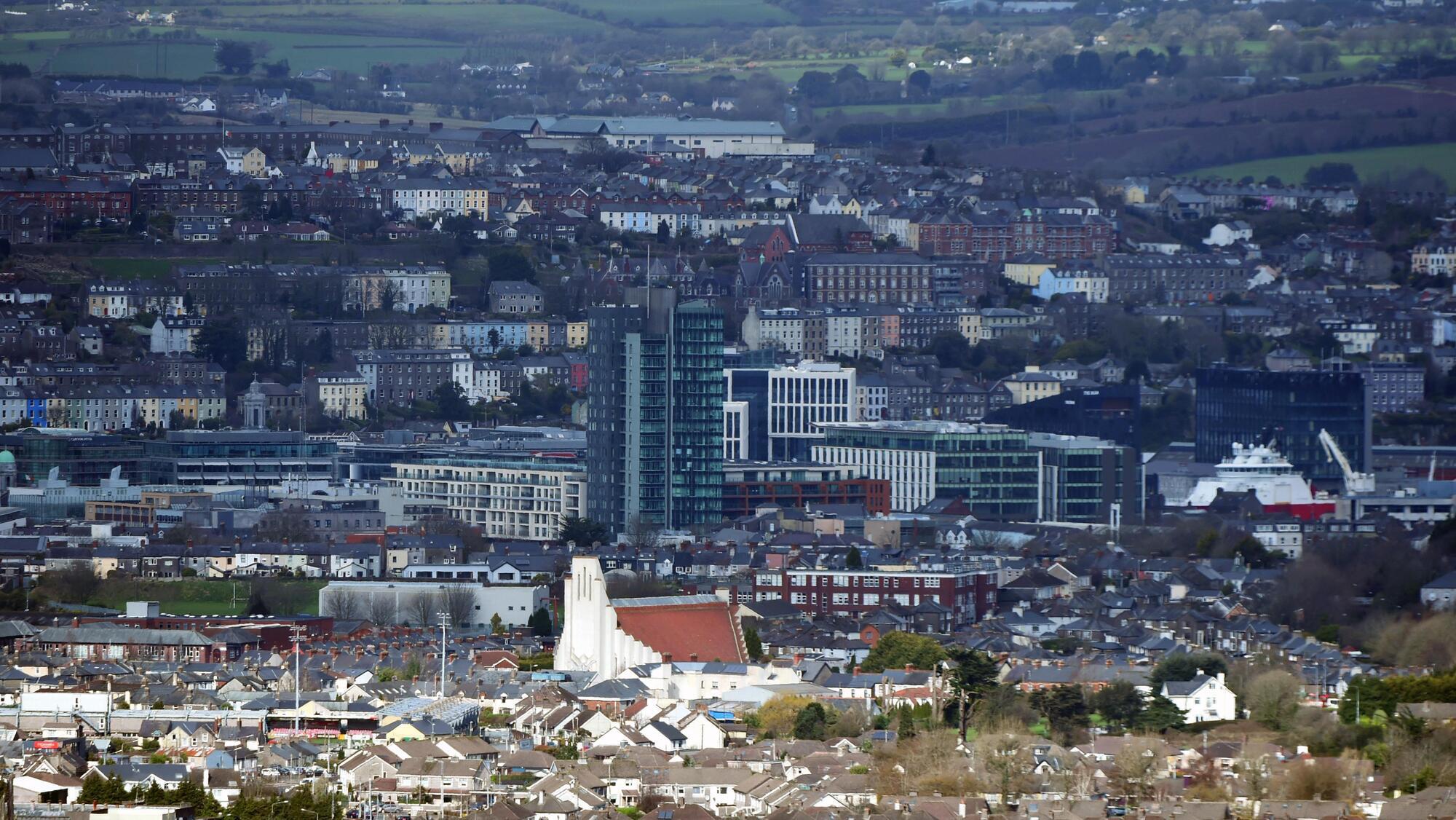
According to the 2022 European Commission country report for Ireland, regional imbalance is likely to grow, rather than reverse, largely due to the ability of urban centres like Cork and Dublin to attract multinationals. Pic: Larry Cummins.
“The border region's GDP per capita has dropped to 52% of the EU 27 average — the lowest since records began. Think about that. Compared to all other EU regions, the border region stands at 52% of the EU average. Its GDP has fallen off a cliff. Generally, I am not given to hyperbole but this is disastrous.”
The warning from independent TD Marian Harkin in a Dáil debate at the end of April was stark. The border region, and the North West at large, is falling behind in a way that might not be reversible.
But Ms Harkin went on: “If you look at the entire northern and western region, you can see that its GDP is at 83% of the EU average. It is not even making the average of all EU regions.
"In 2006 — 17 years ago — the border region was close to the EU average at 98% but it has been steadily declining since and has hit the new low of 52%. This is just not acceptable. In fact, it is a disgrace."
In the debate, Taoiseach Leo Varadkar said that the figure itself was not the whole story. GDP is not everything, he said. GDP must come up with “a very big health warning” he added.
“The presence of Apple’s European headquarters in Cork alone throws the numbers for GDP in the south west region, he argued, while the presence of Microsoft throws the numbers dramatically for the eastern region,” the Taoiseach said.
But is this a case of a regional imbalance that is impacting quality of life across the board? Or is it a misunderstood figure, an incomplete story? Has Dublin left Ireland’s regions behind?
In a way, Mr Varadkar is right, says the North-West Regional Assembly's economist, John Daly.
"GDP is an input to the output which is disposable income, because that measures the real economic wellbeing. So the Taoiseach is right. But if you look at disposable income per capita in the region, it was 92% of the State in 2010 now it's 84%."
According to CSO figures from February, households in the Eastern and Midland region had a median household disposable income of €53,101, compared with €42,690 in the Southern region, and €38,530 in the Northern and Western region.
Mr Daly says he accepts that the North West will always be behind Dublin on metrics like this, but says that a regional imbalance impacts many things. This means that after taxes, the average worker in the Dublin and Midlands region has about €27,000, while in the North-West this drops to €21,000.

"The area suffers from a lack of urban centres which disadvantages us in terms of attracting high-value client companies and growing the local economy that way. The European Commission has said that the North-West is the only area in Ireland classed as a moderate innovator and an area in transition."
This is affecting the region's ability to grow, and to retain young people.
For its part, the Department of Expenditure says that it is committed to balanced development of the regions. They say that it is "a key priority of this Government and is at the heart of Project Ireland 2040", the strategic plan which includes the National Planning Framework (NPF), the overarching spatial strategy for the next twenty years, and the revised National Development Plan 2021 - 30 (NDP) which was published in October 2021. A spokesperson said:
"In 2023, almost €13bn will be made available from the Exchequer for investment in public capital projects, which will provide more schools, homes, hospitals and other pieces of vital infrastructure. This level of expenditure will be pivotal in consolidating the progress already made, supporting balanced regional development and, most importantly, delivering the necessary infrastructure to support our future climate change obligations as well as our social and economic requirements."
However, according to the 2022 European Commission country report for Ireland, regional imbalance is likely to grow, rather than reverse, largely due to the ability of urban centres like Cork and Dublin to attract multinationals.
"Regional disparities remain significant in Ireland and are growing in terms of regional GDP per capita.
"Multinationals are geographically concentrated in the areas in and around Dublin and Cork. These areas have strong regional innovation systems and significantly outperform the rest of the country in all relevant economic indicators, such as growth of regional GDP, productivity of the labour force, or disposable income. Other predominantly rural and remote regions in the north, west, or along the border with Northern Ireland, are lagging behind."
But as Mr Daly points out, the disparity is not just in economics, and extends most notably to infrastructure.
New data published in April shows that Ireland is ranked as the 9th most competitive economy in the EU. However, the data also shows that addressing infrastructure deficits outside of the Greater Dublin Area could significantly improve Ireland’s competitiveness ranking, and that of the Northern and Western Region underperformed in areas relating to infrastructure, innovation capabilities, market size and business sophistication.
In the Northern and Western Regional Assembly's regional economic briefing note, the assembly says that key infrastructure projects must be delivered.
"This also underlines the importance of delivering an integrated sustainable development approach to the prioritization and delivery of large scale infrastructure projects necessary to harness the potential of our regional assets, in our urban centres of scale such as Galway, Sligo, Letterkenny, and Athlone; at our seaports of regional scale — such as Galway Harbour, Killybegs, and Ros a Mhíl — and at our airports."
And this extends to the entire region, Mr Daly adds.
"The underinvestment is having an impact across western Northern Ireland and Derry. It's inefficient to underuse your regions. But we also know that there's a political element there, too, when people feel left behind.
"Ireland falls down on infrastructure, innovation and market size capabilities because the NW region and to a lesser degree the South are underperforming on infrastructure. The North-West is the 17th worst EU region for infrastructure."
Indeed, the findings of the European Commission’s Regional Competitiveness Index show that the the Northern and Western region has underperformed in areas relating to infrastructure, innovation capabilities, market size, and business sophistication.
Of the 234 EU regions examined in the index, the Eastern and midland region was ranked 24th, with the Southern Region ranked 90th and the Northern and Western Region ranked 113th.
When the EU average is set to an index score of 100, the eastern and midland region recorded an above-average infrastructure index score of 115.2, whereas the Northern and Western region recorded an infrastructure index score of only 34.1.
And this goes beyond just roads.

Just last month, the Irish Hospital Consultants Association (IHCA) warned that the growing shortage of essential acute hospital beds and Consultants across the West and North-West region is resulting in waiting lists for treatment that is impacting on patient outcomes.
At the end of March there were 131,600 people waiting for an outpatient appointment, inpatient/day case treatment, or procedure across the six hospitals making up the Saolta University Health Care Group. The IHCA said that just 69 beds had been added in the region over the last three years.
IHCA president Professor Robert Landers said that a new hospital in Galway is welcome, but still five years away.
"It is understood and welcomed that a new elective hospital is planned for Galway, which is expected to include eight operating theatres, seven endoscopy suites, and nine minor operation rooms, intended to provide 175,000 additional procedures, treatments, and diagnostic appointments per year.
"However, despite Government approval last year, progress has been extremely slow, with the new facility — likely to be located at Merlin Park Hospital — not due to be operational until 2028."
Transport presents yet another challenge. Sligo Chamber last week warned that the Government must press ahead with the extension of the N17. Chamber CEO Aidan Doyle, whose organisation represents more than 300 businesses, said the N17 was the main artery and regional link connecting Galway to Ireland West Airport and Sligo.
"It is currently unsafe, unsuitable for the huge volume of traffic using it and in dire need of State intervention to support a long planned for €600m transformation," he added.
But what can be done to address the imbalance? Mr Daly says it's a question of targeted investment.
"In our Budget submission, we'll be asking for a policy of positive discrimination — an above-average capital investment per head to rebalance with Dublin and a regional stimulus package for the likes of Knock Airport.
"The high-level risks are that overdevelopment of Cork and Dublin would essentially build in unsustainable trends — commute times, sprawl, house prices etc — you'll see overheating there and underuse of the urban centres like Galway. That would increase brain drain and workers leaving. Regional economies will continue to underperform.
"We're never going to get above the national average. We will always be the most rural region. But we want to get closer to the average and the EU27."
From the Government's side, the Department says that it "is committed to detailing progress on the delivery of the NDP at regular intervals into the future to allow for full transparency of the implementation of Project Ireland 2040", and that the NDP continues to support a range of projects in the North West, including enabling and main works on Sligo Acute Mental Health Unit, the Interim Emergency Department to facilitate service continuity, University Hospital Galway, construction completed on 14 residential care homes, a range of social housing units delivered across the region, school building projects, upgrade on the N4 from Collooney to Castlebaldwin, N17/18 Gort- Tuam road, N56 Mountcharles to Inver Road, N5 Westport to Turlough (under construction), along with larger projects such as Regeneration of Galway City Inner Harbour.
For Ms Harkin, however, the figures speak for themselves. and a new policy is needed.
"It shows that balanced regional development is just a phrase that is trotted out. It is not a policy that is at the heart of Government. It is an extra tacked on when announcements are made.
"Unless and until balanced regional development has a Minister who is responsible for it, it is a systemic policy objective of this Government that is supported by specific commitments that are revisited and reinforced on a three-monthly basis and there is positive discrimination to address the ever-widening economic gap, we will end up with jaw-dropping figures like this."