Peace pays off: 25 years of safe border business

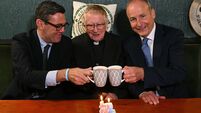
Kian Louët-Feisser runs Carlingford Oyster Company. Picture: Terry McDonagh/Carlingford Oyster Company
Presidents, prime ministers and taoisigh past and present are in Belfast this week to mark the 25th anniversary of the Good Friday Agreement.
Bill and Hillary Clinton, Joe Biden, Tony Blair and Bertie Ahern will join with their Northern counterparts at events to commemorate the Belfast Agreement signed on April 10, 1998, which brought about an enduring, if still fragile, peace.
1998 was a very different country. The IRA had called a ceasefire the year before. The current president of Sinn Féin, Mary-Lou McDonald, had not even joined the party. She joined in 2000, two years after the historic deal.
In July, people were still picking their way around burning cars after sectarian riots on the streets of Belfast. A month later, 29 people were killed in the Omagh bombing. To misquote WB Yeats, peace came dropping slow.
Northern Ireland and the border counties of Donegal, Leitrim, Cavan, Monaghan and Louth had endured a 30-year norm of protection rackets, hijackings, bombings, terror, and mayhem. Both sides targeted businesses. The agreement recognised the need for people and businesses on both sides of the border to integrate, trade and flourish.
The architects of peace knew investors love certainty, in this case, certainty of peace. Cross-border institutions were set up and enshrined in international treaty in order to give local and foreign investors the confidence to take a gamble on the region.
The spoke to six entrepreneurs who doggedly kept their businesses going through the Troubles and grabbed the opportunities peace brought with both hands.
Twenty five years ago, you could not sell an oyster in Ireland, never mind along the border. Yet it was deep in the Grade A waters of Carlingford Lough that Dutch man Peter Louët-Feisser discovered unique tear-drop shaped oysters and set up one of Ireland’s first oyster farms.
The oysters are nature’s own cross-border collaboration — freshwater flows down from the mountain sides of Down in Northern Ireland and Louth in the Republic, swirling together in the lough to give its oysters their distinct sweet, slightly nutty flavour.
Since the Good Friday Agreement, the whole market has transformed “beyond all recognition”, according to Peter’s son Kian Louët-Feisser who now runs Carlingford Oyster Company with his wife Mary. “It used to be a couple of hundred oysters a week and now we’re doing thousands of oysters a week,” he said.
It wasn’t always so. Pre-1998, they sold perhaps a “couple of dozen oysters” to Northern customers, the restaurant trade being decimated by the Troubles. They only entered Northern Ireland to use the post office in Newry to post oysters over to London clients as it was “cheap as chips and worked fairly well”.
The cost-saving measure did not come without its risks however. “I remember actually going up to the post office around the middle of July and you’d be slaloming around all the burnt-out lorries on the road. You’d go up early before the guys who had been out gallivanting the night before had gotten out of bed,” he recalls.
Louët-Feisser brought his wife and mother with him once. When he left the post office he found them terrified and furious. “A couple of 19-year-olds with rifles and army uniforms had been spending 10 minutes looking down the sight of a rifle at them. It’s not nice having someone point a gun at your head. But that’s what we went through,” he said.
He remembers bombs going off and “quite a few atrocities, very, very close to here”. He is still amazed the Good Friday Agreement happened at all.
“To tell you the truth, I still don’t know how they did it. Because it was such a difficult negotiation to carry out and you can see after 25 years that it’s still very, very fragile,” he said.
The biggest legacy of the Belfast Agreement for the border region has been “peace stability”, in his view. The deal brought “a complete change of way of life” for businesses like his along the border region.
When Brexit happened in 2016, the fear of returning to that instability was “heart-breaking”.
“There was a murder every single day of the week without fail. For society to go through that level of violence inflicted… how do you recover when somebody has murdered your child, your father or your brother on purpose. The damage and the wounds that caused is horrendous,” he said.
“Since Brexit happened and there was talk of it all kicking off again, I thought ‘Jesus please don’t let us go back to that’, you know?”
When former British prime minister Theresa May went on a two-day Brexit border tour in 2018, she chose the most western outpost of the United Kingdom as her starting point: Belleek, Co Fermanagh, the final frontier.
Nestled in a crook of the River Erne, a bridge reaches the Republic of Ireland on one side, Northern Ireland on the other. It was the scene of many vicious battles during the Troubles, when it was known as 'Sniper’s Hill'.
Thirty five years ago, the last British soldier was shot dead in front of the local Carlton Hotel, the second most bombed hotel in Northern Ireland after the Europa Hotel in Belfast.
On the day of her visit, May made her Brexit speech from the restaurant of Belleek Pottery. It sits on the Fermanagh side of the bridge, literally 10 yards from the Irish border. “We can’t be any closer to the border,” said Belleek Pottery financial director Martin Sharkey.
“I’m looking out the window and I’m looking at a tricolour flying out my window on the other side of the bridge. I mean like 10 yards away,” he said.
“In fact when I come to work, I come from the north into the south and back into the north again going over the bridge. You can go out and stand on the bridge and you’re in Northern Ireland and in the south on the bridge.”
Belleek prides itself on its resilience through tough times and nowhere is that more evident in the businesses that trade freely over and back between both jurisdictions.
Sharkey reckons 80% of Irish homes or more contain a piece of Belleek pottery. The firm also owns Galway Crystal, another cross-border link that draws Sharkey south every month. For him, the Good Friday Agreement brought stability and that meant tourists.
“The Good Friday Agreement did bring stability to Northern Ireland and Fermanagh in particular. The two biggest things that probably helped us was the amount of tourism that it generated. Because of the Good Friday Agreement, people felt comfortable to come here,” he said.
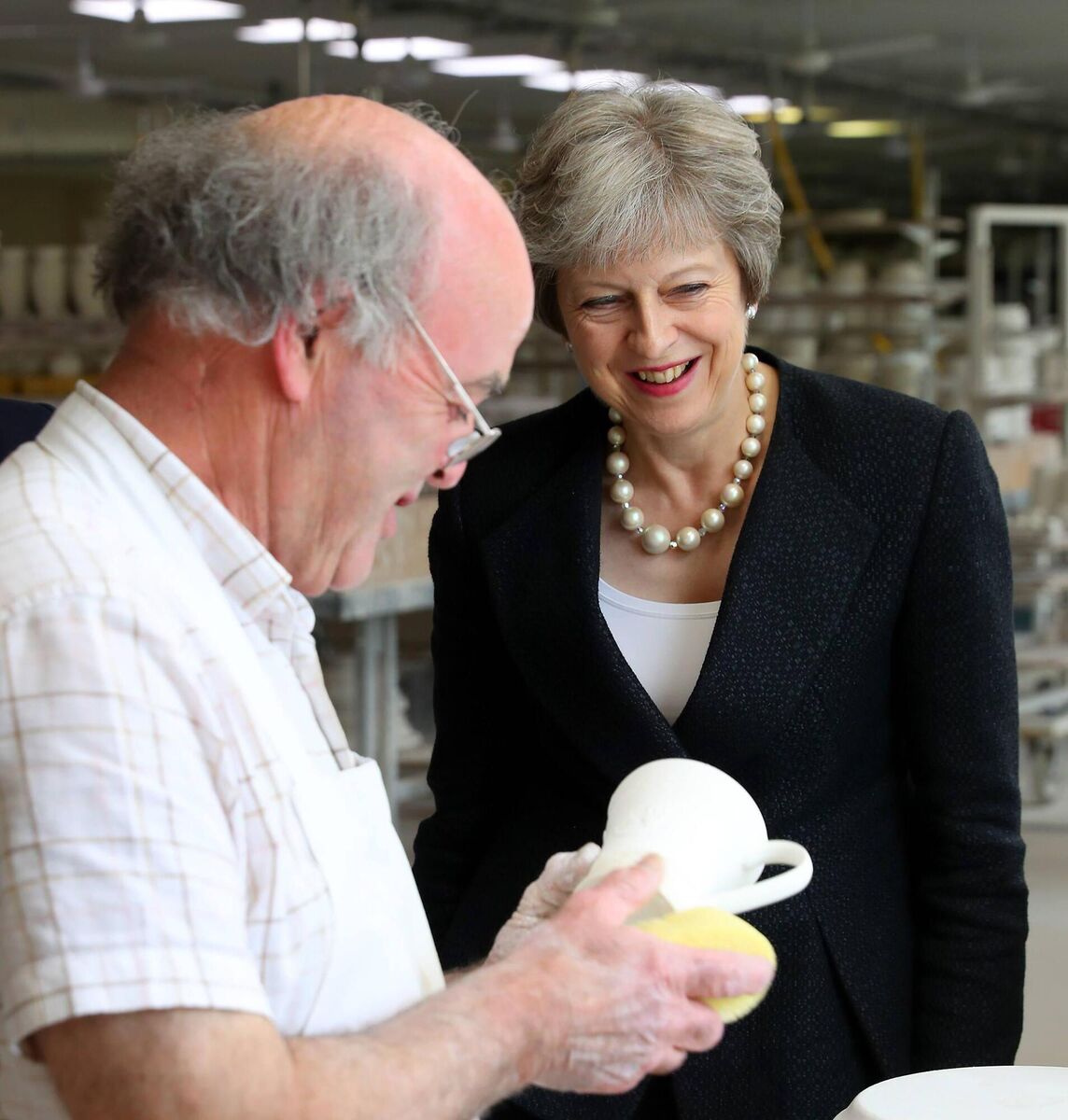
In 1997, they had 161,000 visitors to their visitor centre. The following year, after the Good Friday Agreement, it was almost 200,000.
“We had an uplift of 25%. And we also invested in the factory and put up new warehousing and new buildings. Our turnover grew. The number of visitors went way up and then we invested,” he said.
The company was able to hire more staff for the factory tours, expanded its facilities and today it employs 150 people, from both sides of the border.
Sharkey recalls all too well how difficult business was before the Belfast Agreement and appreciates the legacy. “You were taking risks and you didn’t know what was going to be happening. We had bomb scares in the past and the entire village and the pottery would have been closed. That all stopped. The Good Friday Agreement definitely brought stability to us,” he said.
They could finally plan for progress. It meant tour operators who took buses to Belleek could take bookings and know that they wouldn’t be disrupted. “That’s a huge thing, for you to be able to plan and to make your business viable,” he added.
“It’s difficult enough along the border because you’re away from everywhere else. But all in all, the great trade has been a plus for us, been a plus for everybody,” he said.
There was no overt celebration in northern Monaghan in 1998. Less than 2km from the border with South Armagh, the owners of a resplendent 17th-century castle hotel just heaved a huge sigh of relief.
“You didn’t really believe it,” Sammy Leslie told this newspaper. “You just sort of waited. It was only bit by bit that it slowly dawned on your that this was all happening,” she said.
As the owner of the Castle Leslie luxury hotel, her ancestral home dating from the 1660s, Leslie doesn’t believe the hotel would be at the level it is at today without the Good Friday Agreement. She comes from a “family of eight faiths and probably as many nationalities”.
They had survived world wars and prisoner of war camps before the Troubles hit in the late 1960s.
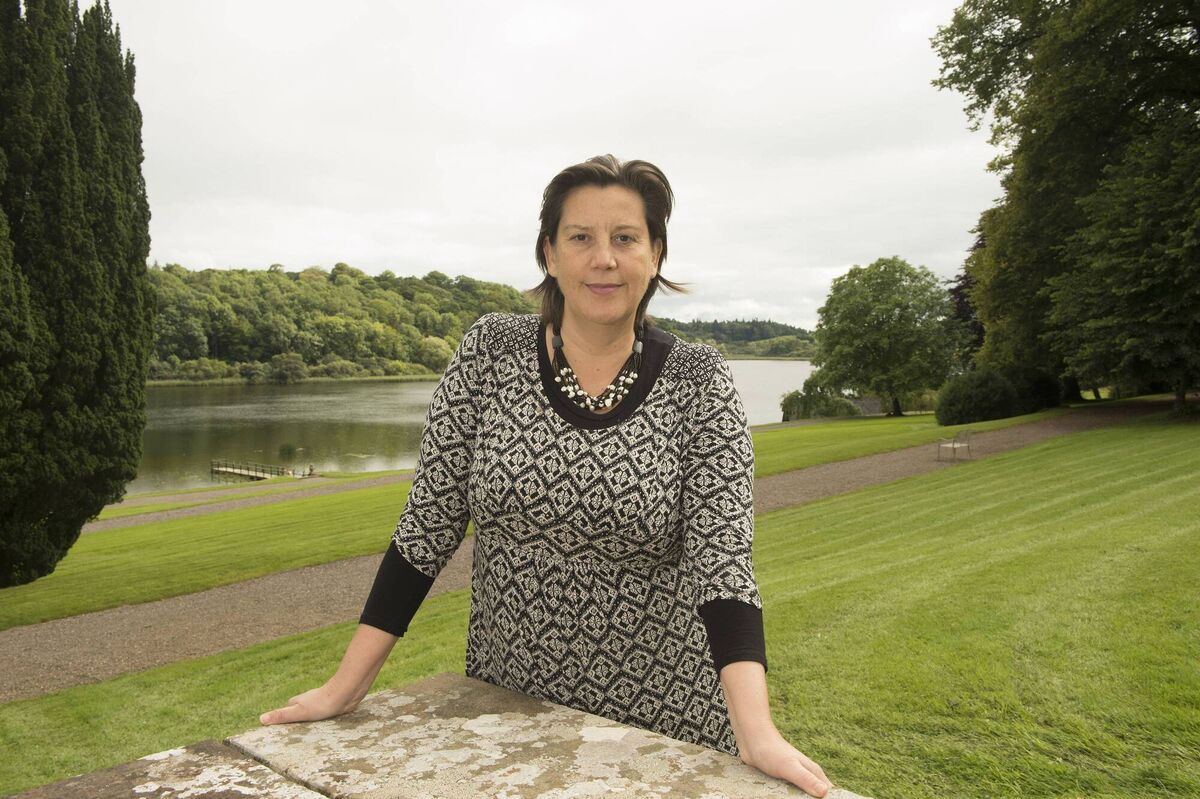
“We are very aware of how desperate conflict can make people. How much stuff can escalate and just never stop. We gave a huge sigh of relief. We had so many false starts,” she added.
The Belfast Agreement gave businesses like Castle Leslie “a chance at a good future” due to the impetus it gave investors, like the Ireland International Fund, to support the border region economically.
It gave funding support to businesses along the border to try and stimulate growth. It helped Leslie refurbish part of the castle. “I don’t think they’d have been able to offer as much support, especially in the border area if the Good Friday Agreement hadn’t happened,” said Leslie.
Their proximity to the border had previously sent investors running for the hills — over 80% of their hinterland lies in Northern Ireland. In the late 60s, her father began to plan a golf course on the estate. But when the Troubles began, “things started to get complicated”.
“All the backers went, ‘listen, we think we need to take stock for a few months and reassess this and see what happens'," said Leslie. All their plans were put on hold for a few months, which turned into 33 years.
There was no tourism to speak of and no future for Castle Leslie until Sammy Leslie opened her tearooms in 1992. She gradually expanded over the next decade to the luxury stays offered today and 200 staff employed. How would she sum up the legacy of the Good Friday Agreement?
“The good possibility of a lasting peace,” she said. But she credits the people of the border, not just the politicians who forged that peace.
“I think this part of the world, the border counties, are some of the most ingenious, the most hardworking, the most resilient and entrepreneurial people. I think border people are incredible people.”
They’re made of tough stuff, truckers. Rightly revered during the pandemic for keeping our supermarket shelves stocked with food, decades earlier William Duffy showed the same determination in keeping his trucks on the road from Donegal to Dublin during the worst years of the Troubles. He transports “absolutely anything at all, except explosives or hazardous chemicals” from Donegal to Dublin.
His routes normally take him through Northern Ireland, providing direct transportation from the remotest reaches of the Republic to the capital. He takes in Strabane, Omagh, Aughnacloy and across the border into Monaghan. But the violence, or threat of it, was always hanging over him before the Good Friday Agreement.
“There was always a fear. There was a fear of lorry hijackings. We often found ourselves having to divert through Sligo or somewhere because we couldn’t take the risk of coming through volatile areas. The worst was in the summer months, particularly around July,” he told the from his company’s base in Newtowncunningham.
It affected how they operated. They couldn’t rush — routes had to be carefully planned around the violence. Roads were closed, blockades in place. They could be two hours sitting in a queue at a checkpoint. Duffy prides himself on never losing a truck or worse. They made many trips at night for driver safety. Or diverted, which cost them time and expense “but that was better than being beyond safe”.
“We were proactive about it. We just didn’t send anybody to an area that might have been a problem,” he said.
The 1998 deal was transformative for Duffy’s business and the border economy. “It gave everybody a lift and you know we felt happy that a lot of progress had been made on the north for a lot of reasons,” he said.
Most importantly, it brought confidence and investment. Cross-border infrastructure and incentives began to get businesses going again. “It opened up Donegal to the north and the north to Donegal. That went both ways. Traffic started to move both ways. The free movement was great, we had much more ease of operation,” he said.
If the Belfast Agreement never happened, Duffy is clear his business would not “be anything near” the success it is today, employing 93 people.
“If it hadn’t been for the peace that came in, then the confidence wouldn’t have been there to do things. It’s good to see it’s continuing and we hope that other issues like Brexit get resolved. Hopefully progress will be kept going, we know we don’t want any backward steps.”
Cavan-based Colm Murphy was one of the hopeful young people looking to a brighter future 25 years ago. He and a business partner had just set up their company, Obelisk, two years earlier, in 1996.
It was the era of Denis O’Brien and Digifone and things were “buoyant” on the southern side of the border, Murphy recalls. But up North, the telecommunications market was virgin territory.
Mobile phone network Three was not established “in any way shape or form in Northern Ireland at that stage”, said Murphy, who exited the firm only last year. Protection rackets were the order of the day, from either side of the sectarian divide.
“Back in those times you could be approached by any side of the coin. You were apprehensive. You had a feeling that you just didn’t know who you were talking to. There would be a question mark over a southern reg vehicle. You don’t create conflict or bring trouble to your door if you can help it, so we avoided the conflict there,” he said.
Of course, avoiding conflict meant keeping as low a profile as possible, but the Belfast Agreement was the game-changer that allowed Murphy open up the Northern Ireland market for Obelisk.
“It changed your confidence as much as anything else in trying to do business, in going across the border to do business. There was a greater sense that you’re potentially a little bit safer. You weren’t going to be approached. It gave us the confidence to be able to apply and approach the likes of Three,” he said.
Their gamble paid off — they landed Three as a client and won the deal to roll out their mobile network across the six counties from 1999 on. “It was a great boost for us. It put us on the map,” said Murphy.
It wasn’t all plain sailing — they were building masts in a region where towers used to hide British soldiers on lookout. Triggering for many.
“As you can imagine, we were building towers and masts in the face of hostility because of the type of infrastructure you were building. People viewed it with varying degrees of acceptance,” he said. They kept their heads down and eventually would build about 85% of the network required by Three at the time.
“We had a good experience up there and made a lot of good friends with local people from all sides of the community up there,” he added.
Business life is “unrecognisable today to what it was back in 1998,” said Ronan Haslette, whose family has been trading across the border for more than 100 years.
The Belfast Agreement “made it possible” for his current firm Merenda and others to thrive.
“It ushered in a business-friendly era and improvements in North-South trade. Northern Ireland used to be seen as an export market but now it’s seen as an island mentality. We have strong growth whereas before business would have been curtailed. Uncertainty breeds curtailment.
"Northern Ireland has really strong indigenous businesses because they had no foreign direct investment, they had to build their own resources. A strong business ethos and the Good Friday Agreement allowed that to flourish,” he said.
For Haslette, the legacy of the Good Friday Agreement goes beyond the economic and the political to what he calls and “unspoken social environment”.
“It’s all about the people working North and South traversing the border, feeling safe and having the comfort to do so,” he added.

CONNECT WITH US TODAY



Be the first to know the latest news and updates