How the Irish Examiner covered the signing of the Good Friday Agreement 25 years ago
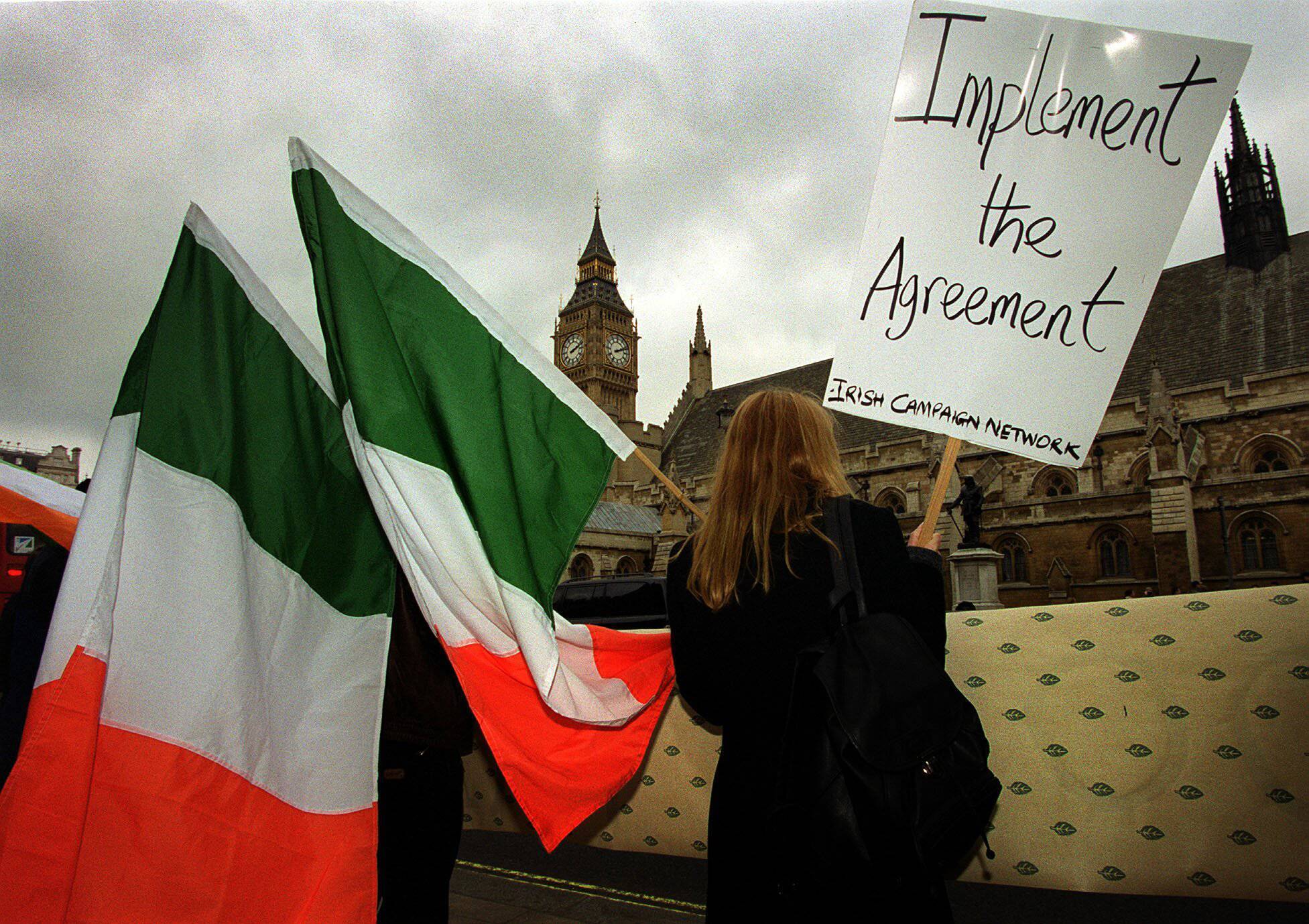
The accord was a major development in the Northern Ireland peace process and saw the beginning of the end of The Troubles.
The Good Friday Agreement, signed 25 years ago this month, effectively brought an end to more than three decades of violence that had racked the country.
The accord was a major development in the Northern Ireland peace process and saw the beginning of the end of The Troubles.
Here is how the covered the signing of the agreement and the hours that led to the historic moment.
The deal is done, but can it be sold? Following a serious threat to his control of the party by a group of MPs led by leadership challenger Jeffrey Donaldson, Ulster Unionist leader David Trimble is today damaged within the ranks.
The events of yesterday afternoon out-matched those of the day before, difficult, though that was to comprehend. Beginning shortly after morning broke, UUP deputy leader John Taylor indicated that a deal would not be done without decommissioning and stiff curbs on early prisoner releases.
Initially, the internal rumblings were not taken too seriously, as people both inside and outside Castle Buildings became embroiled in the air of euphoria which enveloped everyone inside the grim, poorly-serviced complex.
But by noon, the mood had changed, and it went downhill rapidly during the afternoon as word spread of the revolt led by Mr Donaldson, which centred principally on decommissioning, with the add-on of prisoner releases.
Sitting in the Oval Office at 2am before the UUP storm clouds appeared on the horizon, President Bill Clinton leaned back and beamed. The news from Belfast was good, and getting better by the minute — the impossible dream was coming true.
North of Washington's Dupont Circle on S Street, another man, less publicly known, had reason, too, to feel satisfaction — Irish Ambassador Sean Ó hUigínn has been, perhaps, the guiding spirit behind yesterday's magnificent achievement. Let nobody be in any doubt, Ó hUigínn, as head of the Anglo-Irish division of Foreign Affairs, was the intellectual flame for this, along with John Hume.
It is they who brought Sinn Féin in from the cold. "Without that foundation, we would not be here today," said a key Irish official. For a time, the work of a decade was threatened in the aftermath of the IRA bomb attack oil Canary Wharf in February, 1996. A shy, reserved man, Ó hUigínn was close to tears when he heard the news onboard the Government jet as he returned from Washington with Dick Spring: Often the target of criticism, this time politicians of all hues, from Northern Ireland, Dublin and London, have taken the pain of hard decisions.
Today, the North has the hope — not the guarantee, but the hope — that "there could be days like this," to quote Van Morrison. The scale of the decisions are hard to contemplate. No doubt it will never look better than yesterday. No doubt, too, it will be tarnished in the days, weeks and months to come, particularly as unionism threatens to tear itself apart. For now, at least, it should be savoured. Dying to leave Belfast, but "sorry, to go", Senator George Mitchell can return to the United States wearing a deserved garland.
His decision to force the pace by setting April 9 as the deadline paid off, even if the midnight hour laid down came and went without agreement. Indeed, as the clock struck, a deal looked far off and, perhaps, receding.
Democratic Unionist leader Ian Paisley was in the chair in the press briefing room.
"The dreary steeples of Fermanagh and Tyrone" once more dominated the mental landscape. Minutes before, Sinn Féin's chief negotiator Martin McGuinness had been in to warn that unionist intransigence was threatening to bring about stalemate. "As I speak to you now there is no agreement. The unionists are trying to change important aspects of Mitchell's document."
As dawn approached, the signals became ever more contradictory. Sinn Féin had told Taoiseach Bertie Ahern that the package as set out could not work.
Unionists were fuming about a television bulletin which said they would be the ones to make concessions. Shortly after 6 am, Mitchel McLaughlin entered the briefing room.
"Mitchel has a prepared script, and he will not be taking questions," declared Sinn Féin figure, Jim Gibney. A bad sign. McLaughlin is usually sent out to face the media troops when times are tough. Eyebrows were raised about the portable building, which had provided a space on the floor for those lucky enough to be able to enjoy a few minutes of snatched sleep. Was Sinn Féín about to raise the stakes in the game? Would they stay?
Instead, the opposite occurred. McLaughlin was a happy man: "We pointed out that the unionists were attempting to take the substance out of this paper in a number of key areas. They succeeded to some degree in Strand II. This has now been reversed. There has also been some other progress. In particular, Strand I. Sinn Féin continues to be opposed to an assembly. Nevertheless, many of the checks, balances, and safeguards which we argued for during the negotiations have now been secured."
By now, eyebrows were just below journalists' hairlines. "Good Lord, that is incredible," whispered BBC reporter Peter Taylor, who has spent his career explaining the internal workings of the Provisional IRA. In the face of the last-minute unionist stand on decommissioning, Sinn Féin returned to the attack. They had "tremendous" difficulty with an assembly, said McLaughlin, consigning his mellower, earlier words to the dustbin of quotes.
But they did not abstain from a final deal. Even those inside Castle Buildings were unsure until late on Thursday night about whether a deal could be done. "The low point was lunchtime on Thursday. Despite concentrated effort, a lot of people felt that we were not going to make it," said one insider. In the public arena, declarations on Tuesday by David Trimble and John Taylor that they would not touch Mitchell's original package created deep gloom.
Inside Castle Buildings it provoked one SDLP figure to mutter that failure now would cast the North into darkness for a generation, and more. Negotiations on Strand II were tough, but there was a growing acceptance by the Irish Government that Mr Trimble's demands here had to be accommodated — as long as movement did not threaten to bring down the entire house of cards. For a time, it did.
But the UUP leader's decision to attach his wagon on a long leash to the SDLP’s proposal for an assembly created room for manoeuvre, and, allowed Mitchel McLoughlin to trumpet Sinn Fein's "reversal" charge.
The outcome means that two horses are now being ridden. In a considerable feat of drafting ingenuity, the assembly will be set up first, though its survival will be linked to a unionist commitment to "meaningful" cross-border bodies quickly afterwards.
Even though more than a few harbour doubts about the bodies' actual birth, Mr Trimble's decision to accept the assembly in "shadow" form initially, has opened the door to serious discussion on other areas.
The roles played by Bertie Ahern and Tony Blair were critical. The hands-on approach, though risky politically, paid dividends. "Bertie was in his element. He really knows how to push all of the buttons in a situation like this," said an Irish source.
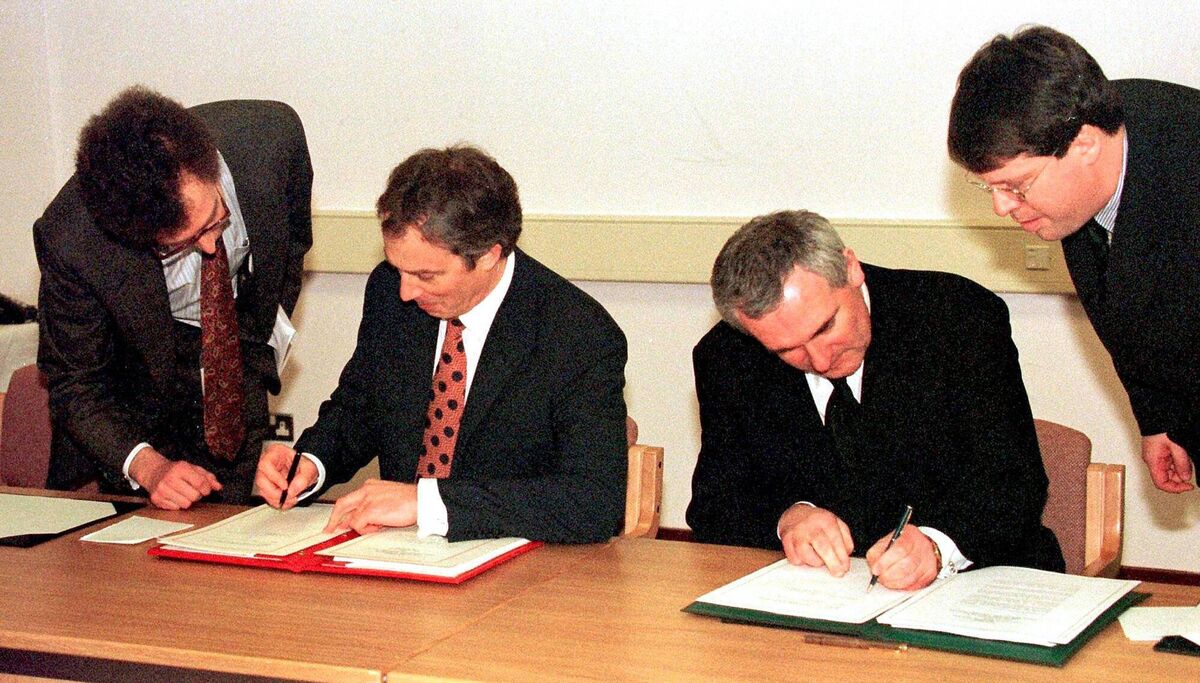
Heading for home, the Taoiseach has good reason to be pleased. Articles 2 and 3 can be "sold" to the electorate, though not without a few "wobbles" amongst some Fianna Fáil TDs and traditional elements within the ranks.
Trimble has an immediate hurdle to overcome — the meeting of the UUP executive in Glengall Street, which was adjourned amid signs of serious division amongst the 80 out of the 110 who turned up. Few of the 30 missing will repeat their absence this morning.
Yesterday, he was able only to sign up for the deal after putting the issue to a vote of his fellow UUP MPs. "He won it, but it was close." said a source with strong UUP ties. Shortly afterwards, Mr Donaldson was seen to leave Castle Buildings. However, Sinn Féin are not without troubles either, though they are probably on a lower scale, in terms of internal opposition, at least.
Mr Adams will have to win the backing of Sinn Féin's Ard Fheis for the package, next weekend, despite the 32 County Sovereignty Movement's campaign. Largely, the Irish attitude was guided by key backroom people, the head of the Anglo-Irish Division, Dermot Gallagher, formerly Ambassador to Washington, and the Taoiseach's Northern adviser, Martin Mansergh.
Two floors above, the British prime minister was doing his own thing, suit jacket off, the tie discarded. By dawn, he looked physically drained from nearly 24 hours of bi-lateral meetings, speedy telephone calls and conferences with staffers.
His decision to go to Belfast has been vindicated.
The darkest hour comes before the dawn in the final countdown to peace.
Gloom surrounds the proceedings and snow and hailstones falls at Stormont. Rumours abound minute by minute of major difficulties inside Castle Buildings, David Trimble leaves for a meeting of his party’s executive.
“There are continuing problems,” said Women’s Coalition leader Monica McWilliams. Mr Blair’s spokesman expressed the hope that his leader can fly to Spain to be with his wife and children with the next 24 hours.
Mr Trimble gets two ovations at his party meeting, though rebel MP William Ross lambasts the process.
There is unease about disunity in UUP ranks.
UDP leader Gary McMichael warns: “We have to prepare ourselves for the possibility of no agreement.” Ian Paisley, DUP, says: “This is worse than the Anglo-Irish Agreement.” Robert McCartney, UK Unionist, claims: “Rationale would tell you no deal should be signed.” Lord Alderdice of Alliance insists: “Yes there is going to be a deal.”
Journalists await news from the UUP meeting as DUP demonstrators protest outside Glengall Street.
PUP negotiator William Smith is allowed into the Maze prison to brief loyalist prisoners; Mr Trimble returns to talks amid claims of unease amongst some supporters and also Sinn Féin.
Irish minister Liz O’Donnell says she is optimistic about agreement. Journalists begin to freeze inside their tents.
Martin McGuinness, Sinn Féin, says: “We told Tony Blair he must avoid the temptation to go with the unionist position.” Mr Blair is looking extremely tired, says an Alliance delegate.
DUP protestors get through Stormont gates. Some shout pro-LVF slogans but they are denounced by Dr Paisley. DUP leader storms into press portable building amid shouts from PUP delegates and supporters. SDLP’s Joe Hendron appeals to him to support peace “for the sake of our children and grandchildren, nationalist and unionist, Catholic and Protestant”.
The deadline passes amid reports that Sinn Féin may not sign agreement deal. Gerry Adams and Martin McGuinness begin walking in circles around the car park. Adams shouts through the fence: “There will be a deal if the unionists allow us to have one.”
Journalists huddle around a single heater in a marquee to settle in for the night. Details of a draft agreement emerge.
John Taylor, UUP, the pessimist throughout ups his odds to 75%. He laughs when a journalist shouted: “How long’s that barge pole now?”
Unionist Jeffrey Donaldson and colleagues decide they’ll walk around the car park for a while.
Journalists awoken by news John Humes has entered the make-shift media village: He’s smiling but not giving interviews. Bill Clinton rings Tony Blair.
Journalists are told by one negotiator that “98%” is agreed.
Warning that deal is still several hours away. Optimism and pessimism prevail in equal measure.
Evening paper reporters begin to warn news editors that their deadlines may not be met. More details are leaked about Northern Assembly.
News programmes go live, but anchormen are now interviewing other journalists to fill in the gaps. SDLP delegate says: “The Ulster Unionists have problems but we are nearly there.” Sinn Féin representative says deal is close.
Breakfast is finished by disorientated journalists and talks delegates. Some of those delegates are seen hugging each other.
A UDP delegate reckons that “difficulties can be ironed out in the next few hours”. The same spin comes from British and Irish sources.
Predictions of 2pm deal. It didn’t, of course, happen.
Twelve hours past the deadline and still no sign of a final settlement. Reports from inside Castle Buildings of major split within the Ulster Unionists.
“We’ll be there before five. Sorry for the delay,” says one British aide. An Irish aide jokes: “The nitty-gritty is over.”
SDLP delegates are seen hugging through the windows of the drab buildings in the background. More rumours of problems with Sinn Féin. Rumours are denied amid confirmation that the document has been adopted and copies make their way out of the building.
BBC starts quoting live from the document. Deal is done. All eight parties have conceded ground to win agreement.
David Adams, UDP, breaks down crying. “I can’t believe it,” he says as his eyes well up. PUP man Gusty Spence says: “I’m afraid to pinch myself.” SDLP leader John Hume says it’s “the best day of my life”. Everyone appears happy. Journalists can’t believe that it has finally been done. There are handshakes and emotional scenes in and around the building.
The deal is done and confirmed. Party leaders thank the premiers and Senator Mitchell. There are generous rounds of applause for every speech.
The rest is history.
CONNECT WITH US TODAY



Be the first to know the latest news and updates