'My son wants his own bedroom' — Cork woman spending her first Christmas homeless
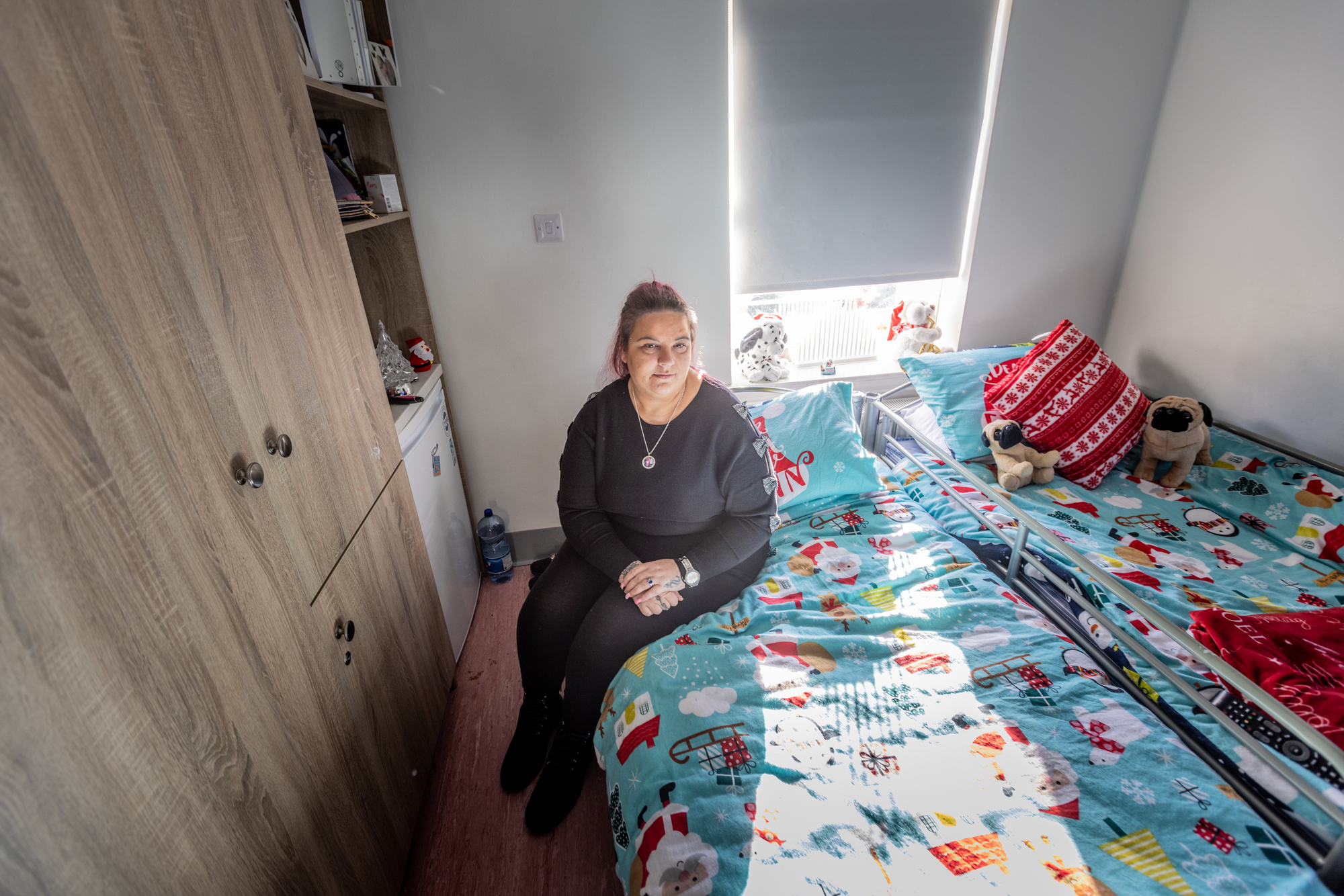
Samantha Forde at the homeless hub in Cork city where she has been living with her son Dillan since June 27. Picture: Neil Michael
At 12 midnight every Tuesday, Samantha Forde is glued to her phone.
Beside her in the bunk bed next to her is her six-year-old son Dillan. As she stares at her phone in the darkness as he sleeps, curled up with his arms around his favourite teddy, she isn’t catching up on the latest YouTube movie release, or latest Netflix series. She’s looking for a home.

The 31-year-old, from Knocknaheeny, is homeless.
Since June 27, she has been living in a small room with Dillan at the Redclyffe Family Hub, a homeless service provided by Good Shepherd Cork. Every day, she checks Daft.ie to see if there is a property anywhere near her price range, and every day, she gets the same result: there isn’t one.
Currently out of work, she survives on benefits. Should she find a home, she has access to a Housing Assistance Payment (HAP) of around €1,000-a-month but she would have to then find a way to top that up to match current rent rates.
She is looking for a two-bed flat in north Cork near where her son goes to school but the cheapest she comes across is usually around €1,500 - and that just isn’t in her price range. “It’s just soul-destroying,” she said.
“You sift through the small number of listings of flats or houses and while you might see the odd property that would suit - a two-bed apartment near where Dillan goes to school - it will just be out of my price range.
“Added to that, a lot of landlords don’t want tenants with children because they are worried they will do things like draw on the wall.
“What I tend to do now is tell them face-to-face at the first meeting that I am on HAP but to be realistic, all I am finding is just out of my price range. I just can’t afford what is there.”
This is where her Tuesday night vigil kicks in. If she can’t find anything on Daft.ie, she logs into Cork City Council’s Choice Based Lettings (CBL) system. Every Tuesday, after midnight, it publishes a list of council properties that are available to rent.
“You are just hoping against hope that what you want is coming up,” Samantha says. “In reality, however, there might only be one, or maybe two or maybe seven new properties in total, but they won’t necessarily be in the area you want. That’s not me being picky.
“I have to consider the fact that my son is settled at school. I don’t have a car and need to be within a certain distance of both Dillan’s school and my mother.”
Even if she does see something she likes, Samantha would probably have to wait until anyone who has been on the waiting list longer than her has had the chance to at least view the property. She should be on the council’s long-term waiting list for housing having first been placed on it more than eight-and-a-half years ago.

But owing to an administrative error, she has ended up at the back of the council’s queue of more than 6,000-plus people and families on the waiting list.
“I had to leave a private rented property I was living in because of mildew,” she says. “This led to my son catching pneumonia and he was so bad with it that doctors at the Mercy Hospital nearly had to put him into an induced coma.”
She had been staying at the Old Mallow Road property and working as a cleaner some two years into being on the council’s waiting list.
After she was forced to move out of that property due to the mildew, she had moved back in with her mother in Knocknaheeny, where home for years was then a sofa for herself and her son in a utility room of her mother’s council house.
While there, she developed back problems - little wonder when a bed is a small sofa shared with a young boy and his teddies - and was unable to work. She has worked as a cleaner, and is currently back looking for work.
She had to leave her mother’s house as there just wasn’t enough room after her sister’s three children moved in.
Without work, or anywhere to stay - she then presented herself to Cork City Council who pointed her in the direction of the council’s Accommodation Placement Services (APS). She was then lucky enough to be pointed in the direction of the hub that is now home to her and her son.
“I told them I was homeless and that I had nowhere to go,” she recalled. “They put me in touch with this hub and I have been here ever since. It’s like home to us now, everyone is very friendly and we love the people here.”

The interview is stopped for a brief period after Samantha bursts into tears when asked what this Christmas is going to be like. The question triggers her still-raw grief over the recent death of her sister.
“This is my first Christmas where I am homeless,” she says. “It is also the first Christmas without my sister Sharon, so as you can imagine it’s very emotional. But I also get emotional about how Dillan is coping with this.”
The two of them live in a small room. Their two beds are placed side by side, and for her son to get out of bed, he has to clamber over the end of his. While his is against the wall, hers is less than two feet from the fridge, the microwave and cupboards with both their clothing.
The end of their beds is also about two feet from the door of the bathroom. About the only toys to be seen are a rubber duck, some teddy bears and a plastic Spiderman figure. Under the bed, is his tablet charging and that’s about it.
His other toys are at his grandmother’s house.
“I’m more disappointed than angry about what is happening in the housing market at the moment,” she says. “Dillan still thinks of this hub as a hotel. But that is changing.
“In the beginning, he used to ask ‘when are we going to the hotel? When are we going to the hotel?’. Now, more and more he asks why we can’t stay longer at his nan’s house. We go there after school and he plays with his niece and he has his toys there too.
In terms of her own life and social life, she leaves the hub in the morning, takes her son to school, does any shopping she needs to do and maybe meets up with a friend, and then she collects Dillan and they will either go for a walk or they will go to her mother’s house.
While Christmas Day will be spent at her mother’s house in north Cork, Samantha and her son will then make their way back to the hub. And then, at around 12 midnight next Tuesday, she will resume her vigil at her phone in the hope an affordable property in north Cork pops up.
Samantha Forde is one of the 11,000-plus people who will spend this Christmas in homeless accommodation. She has been in the Redclyffe Family Hub since the summer.
The home, which has been operating since June 2018, is host to up to 17 families. Families are referred to the hub by Cork City Council’s Accommodation Placement Service.
Acting manager Eithne Murphy said: “We've had lone parents - mostly women but there have been males as well. We have families where there are mothers and fathers.
“We've had one family come in, for example, and she was here with her son and her niece. We've also had a mother come in who had three boys in their late teens. It’s mixed, so it doesn't really matter to us what the make-up of the family is.”
There is no time limit on how long families can stay but the hub is always keen to see families move in and out as quick as possible to avoid them being in their situation any longer they need to.
Asked if she has noticed any trends, she replied: “I think it's gotten worse. I'd like to say that I've seen some positive trends but there aren’t any that spring to mind. There's a constant waiting list here.
The most recent homeless figures supplied to the Simon Community show that Samantha and Dillan are two of the 11,397 people living in emergency homeless accommodation this Christmas.
The figure is the largest increase in homelessness since May 2020 and the first time it has passed 11,000. This led the Simon Communities of Ireland to call on the Government to make 2023 “the year of delivery” with emergency action.
They have also called on the Government to focus on the 166,000 vacant homes around the country and to bring as many as possible into the public housing stock.

This comes on the back of recent reports of an underspend of the budget to build public housing and the slow turnaround in vacanct local authority properties.
The 11,397 men, women and children in homeless emergency accommodation in October represents an increase of 3.85% (422 people) in one month and a 29% increase (2567 people) since this time last year.
Of the total, 1,601 were families, 5,320 were single adults and 3,480 were Children/Dependents while 1,318 were Young People aged 18-24.
The figures showed record numbers seen across nearly all categories including a record-high number of adults (7,917), single adults (5,320), adult men (4,974), adult women (2,943) people aged 18-24 (1,318), people aged 25-44 (4,258), and people aged 45-65 (2,179).