'I feel accepted': Youthreach provides opportunities outside mainstream education
Teenagers who left school during the pandemic and never returned are finding alternative forms of education, friendship, and acceptance in a Cork-based Youthreach centre, writes Liz Dunphy
'I feel accepted': Youthreach provides opportunities outside mainstream education

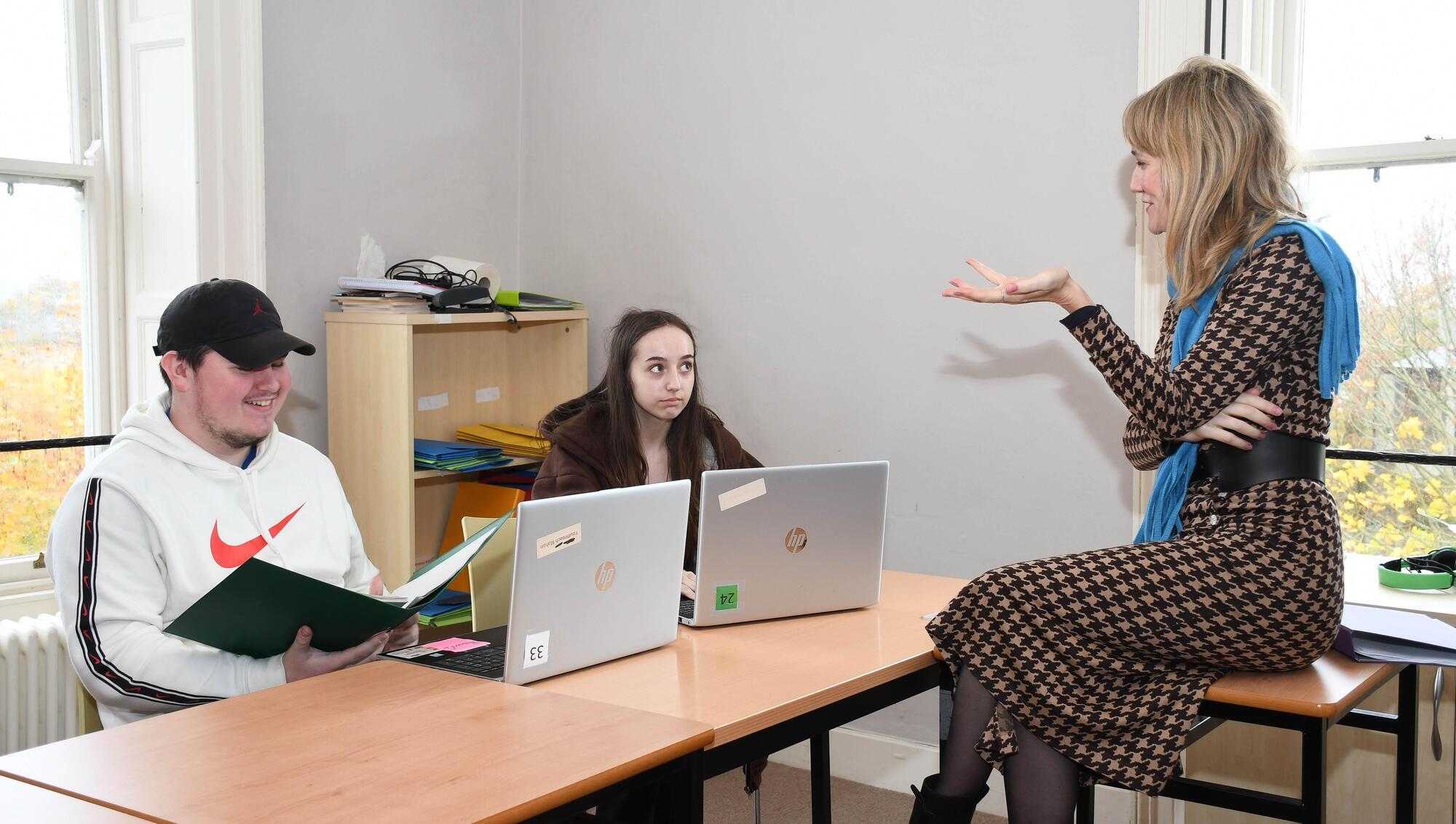
Teacher Laura Kinsella speaking with Sean O'Mahony and Jessica O'Leary in the Youthreach Centre in Mahon. Picture: Howard Crowdy

In just seven weeks, Jessica O’Leary, a bright, eloquent and beautiful 16-year-old who had dropped out of mainstream school with social anxiety, was cracking jokes in class.

She said that after starting school in Youthreach in Mahon, her crippling social anxiety essentially disappeared, and she looked forward to going to school every day.

“When I wake up, I’m excited to come in here. I feel accepted here,” she said. 

When you walk through the grand Georgian door at Youthreach in Mahon, it feels more like walking into a third-level college than into a secondary school.

Students and teachers address each other by first names, there are no uniforms, no bells, and there is a pool table in the hall where students play and gather around on long benches to chat. The atmosphere is relaxed and friendly.

This inclusiveness is one of the things that makes Youthreach in Mahon so special, many students, including Jessica, told the Irish Examiner.

“When I came here and started making friends, everything got better. My social anxiety started getting better, I was speaking to everyone, I was making jokes in class, I never did that before. I’m just completely different.” 

Jessica said that peer groups make a huge difference to a teenager’s experience of school.

She previously attended a mainstream school until second year, but when Covid hit she left and never went back.

Jessica O'Leary with fellow student Sean O'Mahony. Picture: Howard Crowdy

“I struggled extremely badly from social anxiety in there. My way of dealing with that was avoiding school, so I would be absent a lot. That caused a lot of problems because it’s not legal to be out of school for that many days.

“Your classmates can have a huge effect on your school life. I think that’s one of the main things teenagers are affected by in schools."

And being in a school, isolated and alone with no friends, is “probably one of the worst feelings ever,” she said.

“It’s like being in a place full of people where everyone hates you. You’re always looking around thinking people are talking about you.

Even one friend can make the difference sometimes. 

Jessica took a year out from school and said that because she had missed her Junior Cert, none of the three mainstream schools she applied for would take her.

It was scary to think she was locked out of education, she said.

When Youthreach in Mahon was suggested, she was initially resistant.

“But it was just great from the second I walked in. Everyone was just nice and talkative and welcoming.

“Now, I don’t struggle with social anxiety anymore.

“I’ve missed one day. Before this, I had not been in school for a whole week in years.

“All the teachers here are extremely nice. You can come to them with anything, even if it’s a problem from outside, they’ll still help you with it. It’s like family.

“I’ve learned that life can get better. A lot of people think they have no education options left. But your chances are not completely gone.” 

Alternative learning

Youthreach is a network of schools under the Education and Training Board patronage and Community Training Centres which offer youths who have left mainstream education with no formal qualifications an alternative place for education and training. There are 12 such centres in Cork.

Qualifications which are continuous assessment and project-based, are equivalent to the Junior Cert and Leaving Certificate Applied and graduates can go on to third-level education, apprenticeships, and jobs.

The research and projects conducted by Youthreach students in class equip them well for the type of work they will encounter at third level, teacher Laura Kinsella said.

But in addition to academic attainment, the school fosters a family atmosphere where prosocial relationships can be built.

Kelly Moller, director of Youthreach Mahon, said that some of their students had barely left their rooms for the two years of Covid due to crippling anxiety.

They were the kids who have fallen through the cracks with Covid.

“We have a great service to offer in supporting those children in a way that mainstream schools can't, because we’re smaller.”

Youthreach Mahon takes 25 students.

“They get lots of one-to-one support and individual support in the classroom, whereas at school, being one of 30 they might have been at the back of the class not feeling brave enough to ask for the help they needed,” Kelly said.

“We assess where they’re at. And because we have the luxury of being a small place, we can write an individual learning plan for them, and tailor the learning exactly to them.

Teacher Laura Kinsella and Youthreach director Kelly Moller. Picture: Howard Crowdy

“It’s not that we’re doing something better than schools, it’s the luxury of having a small school. Our whole school is smaller than the average class so we can really help them.

You see students who are so bright but were terrified to talk in school before.

Officially, Youthreach in Mahon takes students aged 16 – 20. But with permission from school or an educational welfare officer, students aged 15 can be admitted, Kelly said.

“We’ve seen a massive increase in 15-year-olds and we hear of much younger children wanting to come too. We have children waiting for a place, waiting to turn 15 so that they can come here.

“But we’re now full with a waiting list of seven. And we’re getting phone calls each day with really similar stories, of students who have not returned to school since Covid. There’s a big theme of that.

“It’s very upsetting to tell a parent that you have no place for their child.” 

Youthreach Mahon has seen a “sharp intake” of students with anxiety since the pandemic.

“It was a really traumatic time for young people. But once they gain some confidence at school it can start trickling into other parts of their lives.

Students thriving

“You see students who had a really difficult time are now thriving.

“Nearly all our kids have an issue, maybe ADHD, learning difficulty, dyspraxia, dyslexia, sensory issues, or anxiety is huge, behavioural disorders or being in direct provision or from Traveller communities.

“It’s a safe space here to grow up and mature.” 

Sean O’Mahony, 17, has also been in Youthreach, Mahon since September.

He also dropped out of mainstream school over the pandemic at the very start of third year.

“Second year wasn’t great, I was trying to make friends but I was having fights.

 Teacher Ephie Fitzgerald giving tips to Keith Pyne, Ryan O'Sullivan, and Dylan Pyne during one of their breaks from class in the Youthreach Centre in Mahon. Picture: Howard Crowdy
Teacher Ephie Fitzgerald giving tips to Keith Pyne, Ryan O'Sullivan, and Dylan Pyne during one of their breaks from class in the Youthreach Centre in Mahon. Picture: Howard Crowdy

“It was a lonely experience, most of the time. I’d go in, get it over with and go home. But then I left.

“It was great doing my own thing a year and a half. I got to work in a café doing my own small baking brand.

“But I wanted to go back to school to have some sort of education in case I didn’t want to stick with the baking. Someone recommended this to me.” 

Sean is clearly an intelligent and creative young man but if Youthreach had not been there, his education would likely have been cut unnecessarily short.

“I don’t work well under pressure. If I feel any bit of pressure, I start to crack and it doesn’t go well. But in here, there is none of that pressure and if I am falling behind on something, the teacher’s very understanding of it. They’ll sit me down and talk me through what I need to do and what I need to finish.

“And it's so much better to work in that environment. I can concentrate more, I can do my work better knowing that I have no pressure or stress to worry about.” 

Sense of family

Teacher Laura Kinsella said that building strong relationships is fundamental to the success of the school.

“One of our teachers, Ephie [Fitzgerald, the manager of the Waterford senior football team and former manager of the Cork ladies' football team] he’s like a dad to them. We have a nun here who volunteers, some students refer to her as ’grandma’, especially kids in the care system. There are very strong relationships. And there’s a real sense of family. 

“Education is the prime reason we’re all here but it’s also about building relationships and supporting students in other ways, as a parent would."

Numerous international studies observed sharp increases in rates of depression, anxiety, loneliness, and suicide attempts over the pandemic.

Levels of anxiety and depression spiralled during and after the pandemic, leaving many struggling with mainstream education.

A Dutch study called the Prosocial Project found that as the pandemic wore on, rates of tension increased in adolescents while vigour decreased, and these trends did not ease even during respites from lockdowns and other restrictions.

A spokesperson for the Department of Education said that throughout the Covid-19 pandemic Tusla Education Support Services (TESS) engaged with schools and families to promote connectedness to schools for children who are at risk of educational disadvantage and to support the return to in-classroom learning for all children.

“The School Completion Programme proactively supports students where school refusal or school phobia is a presenting issue. TESS also supports students to continue their learning while they feel unable to attend school, or in certain exceptional circumstances, support parents to access Home Tuition and other supports from the Department of Education.” 

The Department of Education's policy in response to the pandemic was also to try to mitigate the adverse impacts of Covid-19 on student learning loss, the spokesperson said.

More than €150m was provided in 2021 to tackle educational disadvantage in Deis schools and Budget 2022 allocated €18m in 2022 and €32m in 2023 to extend the programme to further schools.

“The Hobfoll Principles promoting a sense of safety, calm, connectedness, efficacy and hope, are key evidence-based principles known to help people regain a sense of normalcy and wellbeing in the aftermath of emergencies/traumatic events.

“Schools used these principles of support, as they formed the basis of the Department’s response to supporting wellbeing during the Covid-19 pandemic.

“Children and young people will do better in the long term if they feel safe, calm and hopeful, if they feel a sense of belonging and connectedness to their new school, and they feel that they can manage and cope.

“Guidance documents on implementing these important principles were shared with schools throughout the Covid period.”

More in this section

Lunchtime News

Newsletter

Keep up with stories of the day with our lunchtime news wrap and important breaking news alerts.

Cookie Policy Privacy Policy Brand Safety FAQ Help Contact Us Terms and Conditions

© Examiner Echo Group Limited