Retirements and a lack of newly qualified vets leave profession in crisis
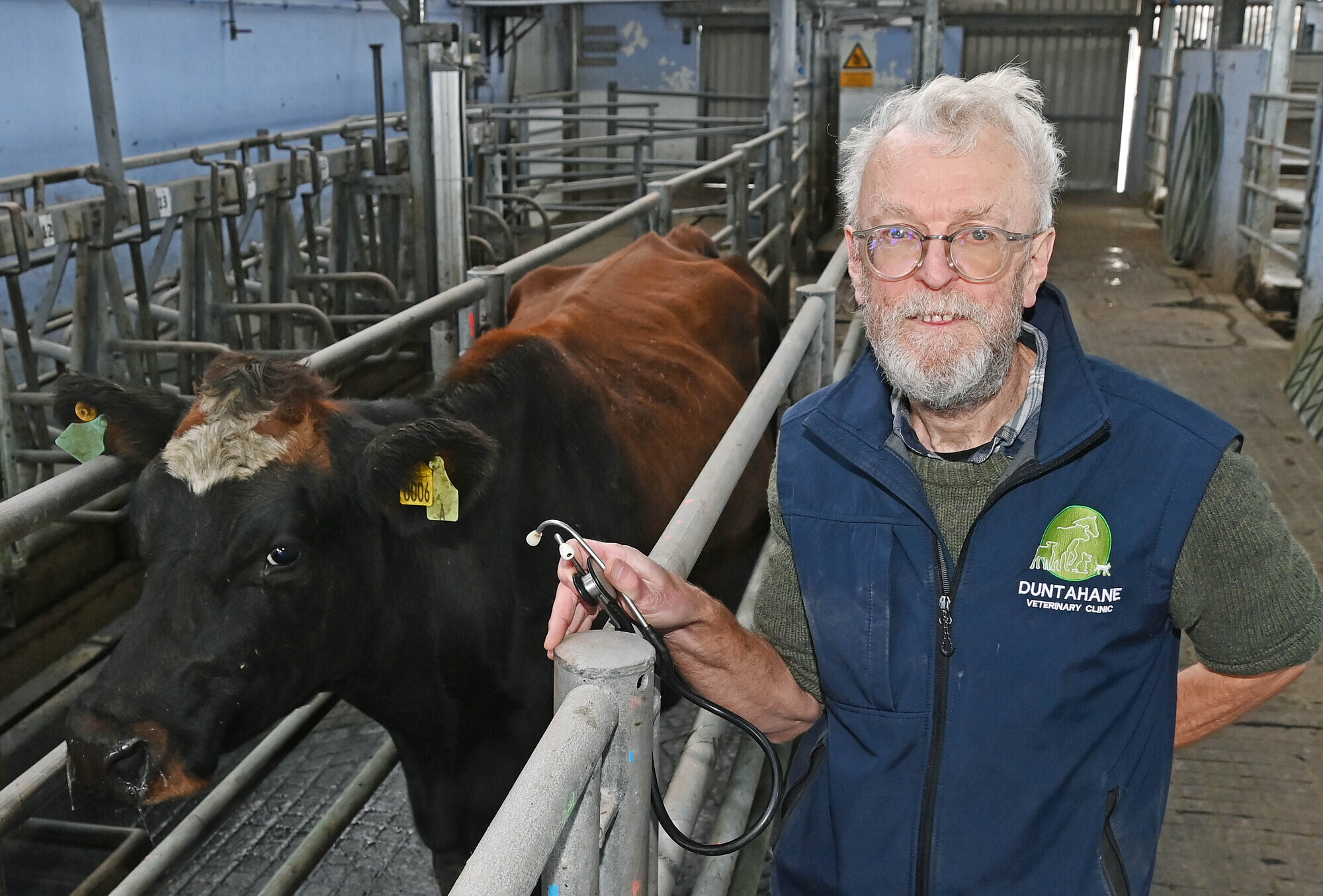
Ian Fleming, a vet in Fermoy, Co Cork, believes a major contributor to recruitment issues is that Ireland currently has just one vet school, at University College Dublin, offering roughly 80 places annually. Picture: Denis Minihane
If you want an idea of the scale of the longstanding but growing national shortage of vets, the classifieds in the is a good place to start.
That is according to Ian Fleming, a vet of 45 years, based at Duntahane Veterinary Clinic, in Fermoy, Co Cork.
“Every month, in that journal you will see 60 to 70 ads, looking for vets,” he told the .
Indeed, this reporter found roughly 80 classifieds seeking vets when it visited the VIJ website this week.
“I am case and point of this issue,” he said. “I’m 45 years in practice, 44 of those in Fermoy, so I wanted to pull back a bit.
“Not retire completely,” he is hasty to add, “but pull back from the out-of-hours stuff. I put an ad out in June 2021 and got a couple of replies but no one suitable.
“It took 15 months to get somebody to fill the space, she’s a lovely girl and we’re happy to have her, but it still took 15 months.”
Mr Fleming is a member of a group of vets who are highlighting the urgent need for new veterinary schools to help tackle a recruitment and retention crisis in the profession.
The country does not have enough vets, and it is also not training enough. It is following a similar pattern to what is happening with doctors in general practice, Mr Fleming believes, where numbers of those qualified are dwindling while demand is booming, all the while we are not training enough practitioners.
“It’s the same boat, and the fragility of the services are now beginning to be exposed, particularly in rural areas," he explains.
And while there are issues throughout Ireland, it is most worrying for remote rural areas. Take Listowel for example. There are five vets — one is 80, two are in their 70s, and two are in their 60s.
Mr Fleming added he had heard of a busy practice in Galway City struggling to recruit.
The shortage of vets is not a new problem. Ireland has quietly relied on attracting large numbers of vets trained abroad in to address a shortfall known about and acknowledged for more than a decade.
In 2007, the Competition Authority warned Ireland should not be reliant on other countries to train vets for its own needs. Between 2001 and 2007, almost 40% of new vets registered with the Veterinary Council of Ireland qualified outside the country.

However, since then, this shortfall has become worse. In 2021, 70% of new vets entering the register were educated outside Ireland, and 45% of these registrations were specifically from foreign vets.
At the same time, demand for vet services has shown no signs of stopping. More people than ever are pet owners now after Covid-19 lockdowns, and the need for vets has also grown across all private, corporate, and State services.
If left uncorrected, a recruitment crisis in the profession will impact severely on animal welfare and food production in the country, which will inevitably comprise the food industry and export trade.
According to Mr Fleming, a major contributor to recruitment issues is that Ireland currently has just one vet school, at University College Dublin (UCD), offering roughly 80 places annually to students through the CAO.
Every year without fail, it is one of the most sought-after university courses in the country. Last year, it attracted first-round CAO cut-off points of 601, requiring students to achieve top grades in every subject and take higher-level maths.
There are just not enough places to meet demand. In 2007, UCD educated more than half of the new vets to join the register. In 2021, this figure stood at 28%, and less than a quarter of the annual demand over the last four years.
Mr Fleming points to another set of issues associated with the high points bar.
This is leading to a ‘mismatch’ which is contributing towards a high attrition rate in the profession in recent years, he believes. The average time spent in practice now is seven years before they leave the profession.
Those who qualify do not typically wish to specialise in larger animals, which is also contributing to the shortage of farm vets for rural areas.
As well as high points, studying in Dublin brings another challenge. The cost of accommodation is simply out of reach for many families across the country.
As a result, every year, hundreds of students hoping to become vets must study abroad, with the majority heading to Eastern Europe.
One of these students is Lucy Buckley Keane, who attended Loreto Secondary School in Fermoy. She is currently a student at the Wroclaw University of Environmental and Life Sciences in Poland, one of 35 Irish students to make up a class of 50. This year is the highest number of Irish students the college has had.
Growing up with all types of animals, she spent her free time horse riding, and working in stables and stud farms.
“I have wanted to be a vet since I was a very young child and have never ever wanted to do anything else," she said.
However, Dublin was out of reach for a few reasons: the 600 points requirement; the cost of accommodation in Dublin; and even the cost of living in Ireland.
She will be in Poland for the next five and a half years.
“The fees are about €8,000 per year, which is less than what accommodation would cost in Dublin, I think for the year."
Students have been going abroad for a good few years now, she added.
"This situation is not good enough. Ireland has a huge love for their animals and with Ireland’s farming and equine industry, having an adequate number of vets is vital."
Both the Department of Further and Higher Education and the Department of Agriculture confirmed each department is aware of the issues facing the profession.
In October, the Higher Education Authority issued a request to all third-level institutions to register their expression of interest in founding a new veterinary medicine school by November 18.
It is expected a full tender will be issued by January 16, with a view to opening for the academic year 2024/25. This news is “very welcome”, Mr Fleming said, adding there is more to be done.
In the long term, vets would also like to see a change to the current admission system to better meet needs across the country. Mr Fleming would like to see points capped at 450, with students required to achieve good grades in Leaving Cert chemistry, biology, and maths.
This could then be combined with an ‘experience portfolio’, where a student came to demonstrate their love of working with animals, as well as an interview stage to measure a student’s empathy and other tendencies.
Vets would also like to see a new education model as well as a focus on research, with an emphasis on the WHO concept of ‘One Health, One Welfare’.
For Lucy Buckley Keane, the cap on points and the introduction of a work experience portfolio would be a welcome change.
"It was really very hard leaving home and my family and of course my pets, but unfortunately this was the only option I had, or else give up and that wasn’t an option for me."