Gun school: Ukraine rolls out weapons training for civilians
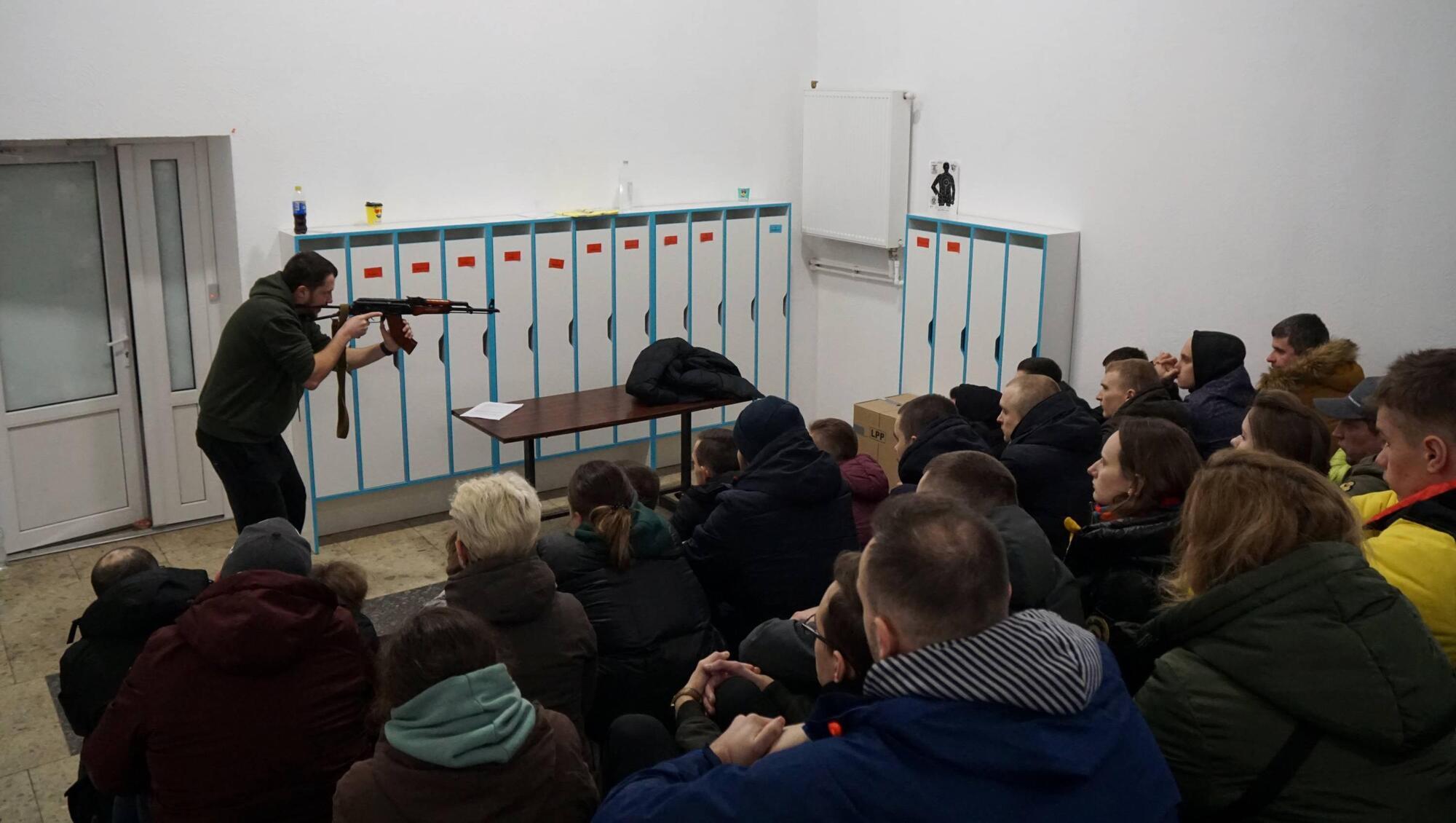
The Lviv Gun School where adults learn how to handle an AK-47. Picture Hannah McCarthy
Children who are learning maths and science filled the classrooms of a school in the suburbs of Lviv three weeks ago. Now those same rooms are packed with sombre adults learning how to handle an AK-47.
When the invasion began, Nazaryy Breezitskyy, the father of a pupil at the school asked the principal if he could use the school for gun training.

The principal agreed and, after a few days, local civilians and members of the Territorial Defence Force, the volunteer branch of the Ukrainian military, were turning up to the school.
In classrooms around the school, they have been taught how to defend themselves with pistols, rifles and machineguns, as well as how to deliver first aid.

So far, around 1,000 people have been trained, aging from 20 up to 65.
Teenagers may be trained in first aid as well, depending on how the invasion progresses, says Maria Milashenko, 21, a volunteer at the school.
The Territorial Defence Force has been swamped with new subscriptions. According to the Ukrainian authorities, 100,000 people have joined the volunteer branch of the Ukrainian army since Russia began its all-out war against Ukraine at the end of February.
“The army doesn’t have the capacity to train everyone, so we set this school up to help,” says Milashenko, who is from Kharkiv, the second-largest city in Ukraine.
Kharkiv is located less than 50km from the Russian border and it’s been on the frontline of the invasion. Much of the city has been levelled to the ground by Russian missiles.
“My parents were locked in Kharkiv for nine days,” she says. “We understand what happened there and when we came to Lviv, we wanted to know how to defend against that.” Maria Lemyshko, the English teacher at the school, has been helping to organise the classes but doesn’t want to learn how to use a gun.
“My husband is already serving on the frontline,” says the mother of one.
Ukrainian General Andrusik Igor visited the school on Sunday to review the weapons training and see how it can be scaled up.

Mr Breezitskyy hopes to deliver the training to many more people, with plans to set up an outdoor shooting range and open more schools.
He’s ambitious about what civilians should be taught. The Ukrainian man wants to train people in military tactics, not just basic weapons handling and first aid.
Most trainers are now in the army, so Mr Breezitskyy has recruited foreign volunteers from Belarus, Finland, Lithuania, Latvia, and Norway. Most came by themselves from Europe.
Gintautas Mauricas, 45, from Lithuania was in the Lithuanian armed forces for over two decades where he worked as an instructor and in military communications.

When the Russian invasion began, he wanted to provide training to Ukrainians — “anything to help win the war,” he says.
“Russian people are just ordinary people like Lithuanians; they just have a terrible leader,” says Povilas Stankunas, 31, another volunteer from Lithuania.

“We need to stop this crazy man,” he says, “otherwise, who will be next?” Many of the European trainers were planning on staying just a few days but, after the attack on the military base outside of Lviv on Sunday, many say they feel an obligation to stay longer.
Mr Breezitskyy is keen to recruit women and provide them with gun training: “it will show the West how serious the situation is.”
Maria Kozij, 33, from Lviv has turned up for weapons training at the school with her sister, 24, and her father, 64. She’s an artist and model but she now wants to learn how to defend herself against Russian forces.
“My other sister who is 20 will come another day,” she says.

Kozij has some concerns about ordinary civilians suddenly being given a Kalashkinov.
“I know people who are crazy in normal situations,” she says “but I still think it's good that people learn how to defend themselves.”
“Citizens need to learn how to use guns,” she says. “We need more instructors and more guns.”