Curious case of the bank in the airport
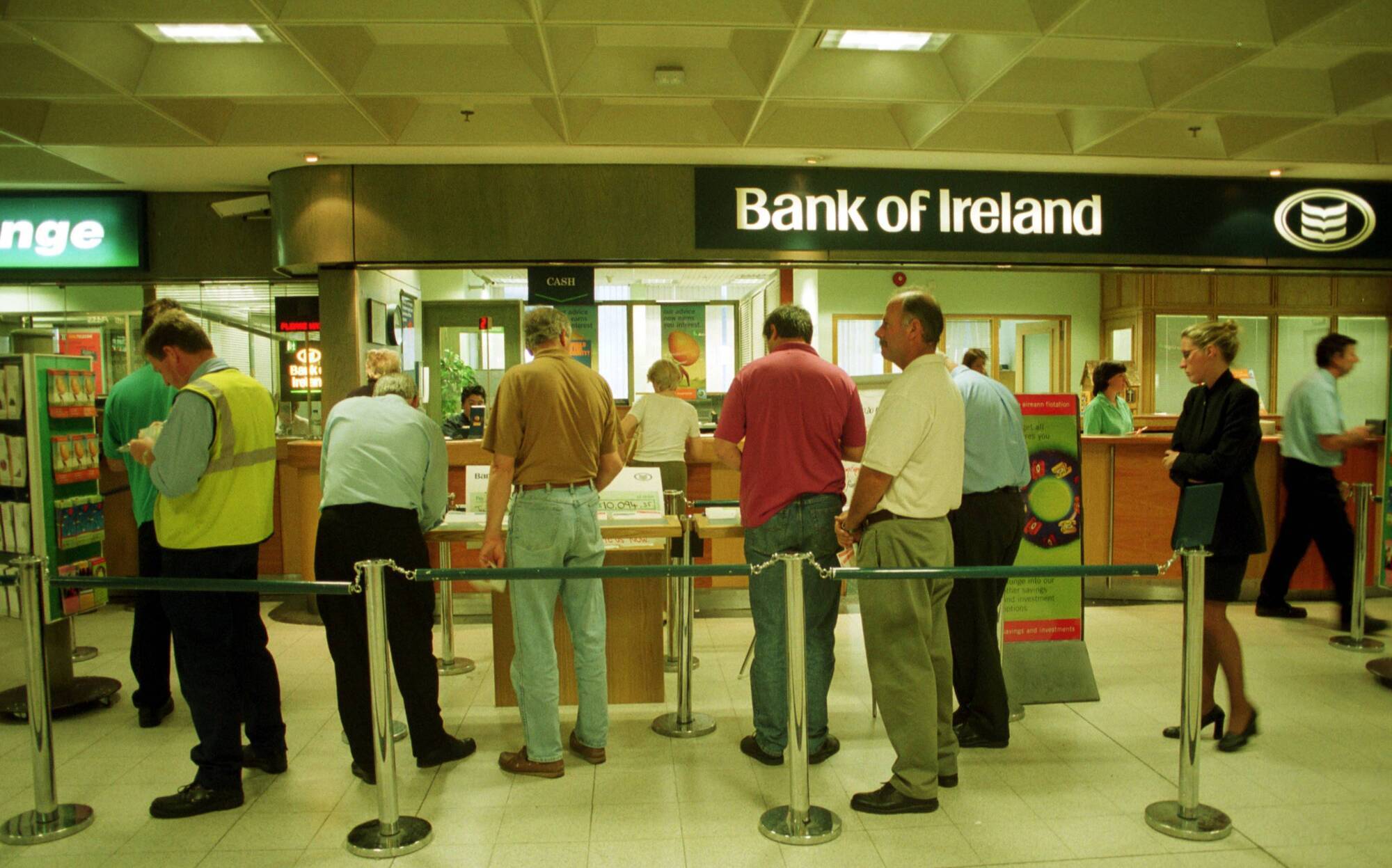
Bank of Ireland at Dublin Airport. File picture: Leon Farrell/Photocall Ireland
For over 10 years, Orla McNulty has been pursuing her former employer, the Bank of Ireland, in the courts.
She worked for the institution for nearly 30 years, most of that time spent in the bank’s Bureau de Change in Dublin Airport. She claims her employment came to an end in acrimonious circumstances for which the bank bears culpability.
The scenario is not unusual. Employment in many walks of life often ends with the employee feeling that he or she has been given a raw deal. The disengagement often leads to action on the former employee’s behalf, sometimes through the Workplace Relations Commission, others in the courts. One of those bodies ultimately determines whether the grievance has a legal basis.
Even within that context, Ms McNulty’s pursuit of what she perceives to be an injustice is unusual. The process is taking an extraordinary long time.
She is alleging the acrimonious end to her employment is associated with a fraudulent scheme within the bank for which she was scapegoated.
After going through two legal teams, she is now representing herself with the assistance of her husband. And it has emerged during the case that the bank destroyed documents that could have played a central role in either confirming or dismissing her allegations of fraud.
The bank is defending the case, saying Ms McNulty went on sick leave soon after she was transferred from Dublin Airport and did not return to work.
The bare background to the case is not in dispute. Ms McNulty was employed in the Bureau de Change in Dublin airport for about 25 years. In that time, she was elevated through the ranks to the role of overseeing the bureau.
The operation was unlike normal branches in that it was open 364 days a year, with three shifts in operation over each 24-hour period.
She worked under a variety of structures at the bank’s airport branch. In April 2000, a new manager, the first female to hold the post at the branch, was appointed.
There is no suggestion there was any personal issue between Ms McNulty and the new manager. Both had known each other from years before when the manager had worked at the airport briefly.
Yet within weeks, Ms McNulty was told she was being transferred to the Blanchardstown branch, which represented an effective demotion for which she says she was given no credible reason.
She claims she was told by the bank there was no other post for her, that she had been out of the branch network for too long and the proposed transfer was all that was available. Ms McNulty didn’t accept this and within months her employment effectively ceased.
Ms McNulty claims, and the bank disputes, that the whole issue around her employment was connected with a fraud that had been ongoing in the Bureau de Change for about 10 years.
In affidavits and other legal documents in the case, she has alleged she had initially been told in the late '90s that a dual system of accounting for turnover would be implemented in order to suppress the actual turnover figure.
This was done, Ms McNulty claims, in order to defraud Aer Rianta, which was entitled to rental fee based on the bureau’s turnover.
She alleges the basis for creating the system was that a senior employee “believed that it was unreasonable to be paying Aer Rianta [at the time, now DAA] a percentage turnover charge as part of the rental agreement. All large transactions now had to be looked at.
(The charity Goal would have been a major client at the Bureau de Change due to the nature of its work in a host of different developing countries. Naturally, the charity would have zero knowledge or input into how its business was processed by the bank.)
Ms McNulty in a later affidavit laid out her claim in detail.
“All of the transactions in excess of the €2,000 threshold were entered on a dedicated Forde Calculator located at the rear of the cash box.
"The tally tolls generated from this Forde Calculator specifically identifies all such daily transactions and the corresponding totals recorded in the bank account of each shift and will assist in identifying the differential being the rental underpayment.”
She claims when the new female manager started in the bank in April 2008, Ms McNulty briefed her about the system that was in existence, according to the allegation.
“It was immediately apparent that she was alarmed and troubled from what the plaintiff [Ms McNulty] was disclosing. She asked who had authorised it? When did it commence? The reasons, circumstances and basis for its existence? She stated that this was all highly irregular.”
Ms McNulty claims the new manager’s unwillingness to continue with the alleged fraud meant that it had to come to an end.
She claims she was then “scapegoated” and told by the bank she was to be transferred, despite having only been a functionary in implementing what she had been told would be policy at the Bureau de Change.
Following a meeting about her employment status, she felt isolated in the workplace, “whereby she was shunned and avoided by her work colleagues up until her departure. The atmosphere changed and the plaintiff [Ms McNulty] was coldly ignored. The plaintiff believes she was being blamed and scapegoated for disclosing the duplicate accounting system to the newly appointed manager.”
She claims that in a series of meetings thereafter she felt bullied and harassed and told that despite her experience and record she had no choice but to accept the transfer.
She claims she was also told she would not be entitled to a redundancy package, despite her service and her opinion that she was entirely overqualified for the new role to which she was to be assigned.
The bank denies this to be the case and is defending the legal action on the basis that changes were to be implemented at the airport, Ms McNulty was transferred and she subsequently went off sick from work.
Ms McNulty issued legal proceedings in 2010, claiming bullying, harassment, loss of earnings and personal injury through stress. The particulars of her action were sent in 2013, outlining the specifics of what she claimed to be a fraud.
There was various back and forth over the following years until an order for discovery was finally issued in February 2017. It in, Ms McNulty requested a raft of documents which she said would substantiate her claim.
Among the documents were the following:
- Turnover figures in respect of the Dublin airport premises submitted to Dublin airport authority /Aer Rianta for the month of July 2007
- Documents recording the actual total of turnover achieved at the Dublin airport branch and submitted to (area manager) for the month of July 2007
- Trading accounts foreign notes sales in respect of shifts a, b and c for July 2007
- Foreign note sales reserve account for July 2007; and “Daily tally rolls generated from the Forde Electronic calculators for July 2007.”
Over the following three years, Ms McNulty issued a number of motions in pursuit of the discovery order. She was told some of the documents no longer existed.
The bank stated it operated a retention period of seven years for most of its records and as such many of those dating from 2007 had been destroyed in one form or another.
MsMcNulty swore another affidavit: “It appears to me that the defendant was operating on the basis that if it stonewalled and obstructed me for long enough I would go away. They were wrong.
“When the same defendant bank issues legal proceedings to recover monies alleged to be owed by its customers it has no difficulty sourcing bank account records going back over 20 years.”
Ms McNulty was in and out of court over the following years attempting to get full discovery. Despite being based in Co Wicklow, she travelled to Cork at one point, according to the records, to access the High Court.
Among her motions were one to have the chief executive of Bank of Ireland, Francesca McDonagh, swear an affidavit to comply with the discovery order. This motion was denied by the High Court and the Court of Appeal.
The bank issued a series of replies and ultimately a sworn statement that set out its complete position.
Some of the documents, the affidavit sworn by the head of industrial relations at the bank, David Coleman stated, were not discovered due to oversight.
“Mr Coleman explained that the documents had been contained, in no particular order, in ‘plastic sleeves’, not all of which had been reviewed in the course of the bank making discovery initially,” a ruling from the Court of Appeal stated.
“Mr Coleman did not elaborate on the circumstances in which the bank had failed to carry out an adequate review initially.”
He also confirmed that other documents, relating to the specifics at the Bureau de Change “no longer existed as the retention period had expired”.
The bank, the court was told, maintained a seven-year retention period after which most documents were destroyed.
Mr Coleman confirmed that no 'litigation hold' had been put on these documents. A ‘litigation hold’ is a process whereby any documents that could be relevant to upcoming litigation are retained in case required by the court.
The judge who issued the three judge court’s ruling, Maurice Collins, was not impressed.
“It is surprising that such should occur within a large and well-resourced organisation such as the bank, with its own internal legal department which was, it appears reasonable to assume, familiar with the bank’s data management processes and its document retention policies and practices,” his ruling stated.
“The value of discovery and its potential to assist a court in getting at the truth in contested cases, such as the claim of the plaintiff here, is obviously undermined if potentially relevant documents are permitted to be destroy while litigation is contemplated,” the judge ruled.
He stated the volume of documents which should have been retained was “relatively limited”.
However, he also noted that “there is no evidence on which this court could property conclude that the bank’s failure in respect of discovery were the result of ‘wilful neglect’.”
The judge ordered that the bank return with a sworn explanation of what precise steps were put in place to put a ‘litigation hold’ on documents.
“It is, in my view, appropriate that this information should be made available as part of the discovery process and in advance of the hearing of these proceedings.”
He also noted that it would be open to Ms McNulty to explore her allegations with witnesses at a full hearing. No date has yet been set for a hearing.
The submitted a number of questions to Bank of Ireland, including whether any internal investigation had been conducted when the allegation of fraud was first brought to the bank’s attention. A spokesperson said that as the matter was before the courts it was inappropriate to comment.
A spokesperson for the Dublin Airport Authority said it was not privy to the case but confirmed that “all our concessions must abide by their contractual arrangements to produce a certificate of turnover for their auditor each year”.
When contacted, Ms McNulty’s husband, Michael Igoe said that the couple had no comment to make on the case.
CONNECT WITH US TODAY



Be the first to know the latest news and updates