A quarter millennium at the heart of Cork for Presentation Sisters
IE NEWS FEATURE WITH EOIN ENGLISH 12/07/2021.
An order whose nuns follow the example of Nano Nagle’s devotion to the service of the poor and providing education are about to celebrate the continued use of their landmark convent for 250 years.
As the Presentation Sisters in Cork city reflect on the past, they have already prepared for the future through the remarkable reimagination of their sacred home on Douglas St.
Nano Nagle Place, a historically important complex, includes Nano Nagle’s grave, the site of the former South Pres secondary school which closed in 1996, and some of the few surviving sites from penal law times of the first Catholic education schools in Ireland.
The complex today celebrates Nano’s vision of empowerment through education, community inclusion and spiritual engagement for a contemporary world.
It houses a museum, heritage rooms, gardens, a restaurant, a design and gift shop, and the regenerated convent buildings are home to several education charities.
It is continuing that remarkable tradition of education and social inclusion pioneered by Nano Nagle, who had opened seven schools for poor children across Cork city before her death in 1784, founded an almshouse for poor women, and most notably, founded the Presentation Order.
Sister Josephine McCarthy, known to most as Sister Jo, says that Nano Nagle has been a constant in her adventurous life that took her to Peru and Ecuador on missionary work for 28 years before she returned to "Celtic Tiger" Ireland in the early 2000s, and helped set up the Cork Migrant Centre, which has embraced those in direct provision centres and helps to recover “a sense of self in those that bring wonderful diversity" to the city.
Born and raised on a farm on the banks of the river Bandon near Dunmanway, the second of seven children, and the eldest girl, Sr Jo joined the Order aged just 17.
“My brother said I wouldn’t last six months. My mother was absolutely delighted,” she says.
In a wonderfully candid podcast interview, one of several with the Presentation Sisters which are available on the Nano Nagle Place website, Sr Jo says it’s been a great life for her.
In 1978, aged 28, and with little or no Spanish, Sr Jo was living with Bon Secours sisters in a shanty town outside Trujillo in northern Peru, about to embark on youth work and catechetic preparatory work in schools in the region as part of the Cork and Ross mission.
“I started to cry and cried for two days,” she says.
“I was lonely there. There were no phones at the time and my mother wrote to me every week: for 20 years. It was fulfilling work: it’s where Nano Nagle would want to be.”
While the life of Nano Nagle resonated strongly with her, Sr Jo says her own hold on the congregation might have faltered at times over the years, and certainly her hold on the Catholic Church might have faltered, but she says her hold on Nano Nagle never faltered.
“Wherever I would go, I would feel Nano Nagle was an inspiration for me,” she says.
“Now we’re much more looking to Nano for inspiration and guidance for what we do and how we do it.”
In 1982, Sr Jo moved to a town in rural Ecuador, about 15kms from the equator, where travel was by jeep, mule or canoe, and from there, she returned to Peru, to a mountainous village in the Andes, just as the Shining Path terrorist group was sweeping through the land, spreading fear and despair.
“I called on the courage of Nano Nagle there,” Sr Jo says.
The terrorists banned charitable work, and executed an Australian nun and two Polish Franciscan priests while she was in Peru.
“I wrote to my sister and said if anything happens to me, don’t blame the congregation, I know where I am and I know what I’m doing,” Sr Jo says.
She returned to Ireland on holiday in 2000 but decided to stay to care for her then 84-year-old mother, who had been widowed some years earlier, and who died three years later. Sr Jo’s been in Ireland since.
“I came back during the Celtic Tiger era. It was obscene in lots of ways. It was money before everything. I’d be very critical of the government at the time. They didn’t see people or communities, it was about balancing economies - that’s very poor governing,” she says.
She has in recent years been working with the migrants right group, NASC, and on a global education project which organises trips for transition year students to India, Pakistan and Zambia, and she helped establish the Cork Migrant Centre.
Former provincial leader, Sr Mary Hoare, who helped lay much of the groundwork for Nano Nagle Place, working with various civic, business and legal bodies to deliver the vision, said Nano had a gift for collaboration.
The site today “is alive, beautiful and uplifting”, she says.
“I never felt alone on this project - I always felt there were so many people wanting the success of this, that it would last and be of value,” she says.
“I’m very hopeful of the aliveness of the place, of the interest in it, and that has to be held but it needs buy-in from the whole of Cork city to keep it going.”
Congregation Leader, Sr Julie Watson, who spent 24 years teaching in Pakistan, says Nano Nagle Place is a “living legacy” of Nano’s life and work.
“Nano Nagle Place is unique because of Nano Nagle, and because of her contribution to the society of her time, to challenging the injustice of her time by providing education,” she says.
“Today, that work continues at Nano Nagle Place in the different ministries that are there. And the influence of what’s happening there is spreading far and wide.”
She said one of the main hopes of the congregation is that Nano’s “spiritual wisdom” will be kept alive in a way that’s relevant for the future, and that people who visit the centre will be touched by something in Nano’s story, causing them to reflect on what the visit has done for them.
“There is a strong energy - there is something there, maybe it’s come down the ages, that energy is caught there, and our hope is that people visiting will find that peace,” she says.
“Covid has made us stop and pause, it’s made us all question what’s it all about, what are our values.
“Hopefully Nano Nagle Place and other centres like this will be the oxygen for the future that people will need as we come out of this pandemic.”

Dr Danielle O’Donovan, an architectural historian and programme manager at Nano Nagle Place, said the contribution of this Order to education and social innovation - not just here but around the world - will be showcased in the ‘Changing Habits’ exhibition which opens on August 1.
It will chart the construction of the convent’s oldest building, built in 1771 by Nano Nagle as home for the Ursuline Sisters she had invited to Cork from Paris, and the foundation of the Presentation Sisters and the changing ways of life on the site up to the present day.
Using the rich archival records of the Ursuline and Presentation sisters, the exhibition will also include artefacts from the collection of objects held by the Presentation Sisters.
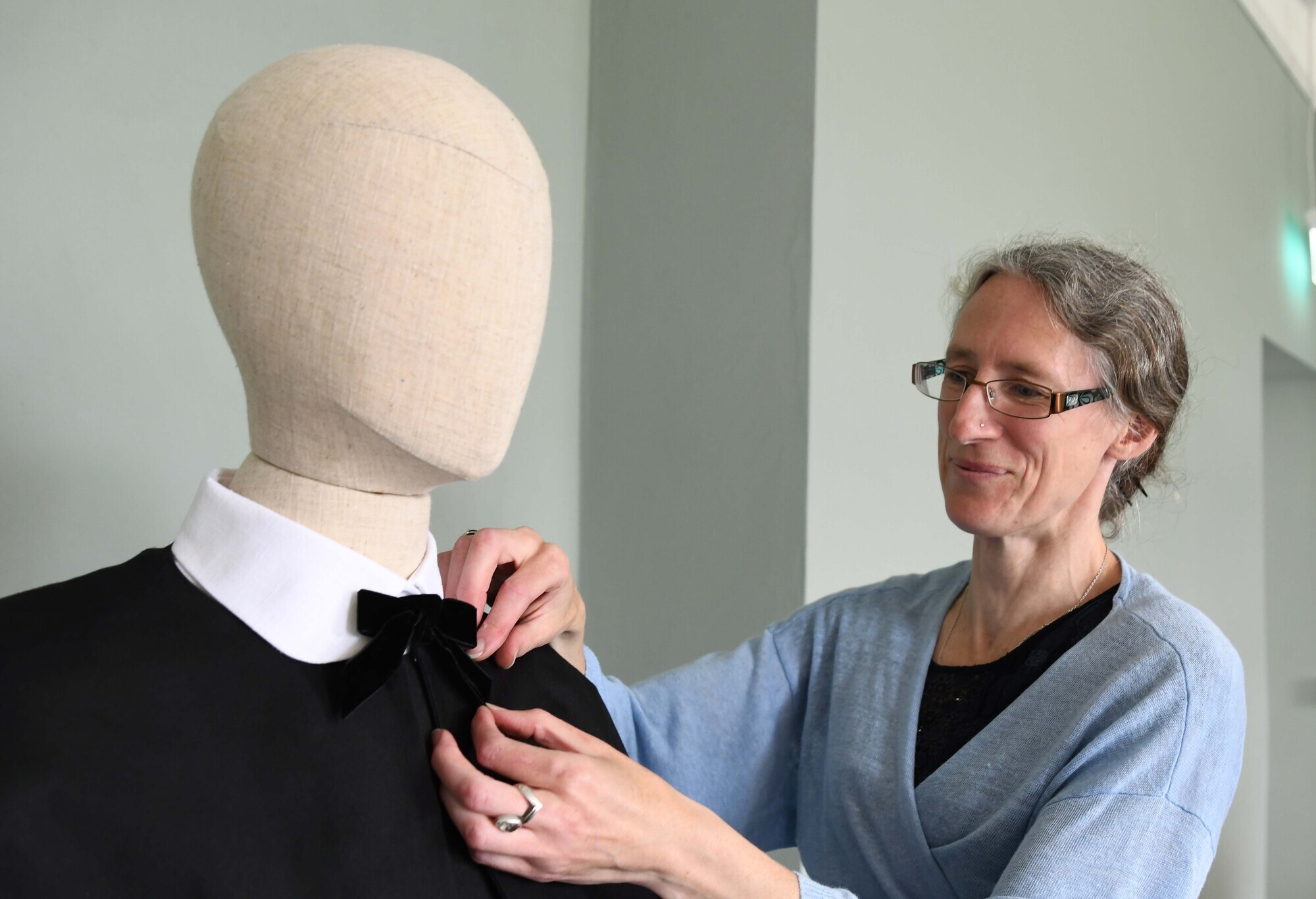
Dr O’Donovan and dressmaker Sam Wynn have also recreated a complete set of habits - including the oldest kind which dates from 1805, and which changed very little for 140 years.
“You work in a museum to capture the past to inspire people in the present. But you have to collect all the stories - not just the good ones,” Dr O’Donovan says.
“We know that not everyone had a good experience going to school in these buildings. So we need to hear those stories too to capture the full story.
“We welcome everyone back, even if they didn’t have a nice time in school. I would encourage people to visit now, to feel it and experience it now, to feel the peace here. This is a site of living heritage.
“It would be amazing if they kept this as their spiritual home and maybe we could have sisters from overseas coming here. That could prove to be an exciting future.
“It could be exciting to have an international community of sisters here in Cork.”
Sisters of Charity of St Paul, Limerick Education has and still is the main apostolate of the Sisters of Charity of St Paul the Apostle, who have been a constant presence in Limerick since 1903.
Known locally as the Kilmallock or Kilfinane nuns, parish work and various voluntary ministries continue to play an important part in the life of the sisters, who have also played a key role in the Cuan Mhuire addiction recovery centre in Bruree.
But as the nuns age and against the backdrop of falling vocations, congregation leader, Sr Kathleen Neenan, a Limerick woman who taught at and was principal of Scoil Pól in Kilfinane, a secondary school founded by the Order in 1915, and who is now based at the Order’s motherhouse in St Paul’s Convent in Selly Park, Birmingham, knows that big conversations are needed.
The Order’s future will be among those big topics at their general chapter next summer.
“With some younger women expressing an interest in becoming postulants, we have to decide do we continue on and develop, or do we come to completion - have we fulfilled our mission, so to speak," she says.
Sr Kathleen oversees a congregation of 101 nuns in Ireland, England, Scotland, South Africa and Romania, where six native Romanian sisters have joined in recent years. Two young women in England have this year expressed an interest in becoming postulants.
Sr Kathleen, who recently celebrated her golden jubilee, says she became a nun at a time when it wasn’t unusual for young women to consider a vocation. She was one of three classmates who joined the Sisters of Charity at the time. One of the three, Sr Kathleen Murphy, is today based in Romania.
But times change, and more opportunities became available to women.
Sr Kathleen is also keenly aware that anti-church and anti-religious or anti-nun sentiment has increased over the years too, and religious life has become less appealing to people.
“There are so many more opportunities now for women to get involved in society - in volunteering, with support groups,” she says.
“A lot of young people interested in a Christian way of life belong to groups. The permanent commitment to our way of life is a problem. But commitment is a problem in all aspects of life.
“Some people may be prepared to give some years to something - but not a lifetime.
“When I look at RIP.ie, I’m always amazed at the number of religious, especially women, who get such glowing tributes from past pupils, those acknowledging the influence they’ve had on their lives, and that’s wonderful to see.
“We see our role now as more collaborative - with other congregations and with other bodies.
“For example, our two secondary schools in Ireland, in Kilfinane and Dublin, are part of the Le Chéile Schools Trust.
“We made similar moves with our schools in South Africa, and we are looking at doing the same with a secondary school in England to ensure that the ethos of Catholic education will live on and that the individual charisms are maintained through the schools.”
Sister Eileen Kelly played a key role fostering that charism for decades, spending eight years teaching in Kilmallock before joining the teaching staff at Scoil Pól in 1981.
Even though she retired from teaching about six years ago, she still chairs the school’s board of management - a position she has held for a remarkable 29 years.
“When I was asked to chair the board, I had no idea really what would be involved. But it has been very enriching for me personally,” she says.
“It keeps me in contact with the school and with the young people but it also makes me very conscious of my age, especially when you see first years coming in with their date of birth in 2009.”
Founded in 1915 as a secondary school for girls, the convent opened to some boarders. In 1968, it became a co-educational school and in 1987 the new secondary school was opened.
But following the closure of the boarding school in 2004, numbers began to fall but Sr Eileen says they have been rising steadily over the last decade. There will be more than 600 pupils on the roll next September and work on an extension is underway.
“We are a smaller Order, with smaller numbers and we came to rural areas like this, to bring education, especially to girls,” she says.
“We looked after education, and I mean that in the broadest sense.
“What we’ve tried to do as a congregation was to ensure that the schools were set up to run well, and we have that set up well now at this stage.
“Our work will continue in the schools but of course charism changes and develops, charism has to live, it is a living thing, and to a certain extent, I feel that part of our work is done, and that we are in a phase of handing things over before we get too old.”
The Order’s convent in Kilfinane is being handed over to Sophia Association for social housing. Sophia is working with several religious orders to develop their lands, or to adapt their buildings, for social housing.
Its partnership with the Presentation Sisters alone will help deliver homes for over 400 people in the next five years so by 2025, 20% of all homes provided by Sophia will be on lands formerly owned by that Order.
Sr Eileen’s colleague, Sr Patricia Coughlan, who went to school in Kilfinane, and went on to teach business in Scoil Pól, has been ministering in the parish for 50 of her 55 years in the order.
She’s retired from teaching but she’s as busy as ever, taking a break from arranging over a dozen bouquets of flowers for a local wedding to chat.
“I’m not a professional flower arranger or anything, but I like doing it, I like being involved in the church, I’m prepared to roll up my sleeves to help,” she says.
She’s been rolling up her sleeves for decades - coaching camogie and ladies football teams, and today, she’s overseeing the Pope John Paul II faith achievement awards which sees young people aged between 16 and 18 volunteering time in their community.
She’s had groups of teenagers out painting the square in Kilfinane, helping the local tidy towns group, cleaning graveyards, and getting involved in church activity either through reading at Mass or stewarding.
“I suppose it fosters a sense of community and volunteering but they love it too because they can talk to each other. They just chat away while they work away,” she says.
It’s that on-the-ground approach that has made the nuns such an integral part of life in this part of Limerick.
“I’ve never felt anti-nun sentiment I suppose because we are, and have always been, out with the community, not apart from them. And people take us as we are.
“A lot of us will have passed on in a few years but I’m sure that the people coming after us, the lay people, will carry on the work that we have been doing.”


CONNECT WITH US TODAY



Be the first to know the latest news and updates