We can turn our city around but we need to start taking back control
Do we want a city of offices, car parks and hotels or one designed for 8- to 80-year-olds to live in, ask Frank O’Connor and Jude Sherry
We can turn our city around but we need to start taking back control

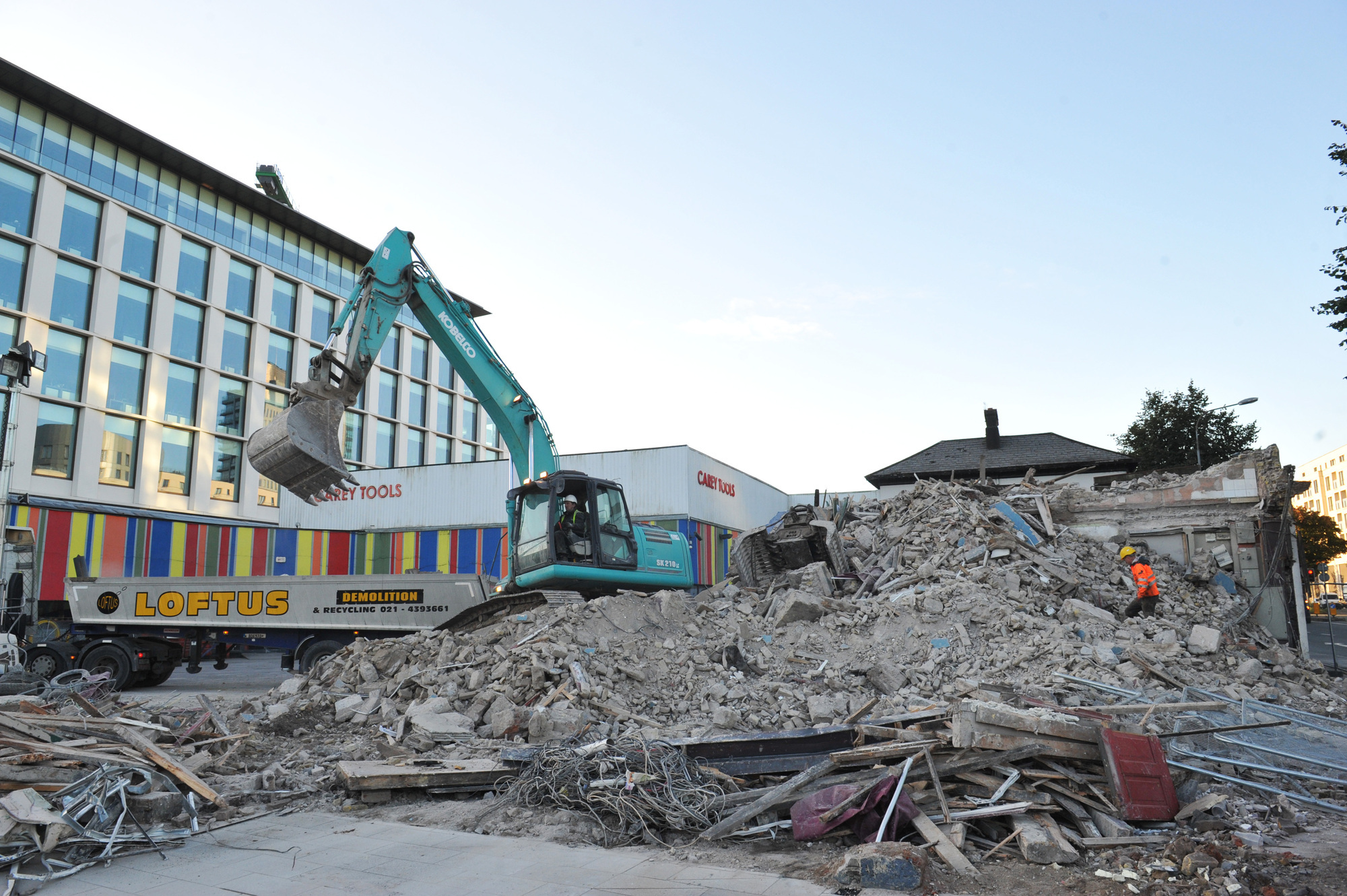
Crowds watched the demolition of The Sextant Bar, Cork to make way for a 25-storey residential 'build to rent' scheme. The scene on Saturday morning last August after the demolition of 145-year-old bar. The developer has now said it is not economically viable to build apartments on the site. Picture: Larry Cummins

ON a fateful Friday night last August, a 145-year-old pub in Cork City was hastily demolished to make way for luxury apartments.

Social media went into a frenzy; how was this iconic building lost?

Yet fast-track planning had been granted a few months earlier. ‘Homes before Heritage’ was the justification and in the midst of a housing crisis, the Sextant pub was the ‘sacrificial lamb’. A 25-storey block of 201 apartments was deemed too essential for the planning authorities to turn down, despite dissenting voices.

The recent announcement by the developer that it is no longer viable to build apartments has put the site in ‘limbo’. Their new proposal: An office block or a long-term vacant site.

It’s not a complete surprise that the most expensive and unsustainable form of home builds are not viable. What is a surprise, though, is the insistence that the only suitable alternative option is high-rise office blocks.

Are we really to believe that Cork is moving in the opposite direction to global markets, where vacant office blocks were being converted into apartments long before Covid?

Of course offices will come back but not to the same level of demand. Currently, there are 13 sites awaiting the construction of large office blocks to provide over a million square feet of space in the centre. This is combined with a surplus of sites waiting to become hotels. 

This is not evidence of a liveable city rising. This is a city being choked by commercial development, when what we actually need is affordable homes, more public space and flexible places for creatives.

The same developer submitted a planning objection to the construction of another apartment block just across the river a few weeks ago. Their objection — on grounds of a failure to meet liveability — could have as easily been applied to their own designs. 

What is more startling is the objection also emphasised their belief that homes were not suitable for the city centre docklands. Why did they change their minds?

So who is going to build city homes now? High-rise apartment blocks were never going to provide affordable or family homes. And they were never going to positively contribute to a human-scale historic city, but they were going to bring people to live in the centre. The planning process is often cited as a drag on home building yet here the failure lies elsewhere. From this and other examples across the city, it would seem the land with planning permission holds the value and not the built environment, especially when you examine the many sites that repeatedly obtain planning but are never developed.

This must be a huge concern to the city’s authorities, already haunted by a dereliction epidemic.

So how did we get to this point, where Cork City is characterised by vacancy and dereliction, crumbling buildings and unfulfilled promises?

Citizens assembly

WE already know development guidelines set out in the City Development Plans and the designation of an Architectural Conservation Area do not provide strong enough teeth to protect the city’s heritage in certain parts of Cork.

We also know that urban prosperity is directly linked to retaining heritage. Many people have lamented the Sextant’s demise on the basis it was an important landmark and reference point, welcoming people into the city.

It clearly had significant cultural value, and more of our priceless heritage is being threatened.

So where do we go from here? There is no doubt these failed projects are damaging the city and raising serious questions about planning, financing, speculation, and future development.

Do we want a city full of offices, car parks, and hotels or one designed for 8- to 80-year-olds to live in?

A citizens assembly is the most democratic means to achieve a clearer vision for a liveable, prosperous and just Cork city. One that cannot be cast aside to satisfy commercial interests. 

One that insists on providing affordable homes, protecting heritage, places to play and create, as well as sustainable buildings that are adaptable, ensuring office blocks can be transformed into apartments, hotels and more, based on the city’s ever evolving needs.

The Sextant has become a poster pub for a failed urban economic strategy, death by a thousand cuts. But there is hope. We are Cork. We can turn this around but we need to take back control.

Frank O’Connor and Jude Sherry, anois.org

How other countries have kick-started private apartment building

Belgium

In certain cities, the demolition of a building and the subsequent reconstruction of a private building is subject to a reduced VAT rate of 6%.

A ‘housing bonus’ in some regions gives a tax reduction to those who take out a loan to buy or build a home and then live in it themselves. However, it was cancelled in the Brussels region and replaced by an increased exemption from registration fees for the selling of existing houses.

Norway

Norwegian real estate developer Fredensborg Bolig introduced a rent-to-own initiative for first-time buyers without equity. It involved first-time buyers entering into a three-year lease/rent contract with the right to buy the dwelling at any time during the rental period at the purchase price at the time of entering the rental agreement. Fredensborg planned to contract 1,000 dwellings in Oslo and the surrounding area under this approach.

Spain

The lack of building land in several cities prompted the government to produce ‘Plan 20,000’ to build 20,000 rental homes over four years at affordable prices, involving a public private partnership arrangement, and on public land made available through a state body.

Australia

The New South Wales government introduced a housing affordability strategy in 2017 for first-time buyers, to increase supply at affordable prices and accelerate the delivery of infrastructure. It included no stamp duty on all homes up to $650,000, a $10,000 grant for builders of new homes up to $750,000 and purchasers of new homes up to $600,000, accelerating rezoning, and building infrastructure such as roads, schools, and utilities.

More in this section

Lunchtime News

Newsletter

Keep up with stories of the day with our lunchtime news wrap and important breaking news alerts.

Cookie Policy Privacy Policy Brand Safety FAQ Help Contact Us Terms and Conditions

© Examiner Echo Group Limited