Special Report: Neighbour against neighbour as fire safety defects spark divisions

Resident Lorraine Carew, who bought her home in 2016, would never have purchased the property if she had known about all the problems. Picture: Eamon Ward
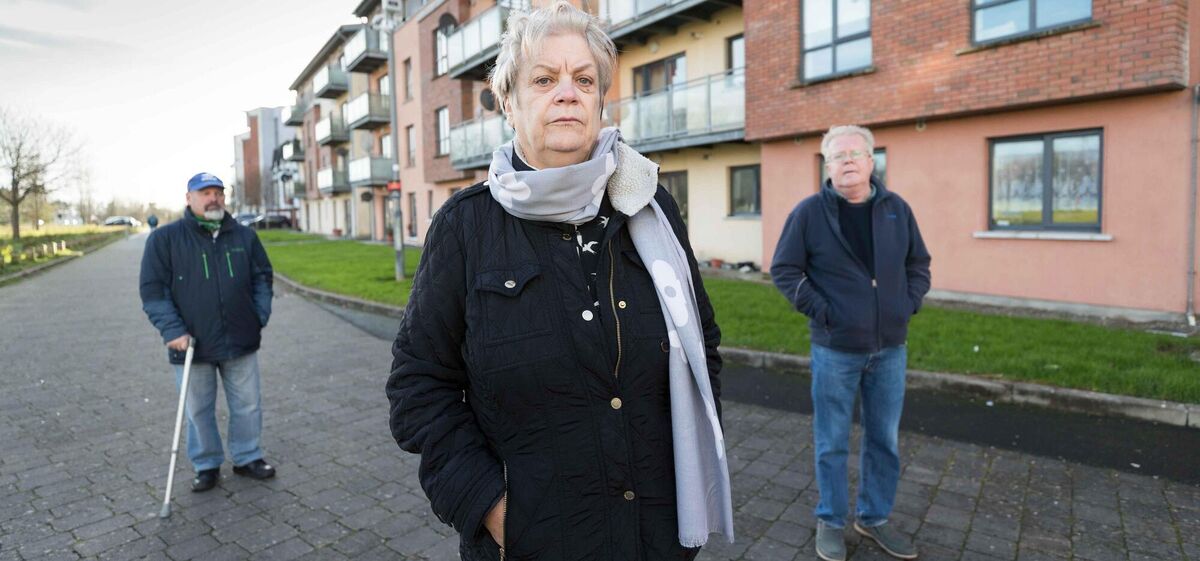
Lorraine Carew is waiting for her next court appearance. She is being chased for a debt of €14,000 and reckons she and her husband Gary, who are both retired, owe another €6,000 by now.
John O’Brien has the specific figure for which he is being pursued in court — €10,533.57. He says that he is at his wit’s end.
- - The full cost of repairs to defective apartments in the State could be more than €1bn, an Oireachtas committee was told last month.
“One of the biggest problems for me is that we don’t know whether that is the final amount,” he says.
Gita, who doesn’t want her surname recorded, reckons she and her husband owe around €20,000 by this stage. They have two children and bought their home just before all the problems were exposed three years ago.
“We are very upset. We feel it is very unfair. We have tried to involve politicians, but everybody is being hands off. We got completely ignored and left on our own.”
Eugene O’Byrne hasn’t been served with any papers yet. He’s about to retire, bought his little apartment a few years back after a painful divorce and now finds himself in a mess that is not of his making.
“I was in dread of being brought to court,” he says. “I don’t need that pressure. I’ve never been in court in my life.”
None of these people ran up debts through flagrant spending, bad investments or living beyond their means. They simply bought a home and trusted that it was a safe and secure abode.
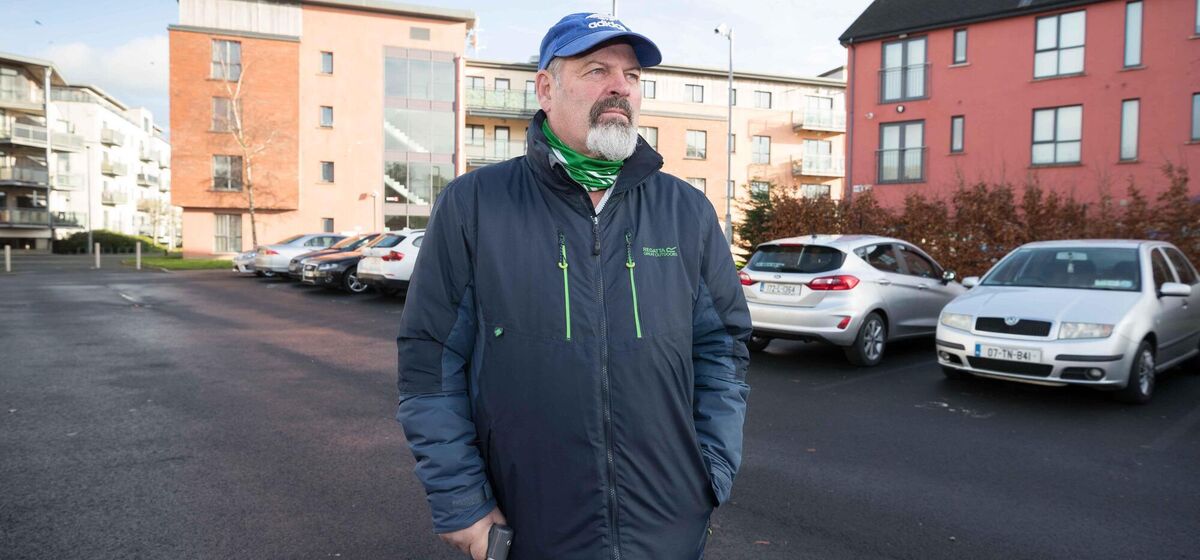
Instead, their homes in the Brú na Sionna development in Shannon, Co. Clare, turned out to be dangerous and defective. Fire safety and other defects have been discovered that will cost at least €4m to rectify. The developer is long gone and out of business.
The complete mess that he left in his wake has now resulted in deep divisions between homeowners as how best to rectify the problems.
Some who are dissatisfied with the approach are refusing to pay for remedial work because they haven’t got the money, they want more information or they are objecting on the basis of fairness. These owners call themselves the Just and Equitable Group.
They are now being pursued for the monies required to fix the problems by fellow owners aligned to the Owners Management Company (OMC). These owners are also in the red, but can’t see any other way to address the issue other than paying what is required.
Read More
And there is a third entity, Double S Housing, which swooped in to pick up some of the apartments cheaply and now has its own priorities.
To that extent, Brú Na Sionna represents the very worst kind of fall-out from the excesses and light-touch regulation of the Celtic Tiger years.
The various groups of owners are now at odds over how to fix a problem that was created by both the developer, by how he built the place, and the State, by completely failing to regulate the construction.
“We bought in 2016 in order to downsize and enjoy retirement,” Ms Carew says.
Brú na Sionna was built by Paddy Burke Builders, a Lisdoonvarna-based firm that was one of the biggest homebuilders in the Mid-West during the 2000s.
It was built between 2005 and 2007 at the height of the building madness. During this period, there was very little monitoring or policing of building by the State regulatory authorities.
The regime was known as “self-certification”. In reality, standards of construction were largely left up to the industry.
The Brú na Sionna development consists of 12 blocks, including 237 residential units, mainly apartments, and 12 commercial units, one of which is a creche.
Around half of the units were eligible for Section 23 tax relief, an instrument used to attract investors with major tax relief. It has been widely accepted that the Section 23 relief played a role in ramping up construction to the ultimately unsustainable level that collapsed in 2008.
The properties were quickly snapped up, the majority bought by investors, including a number of solicitors based in the Mid-West.
Burke’s firm went into receivership in 2010 under the weight of debts. At that stage, Burke still owned 44 apartments in the development.
Brú na Sionna had been financed by a loan from Anglo Irish Bank. Nama took control and appointed a receiver. Since then, Nama has sold the loan to Promontoria, which is a subsidiary of the well-known Cerberus vulture fund.
Read More
It soon became obvious that Burke had left the development in a poor state. The OMC felt that the required works should be undertaken by the receiver on behalf of Burke.
The receiver disagreed. He was of the opinion that the owners had to get in line with other creditors. Both parties armed themselves with lawyers and headed off to the courts. That action has been winding its way through the Circuit and High Courts for the last 10 years.
An AGM for the owners took place on February 11, 2011, in the Oakwood Arms Hotel in Shannon. By then, the OMC, called Tullyvaraga, had taken on Quinn Property Management as its managing agent to deal with the day-to-day business of running the development.
The minutes highlighted a number of building and fire safety defects that had already been discovered. These included a number of leaks, lack of emergency lighting and defective fire alarm panels and hydrants. The meeting was told that, in two blocks, there was a major problem with smoke ventilation.
“This is a major health and safety issue and these two buildings are not compliant under fire regulations,” the minutes read.
There was discussion on whether Clare County Council should be informed of the problem. The local authority is the fire authority.
The minutes show one of the owners “again contended that Clare County Council should be notified and requested to rectify the serious problems. The managing agent advised that, in his experience, the council would not deal with the problems except to close down the units.
He stated that he had discharged his obligations by informing the directors, the receiver, the committee and the owners. It was within any individual owners’ power to report the matter to the council if they so wished.”
Under the law, there is no obligation to report fire safety defects to the local fire authority.
A feature of the discovery of defects over the last decade has been that many owners don’t want the matter revealed. Informing the local fire authority could lead to buildings being evacuated, as noted in the AGM.
Read More
Details emerging in the public domain would inevitably affect property prices.
A number of apartments were sold over the following six years without specific reference to the seriousness of the defects as highlighted in the AGM.
Under the Multi Unit Development (MUD) Act there is a legal requirement to tell purchasers whether a considerable increase in the service charge is pending or whether the developer still needs to do work.
But there appears to be little provision for dealing with a situation where the developer has gone bust.
Ms Carew, who bought in 2016, says she and her husband knew nothing of the defects.
“We never would have bought if we knew how bad it was,” she says. It is also the case that the OMC was unaware at that point of the extent of the fire safety defects.
In 2017, an engineer inspecting an apartment for a prospective purchaser spotted some serious defects. He informed the County Clare fire officer. An investigation by engineers Scott Murphy was commissioned.
It discovered major defects which, it was estimated, would require work costing around €2.5m to bring up to standard. Fire marshals were immediately deployed to ensure that, in the event of a fire, everybody could be evacuated.
Most of the owners knew nothing about any of this ahead of that year’s AGM.
Ms Carew recalls seeing men in high-vis vests around the estate.
“I didn’t know who they were, but they were noticeable,” she says.
“I thought there must be some security thing.”
Towards the end of the year, a circular was issued about the AGM. There was reference that there “could be a substantial increase in the service charge”.
By then, one of the investors in Brú na Sionna, John Callinan, an Ennis-based solicitor, was the chair of the OMC.
Seven years previously, the corresponding AGM had heard that he was Paddy Burke's solicitor.
The understands there were around 30 owners present at the meeting on December 18, 2017.
Mr Callinan laid out the bad news. A significant programme of works would need to be completed. Costings, “based off worst-case scenario, would come to a figure circa €2.25m… it was hoped that this figure would be reduced with positive news once further inspections were completed”.
As it turned out, the figure eventually increased to around €4m, but nobody knew that then.
Mr Callinan advised that the OMC “were now trying to avoid a situation where an evacuation notice could be issued to the owners of the apartments”.
He said that he was willing to step aside if there was a doubt in relation to any of the information provided and that he was an owner of a number of units and “was subject to this significant and painful levy, but he did understand the necessity”.
A few of those present wanted to delay the imposition of a levy on the night as they had just been familiarised with the extent of the problem. A vote to delay was heavily defeated.
The meeting was told that there was a cash-flow problem and action would have to be taken immediately. A vote to incorporate the levy into the service charge was passed by a vote of 61 to four. A number of those votes were proxies held by the chairman and other directors.
The outcome of the meeting was that everybody would have to pay the levy — up to €16,000 per apartment — based on the square footage of the property.
The meeting was told this was how it had to be according to the lease and the law, but there is dispute as to whether that is the case.
That was the night that chasms began to open up between various owners. Investors, for instance, were understandably eager to get the remedial works done. Most of them could afford the levy and they could also claim tax relief on it, which would reduce the cost by up to half.
Owner occupiers had to pay the full whack and, while some had the money and were eager to ensure their homes were made safe, others simply couldn’t afford it.
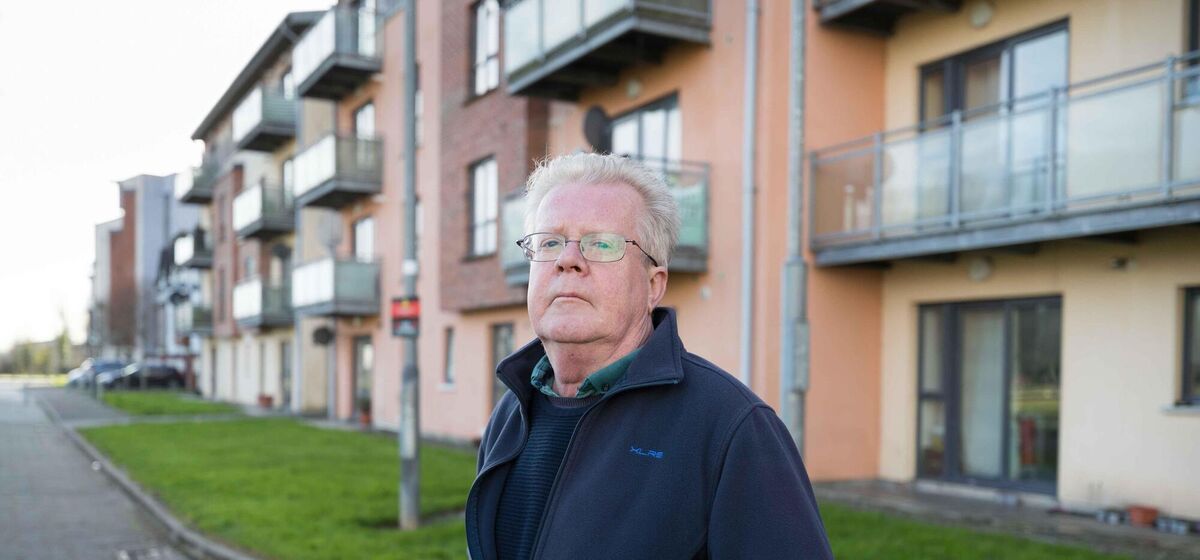
Among the two dozen or so owner occupiers, there are some aligned with the OMC, while the Just and Equitable group, which is refusing to pay, includes some investors. So the chasm is not simply about investor versus owner occupiers.
The court applications to enforce the debts of some of those refusing to pay began last year. Those in favour of paying suggest that there is no choice but to do so.
“Nobody wants to be dragging fellow owners into court,” one owner told the .
“And as far as I know, anybody who can’t pay is not having the debt enforced. Everybody has been left in the lurch here. Most of us just want to deal with it as best as we can.”
In 2019, there was a further complication when commercial property company Double S Housing bought the 44 units originally owned by builder Paddy Burke from the receiver. The units are in three of the 12 blocks.
Double S and the OMC are in dispute as to the fairest way to apportion costs for the remedial work.
“We are prepared to pay more than the levy imposed on us because we recognise that our three blocks have more defects than the other blocks,” according to Noel Hughes of Double S.
“We’re happy to pay the levy, happy to resolve the issue, happy to sit down with anybody.”
A director of the OMC, Stuart Howard, attempted to broker a sit-down between the two sides but was unsuccessful.
Last month, he resigned from the OMC. When contacted, he declined to comment. A number of serving directors of the OMC were contacted but also declined to comment.
The latest newsletter from the OMC sets out its position.
“As an OMC, our purpose is to benefit all the owners. However, we hope that we might find some common ground that would allow Double S to work with us for the benefit of all the owners in all blocks of Brú na Sionna in addition to benefitting their blocks.”
The Just and Equitable group was aligned with Double S earlier in the year, but this is no longer the case.
All of those involved agree that the various disputes have held up the remedial work, which has yet to move on to its second phase.
Read More
A list of questions submitted to the OMC through its managing agent in advance of publication did not receive a reply, despite repeated attempts.
What emerges is a picture of serious disputes between various groups of owners over how to rectify a major problem that was the making of completely separate parties.
The original building works did not adhere to proper and safe standards. Once the company used by the builder went into liquidation, he personally was off the hook.
The State and its agencies failed to fulfil its duty to ensure that homes are built safely and properly.
It is now widely accepted that during the Celtic Tiger years this duty was flagrantly disregarded through a complete lack of enforcement of building regulation.
The full cost of repairs to defective apartments in the State could be more than €1bn, an Oireachtas committee was told last month.
That will not come as a surprise to anybody who has looked at this area.
Since 2011, there has been a drip-feed of examples of apartment complexes that have been found to be defective and dangerous.
As with Brú na Sionna, many of these discoveries occur when an engineer is examining an apartment on behalf of a prospective owner.
Practically all of these defective developments were built between 2000 and 2010 during a building boom which saw practically no regulation.
“It wasn’t light-touch regulation,” one industry source told the . “It was no-touch regulation.”
Typically, corners were cut during this boom. Fire safety certificates, for instance, were issued on the basis of design, rather than construction.
Therefore all developments would have had a certificate but that did not mean that the building was built according to the design criteria. In many instances, they were not.
At the same time, the State’s obligation to police building standards was practically non-existent.
The Oireachtas Housing committee was told that there are up to 100,000 apartments in this country with serious defects, mostly related to fire-safety issues or water ingress.
In many instances, the developer is no longer in business. However, in some cases the developer went bust but is back at work in a different guise. Any liability for defective developments died with the company that was used to build it.
Barrister in construction law, Deirdre Ní Fhlionn, told the housing committee that people who purchased defective apartments “were doing it in a context where builders and developers were, and are still, insulated by the legal system from the risks in what they built".
Kath Cottier, director of housing services with housing association Clúid and chair of the Construction Defects Alliance (CDA), told the committee that while fire defects continue to be found in properties built since 2008, the majority of issues are in Celtic Tiger-era properties.
"From a health-and-safety point of view, this is an appalling vista," Ms Cottier said. "We can’t continue with a hear-no-evil, see-no-evil approach to the issue of fire and other defects."
Read More
"We don’t even have to mention Grenfell Tower to see where that road leads to," she said, citing the high-rise tragedy in London in June 2017, which killed 72 people.
"We simply don’t know how many are affected by defects," Ms Cottier said, adding that fire engineer Eamon O'Boyle had warned, earlier in 2020, that "fire safety of apartments is one of the many legacy issues faced by Government and it cannot be long-fingered until there is a tragedy".
Mr O'Boyle had provided estimates, Ms Cottier said, that 75% of the Celtic Tiger-era apartments sported fire defects, the majority of which are not visible to a layman, at a potential remediation cost of between €5,000 and €60,000 per unit, "with €15,000 seeming to be the median cost".
The committee also heard the majority of buildings with fire defects have yet to be inspected, as the Government opted, post-Grenfell, to only survey buildings of 18m in height and greater, excluding the majority of apartments.
In January 2018, the committee (from the previous Dáil) issued a report, 'Safe As Houses', about the problem.
Among its 26 recommendations were:
- The setting-up of a redress scheme for those who had purchased defective apartments;
- Better regulation through the direct employment of assigned certifiers by the local authority;
- Strengthening of consumer law for purchasers of defective apartments.
Sinn Féin’s Eoin Ó Brion, who authored the report, said at its launch that it must not lie on a shelf. “It has unanimous cross-party support,” he said.
“The next step is to engage with the minister for housing and his officials to see how the recommendations can be progressed.”
Despite the report and enthusiastic noises from Government parties, there has been little concrete progress in addressing the issue over the last two years.
CONNECT WITH US TODAY



Be the first to know the latest news and updates