The 1920's were a roaring success for Ford at the Marina in Cork
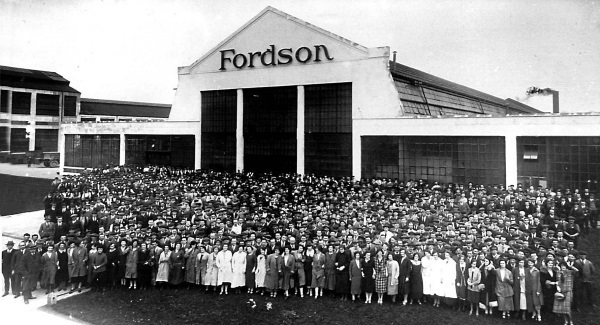
When the first Fordson tractor trundled off the production line in Cork on July 3, 1919, the city stood on the brink of a bright new industrial era.
The factory on the Marina was a beacon of commerce, employing thousands, and there was hope and optimism on the horizon.

However, storm clouds were gathering.
Domestically, Ireland was embroiled in a war of independence which would be followed by a civil war that stretched the very fabric of society to breaking
point.
Although Ford would not find these events insurmountable, the global picture was equally cloudy.
The end of the Great War meant demand for tractors had fallen, before production in Cork had even begun, while there were early signs that the Model T — the most popular car in the world that had brought motoring to the masses — was reaching the end of the road.
The fact the plant in Cork rode out all these changes and for much of the 1920s did a roaring trade, is testament to the strength and resilience of the company, and of its industrious Irish workforce.
Read more: Cork's connection to the opening of Ford plant in Dagenham
The tractor was the sole product of the Cork plant for its first four years, but on December 29, 1923, the 7,605th tractor off its line became the last for five years, after a decision was taken to stop making it in Ireland.
Instead, the plant turned its focus to the assembly of motor vehicles and that year, the Model T began to wheel off the line at the Marina, using a combination of par ts made in the Cork foundry as well as others shipped from the US and Manchester.
By 1927, the Marina was exporting more than £400,000 of parts annually and in early 1929, the daily wage bill in Cork was about £2,000 — all of which was pumped gratefully into the local economy.
In the late 1920s, two events happened which would give the Cork plant another fillip.
A decision was taken to call time on the Model T, but its replacement, the Model A, would also be manufactured in Cork — and the production of the
Fordson tractor returned to the Marina plant.
For Henry Ford and his company, the decision to cease production of the Model T must have been a difficult one, clouded by emotion.
But reality had to be grasped.
Sales had been declining in Ireland and around the world, as other companies introduced new styles and sought to match Ford’s prices.
First quarter sales of the Model T in Ireland in 1926 were down to 434, from 629 in 1925.
The effects of this were seen when Ford downsized their Manchester operation by 250 men and at Cork 145 men were let go.
But no amount of cost-cutting or pressure could change the fact that the Model T was obsolete.
On May 25, 1927, Henry Ford finally announced that production was to be discontinued and in Dearborn the following day, the fifteen millionth ‘Tin Lizzie’ was driven off the assembly line by Henry and Edsel.
By then, even Henry’s righthand man, Charlie Sorensen, had to admit that he was “sick of looking at them — sicker, in fact, than the public was”.
In Cork, there must have been fears among the workforce for the future — in the previous five years, the Cork plant had assembled 10,000 Model T cars.
But already plans were in place to move Ford back to the front of the motor market, and in 1927, drawings were shipped to Cork in preparation for the manufacture of Model A parts.
In Dearborn, the first Model A sedan was assembled on October 20 and by the end of that year, the Cork plant was in on the action.
The Model A made its first appearance in Ireland in late December, when Richard Mulcahy, the Minister for Local Government and Public Health, opened an exhibition of Ford’s new motor car in Dublin’s Metropolitan Hall.
The Model A was a success, with cars being snapped up as fast as Ford could produce them.
In 1928, 633,594 of them were produced worldwide, while the following year output more than doubled to 1,507,132.
With the return of the Fordson tractor to Cork’s output around the same time, the Marina plant was flying.
Within a decade of its opening, it was providing steady, wellpaid employment for a large section of the Cork population — and even contributing to other areas of society.
In 1926, a Fordsons factory team became the first side from Cork to win the FAI Cup, when they defeated Shamrock Rovers 2-3 in the final at Dalymount Park.
It was a golden age for Ford in Ireland, and one that would last into the next decade, the 1930s.